 Add to Chrome
 Add to Firefox
 Add to Edge
Perceptual 3D Simulation With Physical World Modeling
Jun 25, 2026
Predicting how a scene will evolve after a desired 3D transformation from images is a central goal in vision, graphics, and robotics. Yet unlike ideal simulators with full access to 3D geometry and dynamics, real world systems must rely on perceptual inputs and local actions that are inherently partial and incomplete. In this work, we present P3Sim, a physical world modeling system that simulates future scene states under both partial observations and incomplete 3D transformation signals. P3Sim is composed of three interacting components: a learned physical world model, a geometric conditioning module, and a persistent scene memory. The world model interprets perception as probabilistic inference over multimodal scene variables, providing predictions of the distributions of any scene variable conditioned on any combination of others. The geometric conditioning module provides a partial 3D transform signal for conditioning the world model at inference time. The persistent scene memory integrates predictions over time, enabling online updates and consistency under uncertainty. By combining learned inference with explicit geometric structure, P3Sim balances data-driven flexibility with built-in inductive bias. This design yields a flexible perceptual simulator that generalizes across diverse 3D transformation tasks, such as novel view synthesis, object manipulation, and dynamic scene prediction, advancing toward general purpose 3D scene understanding and transformation.

Physical Object Understanding with a Physically Controllable World Model
May 30, 2026A central challenge in visual intelligence is learning the physical structure of scenes from raw videos: how regions form objects and the laws that govern their interactions. Solving these tasks requires world models capable of inferring distributional states of the world from partial observations - capabilities that current architectures do not provide. We introduce a new class of probabilistic world models that support estimation of the probability of any visual variable, such as appearance and dynamics, conditioned on any other variables. Here, we identify that these models can be trained efficiently with autoregressive sequence modeling, yielding world models from which rich object understanding emerges. First, we demonstrate that our model captures the physical laws governing how objects move by generating multiple plausible future states of the world through sequential inference. Then, by analyzing motion correlations across these futures, we extract objects and articulated object subparts. Having discovered these objects, we show that our world model can manipulate them in 3D. Finally, we demonstrate how physical relationships between objects can be computed from the world model, enabling applications such as Visual Jenga.
Unified 3D Scene Understanding Through Physical World Modeling
May 23, 2026Understanding 3D scenes requires flexible combinations of visual reasoning tasks, including depth estimation, novel view synthesis, and object manipulation, all of which are essential for perception and interaction. Existing approaches have typically addressed these tasks in isolation, preventing them from sharing a common representation or transferring knowledge across tasks. A conceptually simpler but practically non-trivial alternative is to unify these diverse tasks into a single model, reducing different tasks from separate training objectives to merely different prompts and allowing for joint training across all datasets. In this work, we present a physical world model for unified 3D understanding and interaction (3WM), formulated as a probabilistic graphical model in which nodes represent multimodal scene elements such as RGB, optical flow, and camera pose. Diverse tasks emerge from different inference pathways through the graph: novel view synthesis from RGB and dense flow prompts, object manipulation from RGB and sparse flow prompts, and depth estimation from RGB and camera conditioning, all zero-shot without task-specific training. 3WM outperforms specialized baselines without the need for finetuning by offering precise controllability, strong geometric consistency, and robustness in real-world scenarios, achieving state-of-the-art performance on NVS and 3D object manipulation. Beyond predefined tasks, the model supports composable inference pathways, such as moving objects aside while navigating a 3D environment, enabling complex geometric reasoning. This demonstrates that a unified model can serve as a practical alternative to fragmented task-specific systems, taking a step towards a general-purpose visual world model.
Zero-shot World Models Are Developmentally Efficient Learners
Apr 11, 2026Young children demonstrate early abilities to understand their physical world, estimating depth, motion, object coherence, interactions, and many other aspects of physical scene understanding. Children are both data-efficient and flexible cognitive systems, creating competence despite extremely limited training data, while generalizing to myriad untrained tasks -- a major challenge even for today's best AI systems. Here we introduce a novel computational hypothesis for these abilities, the Zero-shot Visual World Model (ZWM). ZWM is based on three principles: a sparse temporally-factored predictor that decouples appearance from dynamics; zero-shot estimation through approximate causal inference; and composition of inferences to build more complex abilities. We show that ZWM can be learned from the first-person experience of a single child, rapidly generating competence across multiple physical understanding benchmarks. It also broadly recapitulates behavioral signatures of child development and builds brain-like internal representations. Our work presents a blueprint for efficient and flexible learning from human-scale data, advancing both a computational account for children's early physical understanding and a path toward data-efficient AI systems.
3D Scene Understanding Through Local Random Access Sequence Modeling
Apr 04, 20253D scene understanding from single images is a pivotal problem in computer vision with numerous downstream applications in graphics, augmented reality, and robotics. While diffusion-based modeling approaches have shown promise, they often struggle to maintain object and scene consistency, especially in complex real-world scenarios. To address these limitations, we propose an autoregressive generative approach called Local Random Access Sequence (LRAS) modeling, which uses local patch quantization and randomly ordered sequence generation. By utilizing optical flow as an intermediate representation for 3D scene editing, our experiments demonstrate that LRAS achieves state-of-the-art novel view synthesis and 3D object manipulation capabilities. Furthermore, we show that our framework naturally extends to self-supervised depth estimation through a simple modification of the sequence design. By achieving strong performance on multiple 3D scene understanding tasks, LRAS provides a unified and effective framework for building the next generation of 3D vision models.
Counterfactual World Modeling for Physical Dynamics Understanding
Dec 26, 2023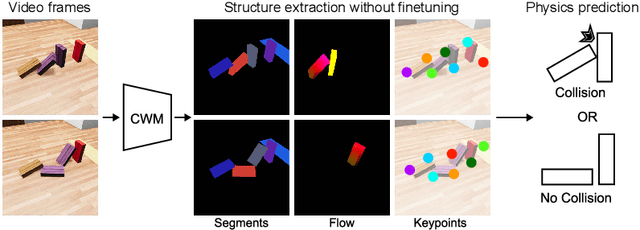
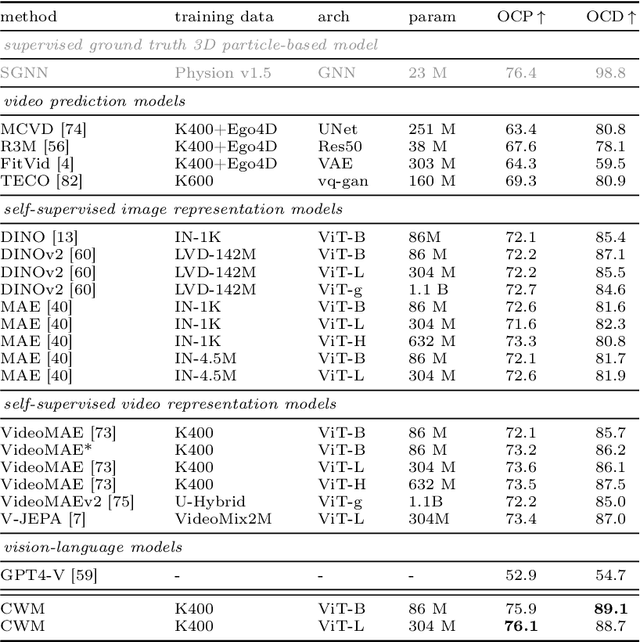


The ability to understand physical dynamics is essential to learning agents acting in the world. This paper presents Counterfactual World Modeling (CWM), a candidate pure vision foundational model for physical dynamics understanding. CWM consists of three basic concepts. First, we propose a simple and powerful temporally-factored masking policy for masked prediction of video data, which encourages the model to learn disentangled representations of scene appearance and dynamics. Second, as a result of the factoring, CWM is capable of generating counterfactual next-frame predictions by manipulating a few patch embeddings to exert meaningful control over scene dynamics. Third, the counterfactual modeling capability enables the design of counterfactual queries to extract vision structures similar to keypoints, optical flows, and segmentations, which are useful for dynamics understanding. We show that zero-shot readouts of these structures extracted by the counterfactual queries attain competitive performance to prior methods on real-world datasets. Finally, we demonstrate that CWM achieves state-of-the-art performance on the challenging Physion benchmark for evaluating physical dynamics understanding.
Unifying (Machine) Vision via Counterfactual World Modeling
Jun 02, 2023

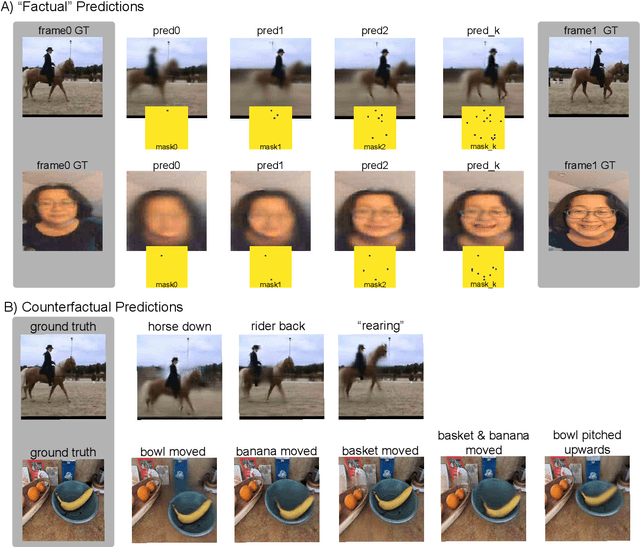

Leading approaches in machine vision employ different architectures for different tasks, trained on costly task-specific labeled datasets. This complexity has held back progress in areas, such as robotics, where robust task-general perception remains a bottleneck. In contrast, "foundation models" of natural language have shown how large pre-trained neural networks can provide zero-shot solutions to a broad spectrum of apparently distinct tasks. Here we introduce Counterfactual World Modeling (CWM), a framework for constructing a visual foundation model: a unified, unsupervised network that can be prompted to perform a wide variety of visual computations. CWM has two key components, which resolve the core issues that have hindered application of the foundation model concept to vision. The first is structured masking, a generalization of masked prediction methods that encourages a prediction model to capture the low-dimensional structure in visual data. The model thereby factors the key physical components of a scene and exposes an interface to them via small sets of visual tokens. This in turn enables CWM's second main idea -- counterfactual prompting -- the observation that many apparently distinct visual representations can be computed, in a zero-shot manner, by comparing the prediction model's output on real inputs versus slightly modified ("counterfactual") inputs. We show that CWM generates high-quality readouts on real-world images and videos for a diversity of tasks, including estimation of keypoints, optical flow, occlusions, object segments, and relative depth. Taken together, our results show that CWM is a promising path to unifying the manifold strands of machine vision in a conceptually simple foundation.