 Add to Chrome
 Add to Firefox
 Add to Edge
Pramana: A Composable, Domain-Specific Backend for Empirical Networking Research
Jul 28, 2026
Networking research advances by turning hypotheses into empirical evidence, so accelerating it means reducing the lag between ideation (synthesizing a hypothesis) and generating the data that tests it. Consider a concrete case: does a bulk BBR download fairly share its bottleneck with competing real-time Google Meet traffic? Validating this requires configuring a realistic bottleneck link, concurrently generating BBR's bulk transfer and Meet's real-time traffic, and collecting relevant service-quality metrics. Today this overhead is high, often forcing researchers to start from scratch for every new idea. This ideation-to-data-generation gap will only worsen in the agentic AI era, where AI-assisted ideation accelerates exponentially, yet its outputs cannot be validated without a data-generation backend. This paper explores how to bridge this gap. We envision a composable, domain-specific backend, Pramana, shaped as a thin waist, with diverse research intents at the top and disparate execution substrates at the bottom. Pramana realizes this waist through a single contract, the intent specification, which disaggregates an experiment into three independent axes: the intent (what data to generate), the substrate (where to generate it), and the mechanism (how to produce it), so one specification runs on any substrate. We demonstrate Pramana's utility by building a first-of-its-kind corpus of 255 data-generation intents mined from 66 published papers, and show the intent specification satisfies all of them, where no existing tool satisfies more than 13%. Our current proof-of-concept implementation already satisfies 34% of these intents, more than twice the best existing tool, and we lay out a roadmap for closing this abstraction-implementation gap through a broader community effort to build the envisioned data-generation backend and accelerate empirical networking research.

NetBurst: Event-Centric Forecasting of Bursty, Intermittent Time Series
Oct 25, 2025Forecasting on widely used benchmark time series data (e.g., ETT, Electricity, Taxi, and Exchange Rate, etc.) has favored smooth, seasonal series, but network telemetry time series -- traffic measurements at service, IP, or subnet granularity -- are instead highly bursty and intermittent, with heavy-tailed bursts and highly variable inactive periods. These properties place the latter in the statistical regimes made famous and popularized more than 20 years ago by B.~Mandelbrot. Yet forecasting such time series with modern-day AI architectures remains underexplored. We introduce NetBurst, an event-centric framework that reformulates forecasting as predicting when bursts occur and how large they are, using quantile-based codebooks and dual autoregressors. Across large-scale sets of production network telemetry time series and compared to strong baselines, such as Chronos, NetBurst reduces Mean Average Scaled Error (MASE) by 13--605x on service-level time series while preserving burstiness and producing embeddings that cluster 5x more cleanly than Chronos. In effect, our work highlights the benefits that modern AI can reap from leveraging Mandelbrot's pioneering studies for forecasting in bursty, intermittent, and heavy-tailed regimes, where its operational value for high-stakes decision making is of paramount interest.
In Search of netUnicorn: A Data-Collection Platform to Develop Generalizable ML Models for Network Security Problems
Jun 15, 2023
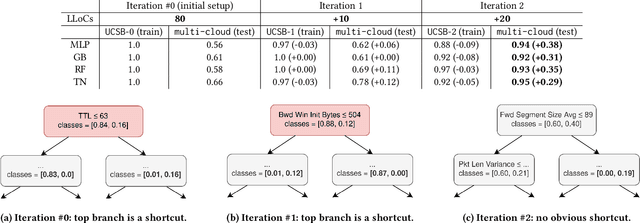
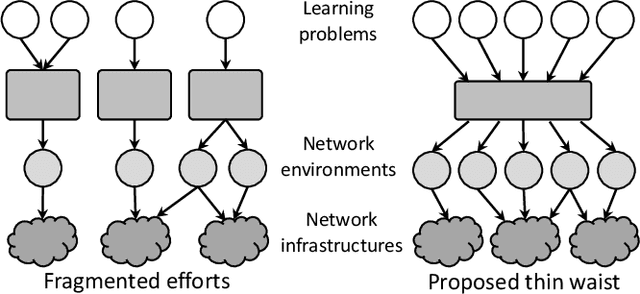
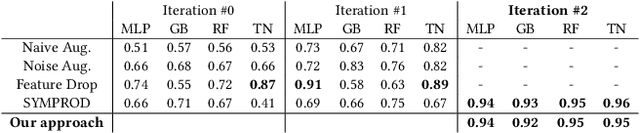
The remarkable success of the use of machine learning-based solutions for network security problems has been impeded by the developed ML models' inability to maintain efficacy when used in different network environments exhibiting different network behaviors. This issue is commonly referred to as the generalizability problem of ML models. The community has recognized the critical role that training datasets play in this context and has developed various techniques to improve dataset curation to overcome this problem. Unfortunately, these methods are generally ill-suited or even counterproductive in the network security domain, where they often result in unrealistic or poor-quality datasets. To address this issue, we propose an augmented ML pipeline that leverages explainable ML tools to guide the network data collection in an iterative fashion. To ensure the data's realism and quality, we require that the new datasets should be endogenously collected in this iterative process, thus advocating for a gradual removal of data-related problems to improve model generalizability. To realize this capability, we develop a data-collection platform, netUnicorn, that takes inspiration from the classic "hourglass" model and is implemented as its "thin waist" to simplify data collection for different learning problems from diverse network environments. The proposed system decouples data-collection intents from the deployment mechanisms and disaggregates these high-level intents into smaller reusable, self-contained tasks. We demonstrate how netUnicorn simplifies collecting data for different learning problems from multiple network environments and how the proposed iterative data collection improves a model's generalizability.