 Add to Chrome
 Add to Firefox
 Add to Edge
Toward Reusability of AI Models Using Dynamic Updates of AI Documentation
Apr 19, 2026
This work addresses the challenge of disseminating reusable artificial intelligence (AI) models accompanied by AI documentation (a.k.a., AI model cards). The work is motivated by the large number of trained AI models that are not reusable due to the lack of (a) AI documentation and (b) the temporal lag between rapidly changing requirements on AI model reusability and those specified in various AI model cards. Our objectives are to shorten the lag time in updating AI model card templates and align AI documentation more closely with current AI best practices. Our approach introduces a methodology for delivering agile, data-driven, and community-based AI model cards. We use the Hugging Face (HF) repository of AI models, populated by a subset of the AI research and development community, and the AI consortium-based Zero Draft (ZD) templates for the AI documentation of AI datasets and AI models, as our test datasets. We also address questions about the value of AI documentation for AI reusability. Our work quantifies the correlations between AI model downloads/likes (i.e., AI model reuse metrics) from the HF repository and their documentation alignment with the ZD documentation templates using tables of contents and word statistics (i.e., AI documentation quality metrics). Furthermore, our work develops the infrastructure to regularly compare AI documentation templates against community-standard practices derived from millions of uploaded AI models in the Hugging Face repository. The impact of our work lies in introducing a methodology for delivering agile, data-driven, and community-based standards for documenting AI models and improving AI model reuse.

AI Model Utilization Measurements For Finding Class Encoding Patterns
Dec 12, 2022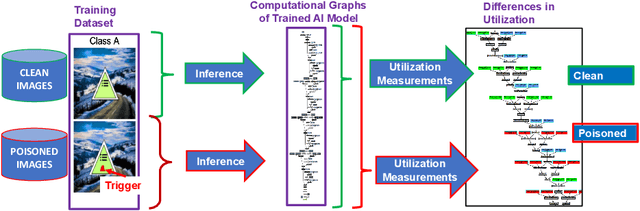
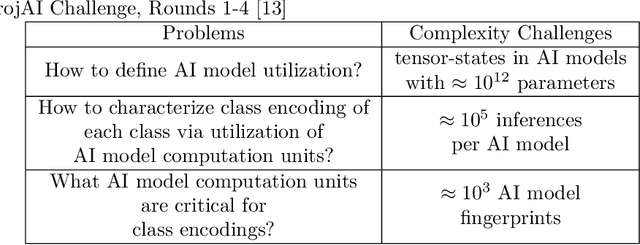
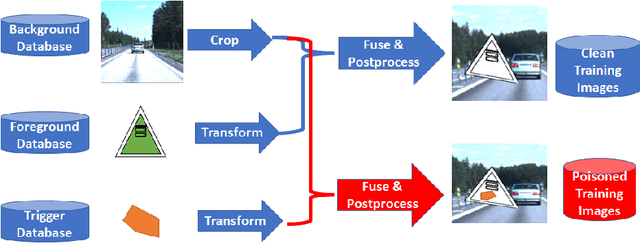
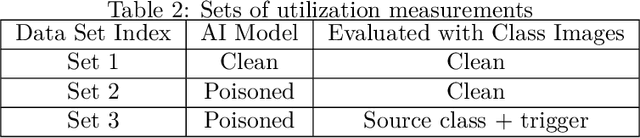
This work addresses the problems of (a) designing utilization measurements of trained artificial intelligence (AI) models and (b) explaining how training data are encoded in AI models based on those measurements. The problems are motivated by the lack of explainability of AI models in security and safety critical applications, such as the use of AI models for classification of traffic signs in self-driving cars. We approach the problems by introducing theoretical underpinnings of AI model utilization measurement and understanding patterns in utilization-based class encodings of traffic signs at the level of computation graphs (AI models), subgraphs, and graph nodes. Conceptually, utilization is defined at each graph node (computation unit) of an AI model based on the number and distribution of unique outputs in the space of all possible outputs (tensor-states). In this work, utilization measurements are extracted from AI models, which include poisoned and clean AI models. In contrast to clean AI models, the poisoned AI models were trained with traffic sign images containing systematic, physically realizable, traffic sign modifications (i.e., triggers) to change a correct class label to another label in a presence of such a trigger. We analyze class encodings of such clean and poisoned AI models, and conclude with implications for trojan injection and detection.