 Add to Chrome
 Add to Firefox
 Add to Edge
Learning to Order Things
May 27, 2011
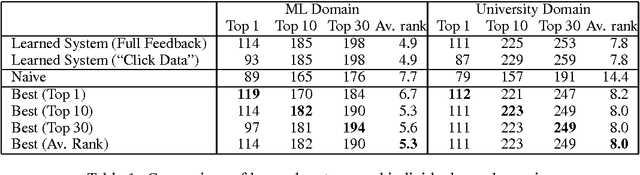
There are many applications in which it is desirable to order rather than classify instances. Here we consider the problem of learning how to order instances given feedback in the form of preference judgments, i.e., statements to the effect that one instance should be ranked ahead of another. We outline a two-stage approach in which one first learns by conventional means a binary preference function indicating whether it is advisable to rank one instance before another. Here we consider an on-line algorithm for learning preference functions that is based on Freund and Schapire's 'Hedge' algorithm. In the second stage, new instances are ordered so as to maximize agreement with the learned preference function. We show that the problem of finding the ordering that agrees best with a learned preference function is NP-complete. Nevertheless, we describe simple greedy algorithms that are guaranteed to find a good approximation. Finally, we show how metasearch can be formulated as an ordering problem, and present experimental results on learning a combination of 'search experts', each of which is a domain-specific query expansion strategy for a web search engine.

Pac-Learning Recursive Logic Programs: Efficient Algorithms
May 01, 1995

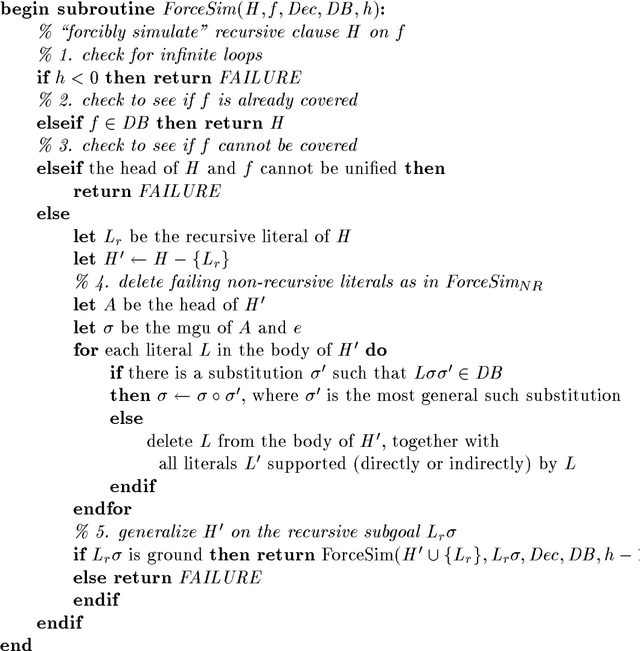
We present algorithms that learn certain classes of function-free recursive logic programs in polynomial time from equivalence queries. In particular, we show that a single k-ary recursive constant-depth determinate clause is learnable. Two-clause programs consisting of one learnable recursive clause and one constant-depth determinate non-recursive clause are also learnable, if an additional ``basecase'' oracle is assumed. These results immediately imply the pac-learnability of these classes. Although these classes of learnable recursive programs are very constrained, it is shown in a companion paper that they are maximally general, in that generalizing either class in any natural way leads to a computationally difficult learning problem. Thus, taken together with its companion paper, this paper establishes a boundary of efficient learnability for recursive logic programs.
* See http://www.jair.org/ for any accompanying files
Pac-learning Recursive Logic Programs: Negative Results
May 01, 1995In a companion paper it was shown that the class of constant-depth determinate k-ary recursive clauses is efficiently learnable. In this paper we present negative results showing that any natural generalization of this class is hard to learn in Valiant's model of pac-learnability. In particular, we show that the following program classes are cryptographically hard to learn: programs with an unbounded number of constant-depth linear recursive clauses; programs with one constant-depth determinate clause containing an unbounded number of recursive calls; and programs with one linear recursive clause of constant locality. These results immediately imply the non-learnability of any more general class of programs. We also show that learning a constant-depth determinate program with either two linear recursive clauses or one linear recursive clause and one non-recursive clause is as hard as learning boolean DNF. Together with positive results from the companion paper, these negative results establish a boundary of efficient learnability for recursive function-free clauses.
* See http://www.jair.org/ for any accompanying files