 Add to Chrome
 Add to Firefox
 Add to Edge
On the Mechanisms of Collaborative Learning in VAE Recommenders
Nov 10, 2025
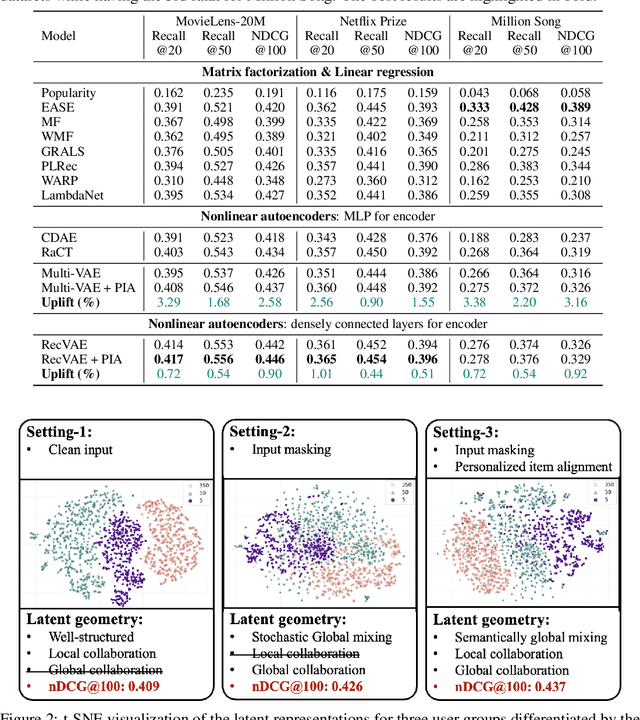
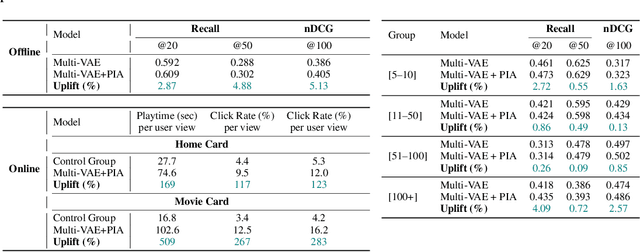
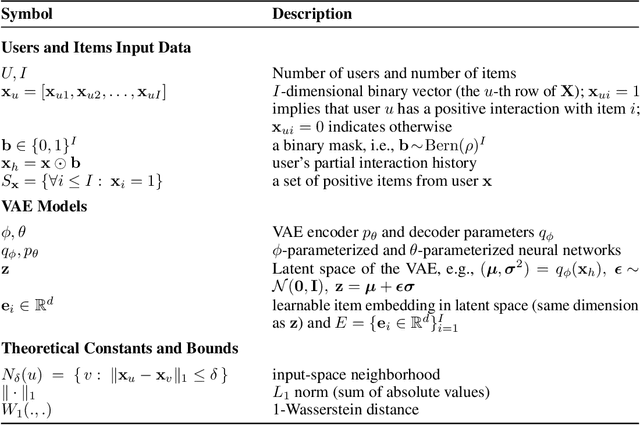
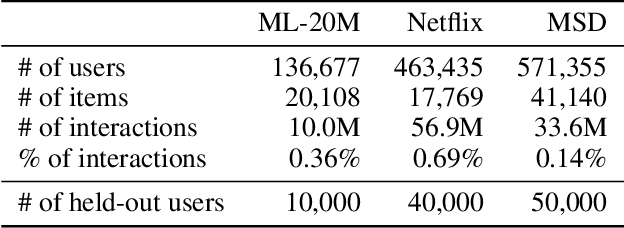
Variational Autoencoders (VAEs) are a powerful alternative to matrix factorization for recommendation. A common technique in VAE-based collaborative filtering (CF) consists in applying binary input masking to user interaction vectors, which improves performance but remains underexplored theoretically. In this work, we analyze how collaboration arises in VAE-based CF and show it is governed by latent proximity: we derive a latent sharing radius that informs when an SGD update on one user strictly reduces the loss on another user, with influence decaying as the latent Wasserstein distance increases. We further study the induced geometry: with clean inputs, VAE-based CF primarily exploits \emph{local} collaboration between input-similar users and under-utilizes global collaboration between far-but-related users. We compare two mechanisms that encourage \emph{global} mixing and characterize their trade-offs: (1) $β$-KL regularization directly tightens the information bottleneck, promoting posterior overlap but risking representational collapse if too large; (2) input masking induces stochastic geometric contractions and expansions, which can bring distant users onto the same latent neighborhood but also introduce neighborhood drift. To preserve user identity while enabling global consistency, we propose an anchor regularizer that aligns user posteriors with item embeddings, stabilizing users under masking and facilitating signal sharing across related items. Our analyses are validated on the Netflix, MovieLens-20M, and Million Song datasets. We also successfully deployed our proposed algorithm on an Amazon streaming platform following a successful online experiment.

MARec: Metadata Alignment for cold-start Recommendation
Apr 20, 2024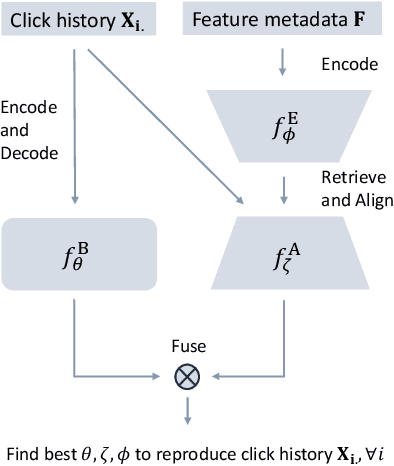
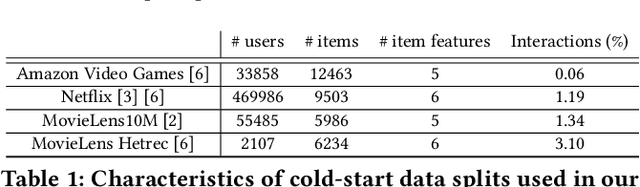
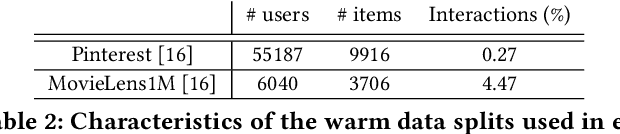
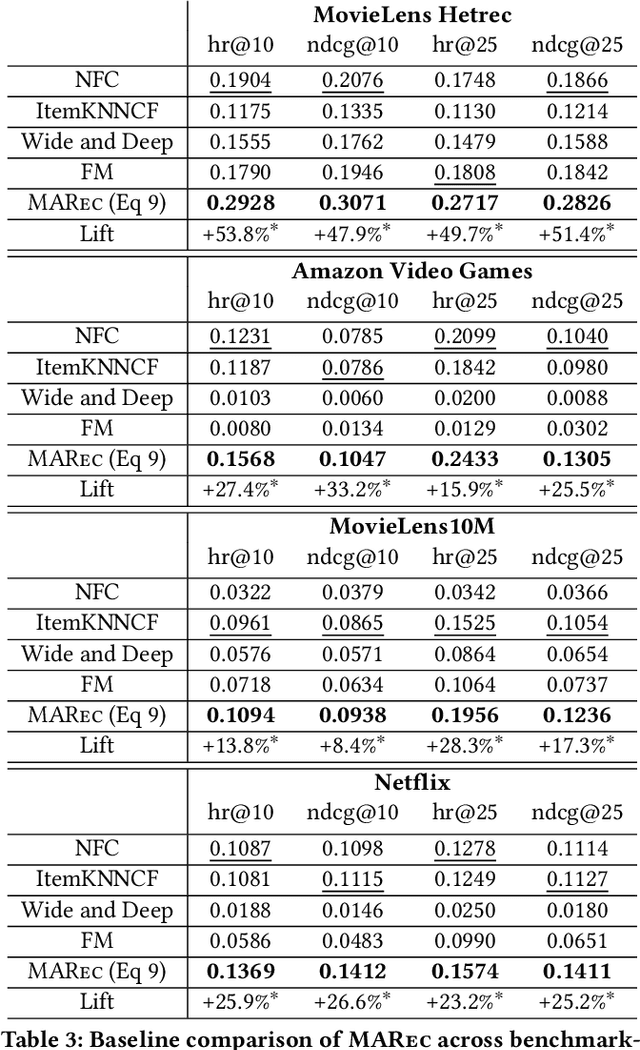
For many recommender systems the primary data source is a historical record of user clicks. The associated click matrix which is often very sparse, however, as the number of users x products can be far larger than the number of clicks, and such sparsity is accentuated in cold-start settings. The sparsity of the click matrix is the reason matrix factorization and autoencoders techniques remain highly competitive across collaborative filtering datasets. In this work, we propose a simple approach to address cold-start recommendations by leveraging content metadata, Metadata Alignment for cold-start Recommendation. we show that this approach can readily augment existing matrix factorization and autoencoder approaches, enabling a smooth transition to top performing algorithms in warmer set-ups. Our experimental results indicate three separate contributions: first, we show that our proposed framework largely beats SOTA results on 4 cold-start datasets with different sparsity and scale characteristics, with gains ranging from +8.4% to +53.8% on reported ranking metrics; second, we provide an ablation study on the utility of semantic features, and proves the additional gain obtained by leveraging such features ranges between +46.8% and +105.5%; and third, our approach is by construction highly competitive in warm set-ups, and we propose a closed-form solution outperformed by SOTA results by only 0.8% on average.