 Add to Chrome
 Add to Firefox
 Add to Edge
End-to-End O-RAN Testbed for Edge-AI-Enabled 5G/6G Connected Industrial Robotics
Mar 13, 2026
Connected robotics is one of the principal use cases driving the transition towards more intelligent and capable 6G mobile cellular networks. Replacing wired connections with highly reliable, high-throughput, and low-latency 5G/6G radio interfaces enables robotic system mobility and the offloading of compute-intensive artificial intelligence (AI) models for robotic perception and control to servers located at the network edge. The transition towards Edge AI as a Service (E-AIaaS) simplifies on-site maintenance of robotic systems and reduces operational costs in industrial environments, while supporting flexible AI model life-cycle management and seamless upgrades of robotic functionalities over time. In this paper, we present a 5G/6G O-RAN-based end-to-end testbed that integrates E-AIaaS for connected industrial robotic applications. The objective is to design and deploy a generic experimental platform based on open technologies and interfaces, demonstrated through an E-AIaaS-enabled autonomous welding scenario. Within this scenario, the testbed is used to investigate trade-offs among different data acquisition, edge processing, and real-time streaming approaches for robotic perception, while supporting emerging paradigms such as semantic and goal-oriented communications.

Task-Oriented Wireless Transmission of 3D Point Clouds: Geometric Versus Semantic Robustness
Mar 13, 2026Wireless transmission of high-dimensional 3D point clouds (PCs) is increasingly required in industrial collaborative robotics systems. Conventional compression methods prioritize geometric fidelity, although many practical applications ultimately depend on reliable task-level inference rather than exact coordinate reconstruction. In this paper, we propose an end-to-end semantic communication framework for wireless 3D PC transmission and conduct a systematic study of the relationship between geometric reconstruction fidelity and semantic robustness under channel impairments. The proposed architecture jointly supports geometric recovery and object classification from a shared transmitted representation, enabling direct comparison between coordinate-level and task-level sensitivity to noise. Experimental evaluation on a real industrial dataset reveals a pronounced asymmetry: semantic inference remains stable across a broad signal-to-noise ratio (SNR) range even when geometric reconstruction quality degrades significantly. These results demonstrate that reliable task execution does not require high-fidelity geometric recovery and provide design insights for task-oriented wireless perception systems in bandwidth- and power-constrained industrial environments.
Non-adversarial Robustness of Deep Learning Methods for Computer Vision
May 24, 2023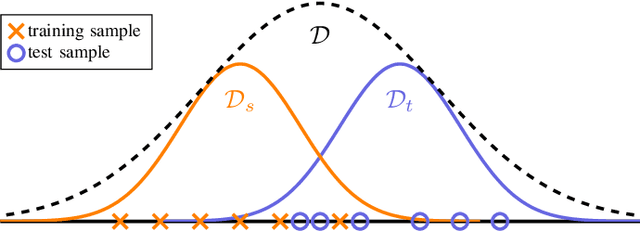
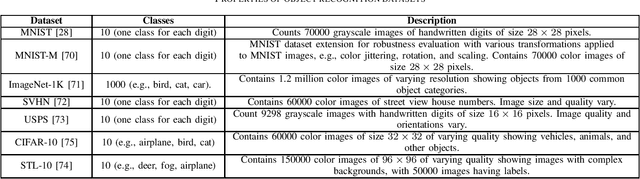
Non-adversarial robustness, also known as natural robustness, is a property of deep learning models that enables them to maintain performance even when faced with distribution shifts caused by natural variations in data. However, achieving this property is challenging because it is difficult to predict in advance the types of distribution shifts that may occur. To address this challenge, researchers have proposed various approaches, some of which anticipate potential distribution shifts, while others utilize knowledge about the shifts that have already occurred to enhance model generalizability. In this paper, we present a brief overview of the most recent techniques for improving the robustness of computer vision methods, as well as a summary of commonly used robustness benchmark datasets for evaluating the model's performance under data distribution shifts. Finally, we examine the strengths and limitations of the approaches reviewed and identify general trends in deep learning robustness improvement for computer vision.