 Add to Chrome
 Add to Firefox
 Add to Edge
Rethinking the Role of Collaborative Robots in Rehabilitation
Mar 05, 2026
Current research on collaborative robots (cobots) in physical rehabilitation largely focuses on repeated motion training for people undergoing physical therapy (PuPT), even though these sessions include phases that could benefit from robotic collaboration and assistance. Meanwhile, access to physical therapy remains limited for people with disabilities and chronic illnesses. Cobots could support both PuPT and therapists, and improve access to therapy, yet their broader potential remains underexplored. We propose extending the scope of cobots by imagining their role in assisting therapists and PuPT before, during, and after a therapy session. We discuss how cobot assistance may lift access barriers by promoting ability-based therapy design and helping therapists manage their time and effort. Finally, we highlight challenges to realizing these roles, including advancing user-state understanding, ensuring safety, and integrating cobots into therapists' workflow. This view opens new research questions and opportunities to draw from the HRI community's advances in assistive robotics.

Optometrist's Algorithm for Personalizing Robot-Human Handovers
Aug 29, 2023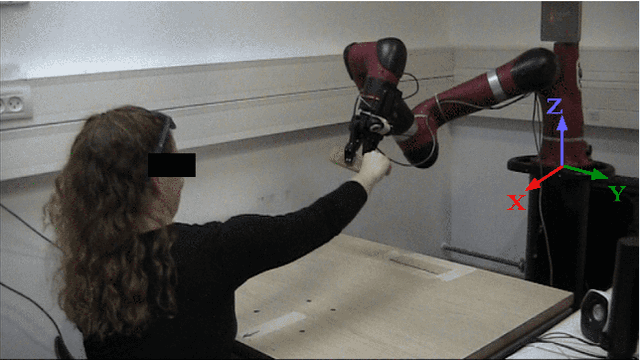

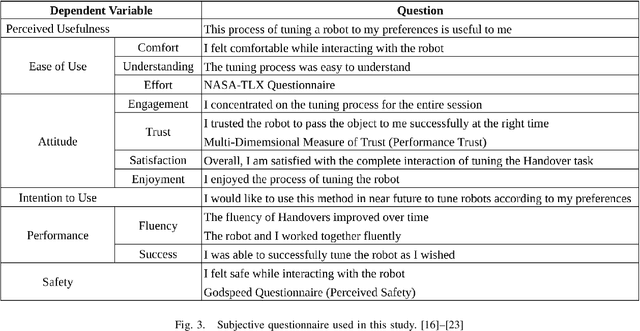
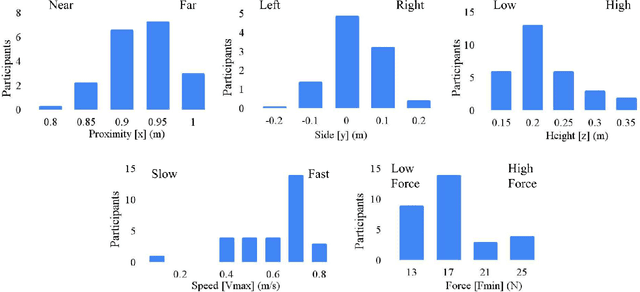
With an increasing interest in human-robot collaboration, there is a need to develop robot behavior while keeping the human user's preferences in mind. Highly skilled human users doing delicate tasks require their robot partners to behave according to their work habits and task constraints. To achieve this, we present the use of the Optometrist's Algorithm (OA) to interactively and intuitively personalize robot-human handovers. Using this algorithm, we tune controller parameters for speed, location, and effort. We study the differences in the fluency of the handovers before and after tuning and the subjective perception of this process in a study of $N=30$ non-expert users of mixed background -- evaluating the OA. The users evaluate the interaction on trust, safety, and workload scales, amongst other measures. They assess our tuning process to be engaging and easy to use. Personalization leads to an increase in the fluency of the interaction. Our participants utilize the wide range of parameters ending up with their unique personalized handover.