 Add to Chrome
 Add to Firefox
 Add to Edge
SAGA: Source Attribution of Generative AI Videos
Nov 16, 2025
The proliferation of generative AI has led to hyper-realistic synthetic videos, escalating misuse risks and outstripping binary real/fake detectors. We introduce SAGA (Source Attribution of Generative AI videos), the first comprehensive framework to address the urgent need for AI-generated video source attribution at a large scale. Unlike traditional detection, SAGA identifies the specific generative model used. It uniquely provides multi-granular attribution across five levels: authenticity, generation task (e.g., T2V/I2V), model version, development team, and the precise generator, offering far richer forensic insights. Our novel video transformer architecture, leveraging features from a robust vision foundation model, effectively captures spatio-temporal artifacts. Critically, we introduce a data-efficient pretrain-and-attribute strategy, enabling SAGA to achieve state-of-the-art attribution using only 0.5\% of source-labeled data per class, matching fully supervised performance. Furthermore, we propose Temporal Attention Signatures (T-Sigs), a novel interpretability method that visualizes learned temporal differences, offering the first explanation for why different video generators are distinguishable. Extensive experiments on public datasets, including cross-domain scenarios, demonstrate that SAGA sets a new benchmark for synthetic video provenance, providing crucial, interpretable insights for forensic and regulatory applications.

Towards a Universal Synthetic Video Detector: From Face or Background Manipulations to Fully AI-Generated Content
Dec 16, 2024


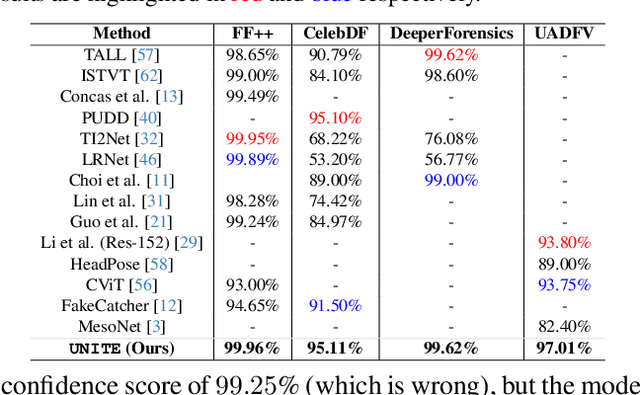
Existing DeepFake detection techniques primarily focus on facial manipulations, such as face-swapping or lip-syncing. However, advancements in text-to-video (T2V) and image-to-video (I2V) generative models now allow fully AI-generated synthetic content and seamless background alterations, challenging face-centric detection methods and demanding more versatile approaches. To address this, we introduce the \underline{U}niversal \underline{N}etwork for \underline{I}dentifying \underline{T}ampered and synth\underline{E}tic videos (\texttt{UNITE}) model, which, unlike traditional detectors, captures full-frame manipulations. \texttt{UNITE} extends detection capabilities to scenarios without faces, non-human subjects, and complex background modifications. It leverages a transformer-based architecture that processes domain-agnostic features extracted from videos via the SigLIP-So400M foundation model. Given limited datasets encompassing both facial/background alterations and T2V/I2V content, we integrate task-irrelevant data alongside standard DeepFake datasets in training. We further mitigate the model's tendency to over-focus on faces by incorporating an attention-diversity (AD) loss, which promotes diverse spatial attention across video frames. Combining AD loss with cross-entropy improves detection performance across varied contexts. Comparative evaluations demonstrate that \texttt{UNITE} outperforms state-of-the-art detectors on datasets (in cross-data settings) featuring face/background manipulations and fully synthetic T2V/I2V videos, showcasing its adaptability and generalizable detection capabilities.