 Add to Chrome
 Add to Firefox
 Add to Edge
WarpRec: Unifying Academic Rigor and Industrial Scale for Responsible, Reproducible, and Efficient Recommendation
Feb 19, 2026
Innovation in Recommender Systems is currently impeded by a fractured ecosystem, where researchers must choose between the ease of in-memory experimentation and the costly, complex rewriting required for distributed industrial engines. To bridge this gap, we present WarpRec, a high-performance framework that eliminates this trade-off through a novel, backend-agnostic architecture. It includes 50+ state-of-the-art algorithms, 40 metrics, and 19 filtering and splitting strategies that seamlessly transition from local execution to distributed training and optimization. The framework enforces ecological responsibility by integrating CodeCarbon for real-time energy tracking, showing that scalability need not come at the cost of scientific integrity or sustainability. Furthermore, WarpRec anticipates the shift toward Agentic AI, leading Recommender Systems to evolve from static ranking engines into interactive tools within the Generative AI ecosystem. In summary, WarpRec not only bridges the gap between academia and industry but also can serve as the architectural backbone for the next generation of sustainable, agent-ready Recommender Systems. Code is available at https://github.com/sisinflab/warprec/

Post-hoc Selection of Pareto-Optimal Solutions in Search and Recommendation
Jun 21, 2023Information Retrieval (IR) and Recommender Systems (RS) tasks are moving from computing a ranking of final results based on a single metric to multi-objective problems. Solving these problems leads to a set of Pareto-optimal solutions, known as Pareto frontier, in which no objective can be further improved without hurting the others. In principle, all the points on the Pareto frontier are potential candidates to represent the best model selected with respect to the combination of two, or more, metrics. To our knowledge, there are no well-recognized strategies to decide which point should be selected on the frontier. In this paper, we propose a novel, post-hoc, theoretically-justified technique, named "Population Distance from Utopia" (PDU), to identify and select the one-best Pareto-optimal solution from the frontier. In detail, PDU analyzes the distribution of the points by investigating how far each point is from its utopia point (the ideal performance for the objectives). The possibility of considering fine-grained utopia points allows PDU to select solutions tailored to individual user preferences, a novel feature we call "calibration". We compare PDU against existing state-of-the-art strategies through extensive experiments on tasks from both IR and RS. Experimental results show that PDU and combined with calibration notably impact the solution selection. Furthermore, the results show that the proposed framework selects a solution in a principled way, irrespective of its position on the frontier, thus overcoming the limits of other strategies.
Adherence and Constancy in LIME-RS Explanations for Recommendation
Sep 05, 2021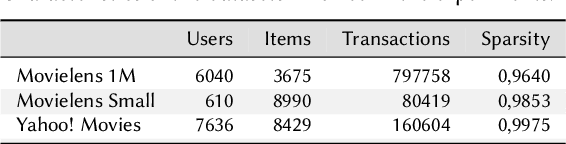
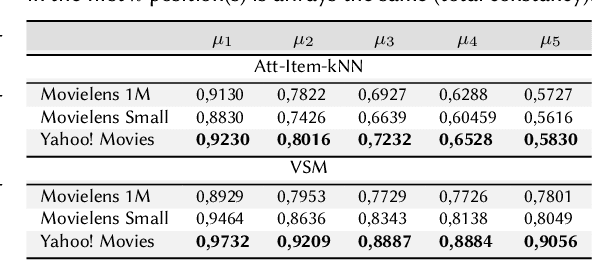
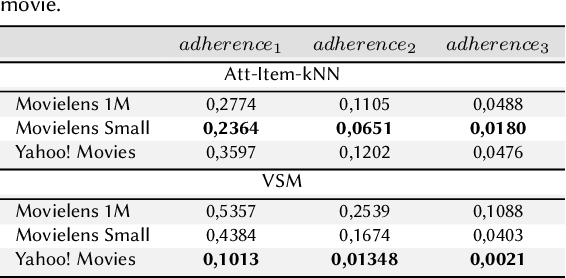
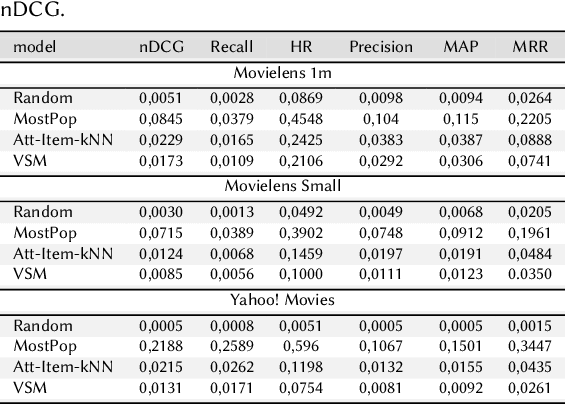
Explainable Recommendation has attracted a lot of attention due to a renewed interest in explainable artificial intelligence. In particular, post-hoc approaches have proved to be the most easily applicable ones to increasingly complex recommendation models, which are then treated as black-boxes. The most recent literature has shown that for post-hoc explanations based on local surrogate models, there are problems related to the robustness of the approach itself. This consideration becomes even more relevant in human-related tasks like recommendation. The explanation also has the arduous task of enhancing increasingly relevant aspects of user experience such as transparency or trustworthiness. This paper aims to show how the characteristics of a classical post-hoc model based on surrogates is strongly model-dependent and does not prove to be accountable for the explanations generated.