 Add to Chrome
 Add to Firefox
 Add to Edge
The Representational Limit of Scalar Interactions: An Interventional Decomposition
Jun 17, 2026
Signed pairwise interaction scores fundamentally conflate uniqueness (U), redundancy (R), and synergy (S). We prove this on a minimal 3-way XOR structural causal model: faithful indices such as Shapley-Taylor return zero per pair, whereas projective indices such as Shapley Interaction spread the third-order effect into pair scalars that conflate the three mechanisms. We introduce Stochastic Hi-Fi, a post-hoc, retraining-free predictability decomposition that estimates per-feature U/R/S profiles by interventional masked inference. The estimator provides exact interventional semantics, finite-sample Monte Carlo bounds, strict variance reduction from coupled diamond sampling, and uniform finite-vocabulary convergence. Across tabular SCMs, Stochastic Hi-Fi recovers structure missed by scalar baselines (up to 411x larger interaction-magnitude recovery ratios). It also separates redundant and synergistic heads in the GPT-2 IOI circuit. On NIH ChestX-ray14, Stochastic Hi-Fi matches GradCAM on Pointing Game and improves substantially on Deletion AUC.

WarpRec: Unifying Academic Rigor and Industrial Scale for Responsible, Reproducible, and Efficient Recommendation
Feb 19, 2026Innovation in Recommender Systems is currently impeded by a fractured ecosystem, where researchers must choose between the ease of in-memory experimentation and the costly, complex rewriting required for distributed industrial engines. To bridge this gap, we present WarpRec, a high-performance framework that eliminates this trade-off through a novel, backend-agnostic architecture. It includes 50+ state-of-the-art algorithms, 40 metrics, and 19 filtering and splitting strategies that seamlessly transition from local execution to distributed training and optimization. The framework enforces ecological responsibility by integrating CodeCarbon for real-time energy tracking, showing that scalability need not come at the cost of scientific integrity or sustainability. Furthermore, WarpRec anticipates the shift toward Agentic AI, leading Recommender Systems to evolve from static ranking engines into interactive tools within the Generative AI ecosystem. In summary, WarpRec not only bridges the gap between academia and industry but also can serve as the architectural backbone for the next generation of sustainable, agent-ready Recommender Systems. Code is available at https://github.com/sisinflab/warprec/
RUVA: Personalized Transparent On-Device Graph Reasoning
Feb 17, 2026The Personal AI landscape is currently dominated by "Black Box" Retrieval-Augmented Generation. While standard vector databases offer statistical matching, they suffer from a fundamental lack of accountability: when an AI hallucinates or retrieves sensitive data, the user cannot inspect the cause nor correct the error. Worse, "deleting" a concept from a vector space is mathematically imprecise, leaving behind probabilistic "ghosts" that violate true privacy. We propose Ruva, the first "Glass Box" architecture designed for Human-in-the-Loop Memory Curation. Ruva grounds Personal AI in a Personal Knowledge Graph, enabling users to inspect what the AI knows and to perform precise redaction of specific facts. By shifting the paradigm from Vector Matching to Graph Reasoning, Ruva ensures the "Right to be Forgotten." Users are the editors of their own lives; Ruva hands them the pen. The project and the demo video are available at http://sisinf00.poliba.it/ruva/.
Training-Free Consistency Pipeline for Fashion Repose
Jan 23, 2025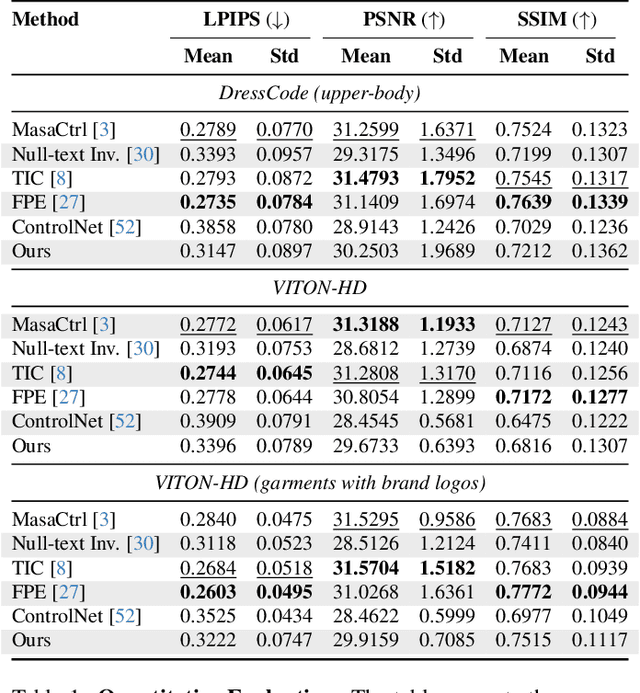
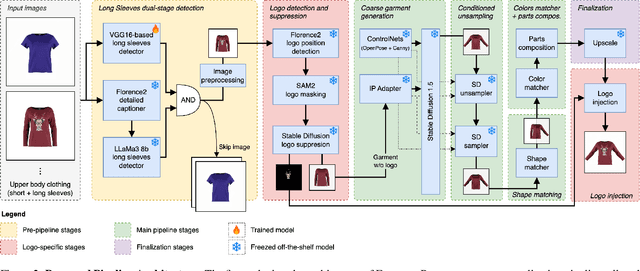
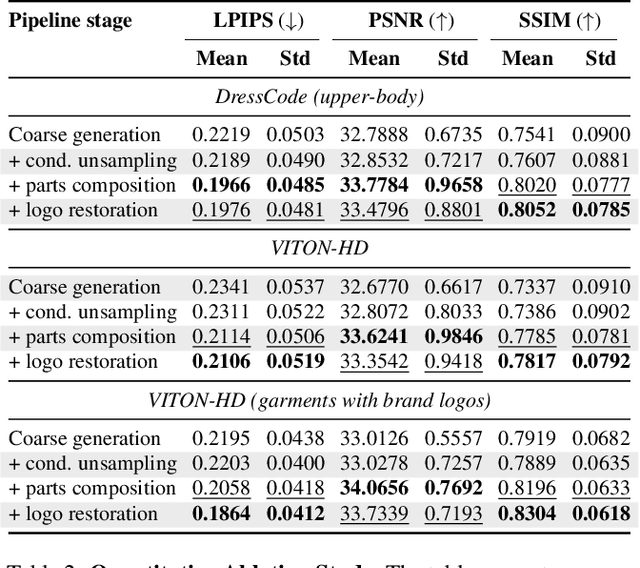
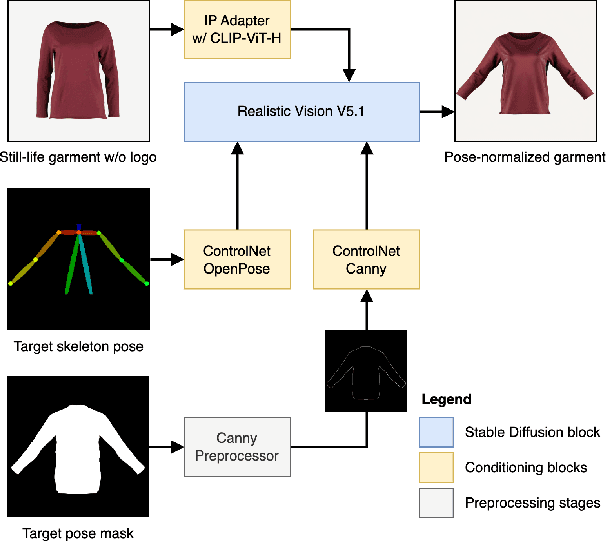
Recent advancements in diffusion models have significantly broadened the possibilities for editing images of real-world objects. However, performing non-rigid transformations, such as changing the pose of objects or image-based conditioning, remains challenging. Maintaining object identity during these edits is difficult, and current methods often fall short of the precision needed for industrial applications, where consistency is critical. Additionally, fine-tuning diffusion models requires custom training data, which is not always accessible in real-world scenarios. This work introduces FashionRepose, a training-free pipeline for non-rigid pose editing specifically designed for the fashion industry. The approach integrates off-the-shelf models to adjust poses of long-sleeve garments, maintaining identity and branding attributes. FashionRepose uses a zero-shot approach to perform these edits in near real-time, eliminating the need for specialized training. consistent image editing. The solution holds potential for applications in the fashion industry and other fields demanding identity preservation in image editing.
Scalable Cloud-Native Pipeline for Efficient 3D Model Reconstruction from Monocular Smartphone Images
Sep 28, 2024In recent years, 3D models have gained popularity in various fields, including entertainment, manufacturing, and simulation. However, manually creating these models can be a time-consuming and resource-intensive process, making it impractical for large-scale industrial applications. To address this issue, researchers are exploiting Artificial Intelligence and Machine Learning algorithms to automatically generate 3D models effortlessly. In this paper, we present a novel cloud-native pipeline that can automatically reconstruct 3D models from monocular 2D images captured using a smartphone camera. Our goal is to provide an efficient and easily-adoptable solution that meets the Industry 4.0 standards for creating a Digital Twin model, which could enhance personnel expertise through accelerated training. We leverage machine learning models developed by NVIDIA Research Labs alongside a custom-designed pose recorder with a unique pose compensation component based on the ARCore framework by Google. Our solution produces a reusable 3D model, with embedded materials and textures, exportable and customizable in any external 3D modelling software or 3D engine. Furthermore, the whole workflow is implemented by adopting the microservices architecture standard, enabling each component of the pipeline to operate as a standalone replaceable module.