 Add to Chrome
 Add to Firefox
 Add to Edge
Trustworthy and Explainable Deep Reinforcement Learning for Safe and Energy-Efficient Process Control: A Use Case in Industrial Compressed Air Systems
Dec 20, 2025
This paper presents a trustworthy reinforcement learning approach for the control of industrial compressed air systems. We develop a framework that enables safe and energy-efficient operation under realistic boundary conditions and introduce a multi-level explainability pipeline combining input perturbation tests, gradient-based sensitivity analysis, and SHAP (SHapley Additive exPlanations) feature attribution. An empirical evaluation across multiple compressor configurations shows that the learned policy is physically plausible, anticipates future demand, and consistently respects system boundaries. Compared to the installed industrial controller, the proposed approach reduces unnecessary overpressure and achieves energy savings of approximately 4\,\% without relying on explicit physics models. The results further indicate that system pressure and forecast information dominate policy decisions, while compressor-level inputs play a secondary role. Overall, the combination of efficiency gains, predictive behavior, and transparent validation supports the trustworthy deployment of reinforcement learning in industrial energy systems.

ML-Based Bidding Price Prediction for Pay-As-Bid Ancillary Services Markets: A Use Case in the German Control Reserve Market
Mar 21, 2025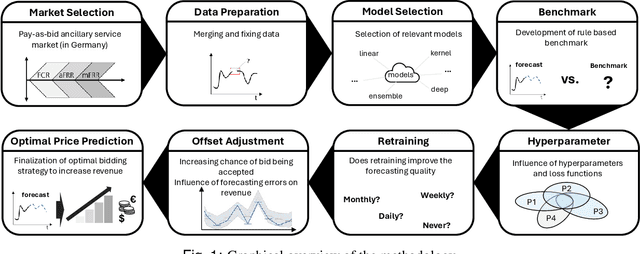
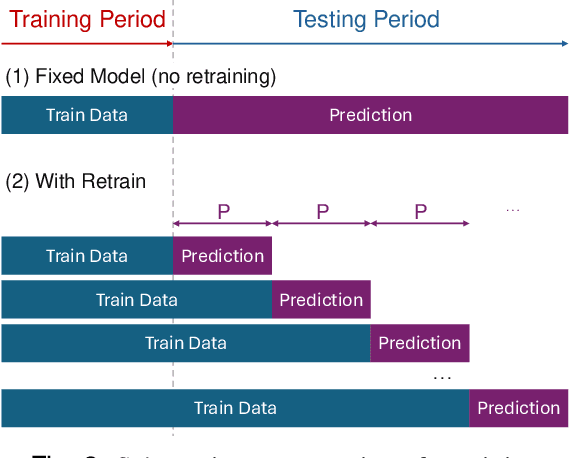
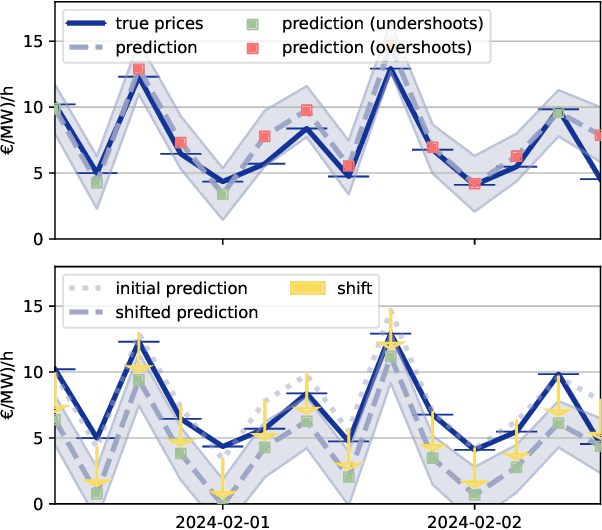
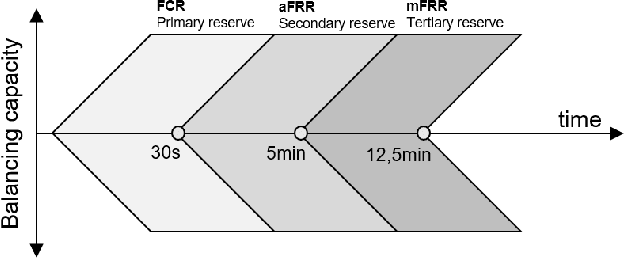
The increasing integration of renewable energy sources has led to greater volatility and unpredictability in electricity generation, posing challenges to grid stability. Ancillary service markets, such as the German control reserve market, allow industrial consumers and producers to offer flexibility in their power consumption or generation, contributing to grid stability while earning additional income. However, many participants use simple bidding strategies that may not maximize their revenues. This paper presents a methodology for forecasting bidding prices in pay-as-bid ancillary service markets, focusing on the German control reserve market. We evaluate various machine learning models, including Support Vector Regression, Decision Trees, and k-Nearest Neighbors, and compare their performance against benchmark models. To address the asymmetry in the revenue function of pay-as-bid markets, we introduce an offset adjustment technique that enhances the practical applicability of the forecasting models. Our analysis demonstrates that the proposed approach improves potential revenues by 27.43 % to 37.31 % compared to baseline models. When analyzing the relationship between the model forecasting errors and the revenue, a negative correlation is measured for three markets; according to the results, a reduction of 1 EUR/MW model price forecasting error (MAE) statistically leads to a yearly revenue increase between 483 EUR/MW and 3,631 EUR/MW. The proposed methodology enables industrial participants to optimize their bidding strategies, leading to increased earnings and contributing to the efficiency and stability of the electrical grid.