 Add to Chrome
 Add to Firefox
 Add to Edge
CHAI: CacHe Attention Inference for text2video
Feb 18, 2026
Text-to-video diffusion models deliver impressive results but remain slow because of the sequential denoising of 3D latents. Existing approaches to speed up inference either require expensive model retraining or use heuristic-based step skipping, which struggles to maintain video quality as the number of denoising steps decreases. Our work, CHAI, aims to use cross-inference caching to reduce latency while maintaining video quality. We introduce Cache Attention as an effective method for attending to shared objects/scenes across cross-inference latents. This selective attention mechanism enables effective reuse of cached latents across semantically related prompts, yielding high cache hit rates. We show that it is possible to generate high-quality videos using Cache Attention with as few as 8 denoising steps. When integrated into the overall system, CHAI is 1.65x - 3.35x faster than baseline OpenSora 1.2 while maintaining video quality.

Lynx: Enabling Efficient MoE Inference through Dynamic Batch-Aware Expert Selection
Nov 13, 2024
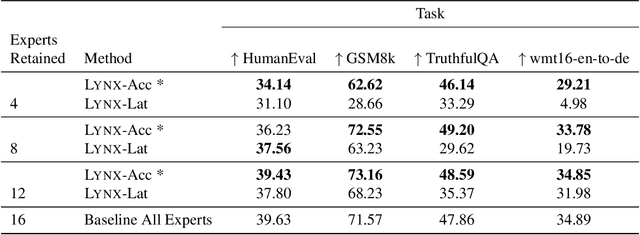
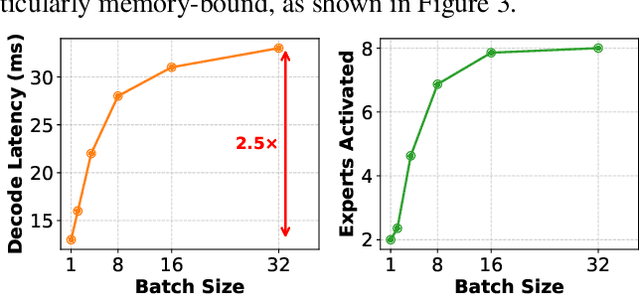
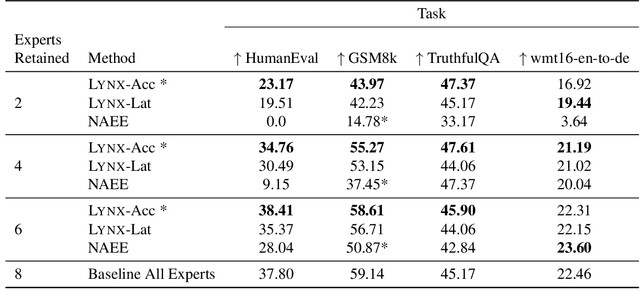
Mixture-of-Experts (MoE) architectures have recently gained popularity in enabling efficient scaling of large language models. However, we uncover a fundamental tension: while MoEs are designed for selective expert activation, production serving requires request batching, which forces the activation of all experts and negates MoE's efficiency benefits during the decode phase. We present Lynx, a system that enables efficient MoE inference through dynamic, batch-aware expert selection. Our key insight is that expert importance varies significantly across tokens and inference phases, creating opportunities for runtime optimization. Lynx leverages this insight through a lightweight framework that dynamically reduces active experts while preserving model accuracy. Our evaluations show that Lynx achieves up to 1.55x reduction in inference latency while maintaining negligible accuracy loss from baseline model across complex code generation and mathematical reasoning tasks.
Neural Network Models of Becoming a Cardinal Principle Knower
Nov 26, 2023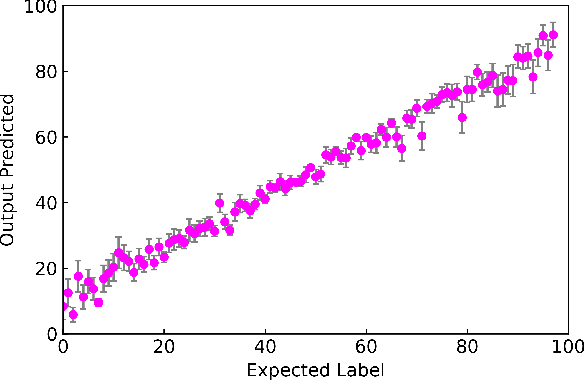
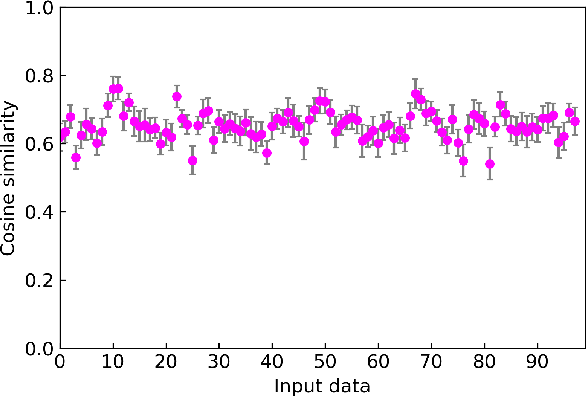
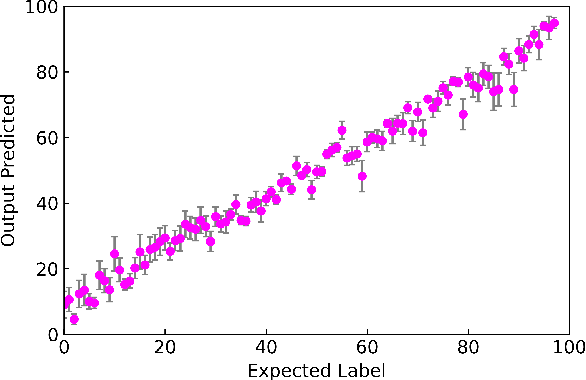
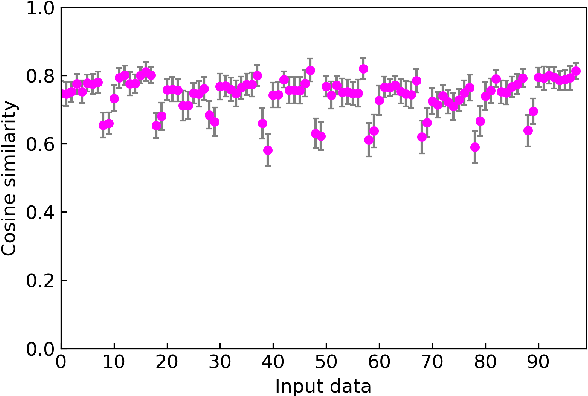
As children enter elementary school, their understanding of the ordinal structure of numbers transitions from a memorized count list of the first 50-100 numbers to knowing the successor function and understanding the countably infinite. We investigate this developmental change in two neural network models that learn the successor function on the pairs (N, N+1) for N in (0, 98). The first uses a one-hot encoding of the input and output values and corresponds to children memorizing a count list, while the second model uses a place-value encoding and corresponds to children learning the language rules for naming numbers. The place-value model showed a predicted drop in representational similarity across tens boundaries. Counting across a tens boundary can be understood as a vector operation in 2D space, where the numbers with the same tens place are organized in a linearly separable manner, whereas those with the same ones place are grouped together. A curriculum learning simulation shows that, in the expanding numerical environment of the developing child, representations of smaller numbers continue to be sharpened even as larger numbers begin to be learned. These models set the stage for future work using recurrent architectures to move beyond learning the successor function to simulating the counting process more generally, and point towards a deeper understanding of what it means to understand the countably infinite.