 Add to Chrome
 Add to Firefox
 Add to Edge
Sona Technical Report
Aug 12, 2026
We introduce Sona, a single-model generative recommender for Yandex Music. In an online A/B test, Sona replaced the entire production cascade, comprising more than 15 candidate generators followed by pre-ranking and ranking models that consume hundreds of features, including signals from large transformer models such as Argus and target-attention scorers, while significantly improving key engagement metrics. The architecture of Sona unifies candidate generation and ranking around a shared user representation. Its encoder transforms the user's chronological sequence of logged engagement events into hidden states consumed by both the autoregressive decoder and the Ranking Module. The next-token-prediction and distillation objectives jointly update the encoder, coupling generation and ranking through the same user state. Neither Sona nor its Teacher Ranker uses hand-engineered features; both operate on logged event fields and learned item representations. In the final Sona configuration, the larger teacher supplies ranking targets during training but is absent from serving, leaving the encoder, decoder, and Ranking Module as a single deployed model. We evaluate Sona in an online A/B experiment using live traffic from My Vibe on smart speakers, one of Yandex Music's largest recommendation surfaces. Relative to the production control, Sona produced statistically significant uplifts of 4.53% in Active Users, the primary metric, 6.30% in Total Listening Time, and 11.42% in Likes. These effects were incremental to improvements retained from preceding deployments. The Active Users uplift was 2.35 times the increment previously delivered by Argus, the strongest model deployed on this surface before Sona. These results show that a single jointly trained model can replace a mature multi-stage recommendation cascade while improving recommendation quality on live traffic.

Gryphon-v2: One Model in Place of a Cascade - Generate-and-Rank Recommender with Rollout Distillation
Aug 06, 2026Industrial recommender systems are commonly deployed as multi-stage cascades with separate candidate generators, pre-rankers, and final rankers. Although effective, these cascades require repeated user-history processing, complex feature pipelines, and multiple serving stages. Semantic-ID-based generative retrieval offers a path toward simpler end-to-end systems, but next-item prediction alone does not capture the fine-grained preferences encoded by production ranking objectives. We present Gryphon-v2, a unified generate-and-rank architecture for end-to-end recommendation. The model encodes a user history once, generates Semantic-ID candidates with an autoregressive decoder, resolves them to catalogue items, and ranks them with an item-level Ranking Module that reuses the shared encoder states. To transfer fine-grained production ranking preferences without adding an expensive second model to the serving path, we distill a high-capacity, training-only Teacher Ranker into the Ranking Module. Gryphon-v2 is trained with Rollout Distillation: teacher scores are the only ranking supervision, and they are collected over two complementary candidate distributions. Rollouts from the current decoder expose the Ranking Module to candidates produced by the same generation mechanism used at serving time, while logged impressions cover items users were actually shown. In an online A/B experiment on a large-scale recommendation surface at Yandex Music, a single Gryphon-v2 model replaces a production cascade comprising more than 15 candidate generators, pre-ranking, and final ranking. The deployment increases the number of active users by 1.41% at serving latency comparable to the production cascade. These results support the practical viability of a generative retriever with a Ranking Module distilled from the Teacher Ranker as an end-to-end alternative to a production cascade.
Reintroducing Straight-Through Estimators as Principled Methods for Stochastic Binary Networks
Jun 11, 2020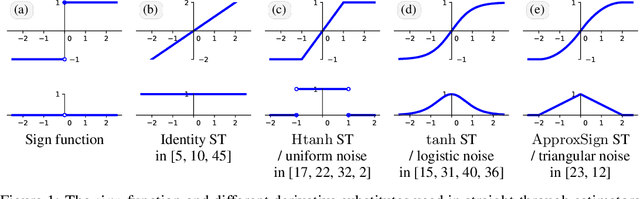
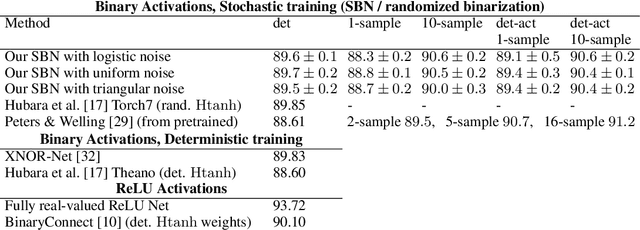
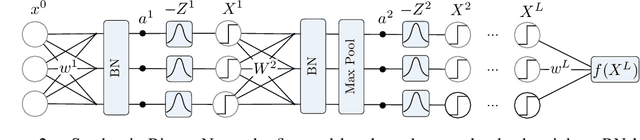

Training neural networks with binary weights and activations is a challenging problem due to the lack of gradients and difficulty of optimization over discrete weights. Many successful experimental results have been recently achieved using the empirical straight-through estimation approach. This approach has generated a variety of ad-hoc rules for propagating gradients through non-differentiable activations and updating discrete weights. We put such methods on a solid basis by obtaining them as viable approximations in the stochastic binary network (SBN) model with Bernoulli weights. In this model gradients are well-defined and the weight probabilities can be optimized by continuous techniques. By choosing the activation noises in SBN appropriately and choosing mirror descent (MD) for optimization, we obtain methods that closely resemble several existing straight-through variants, but unlike them, all work reliably and produce equally good results. We further show that variational inference for Bayesian learning of Binary weights can be implemented using MD updates with the same simplicity.
Path Sample-Analytic Gradient Estimators for Stochastic Binary Networks
Jun 04, 2020
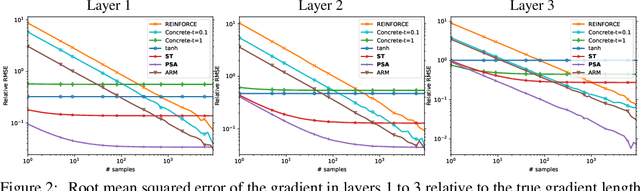
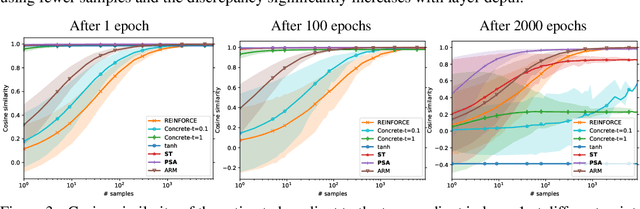
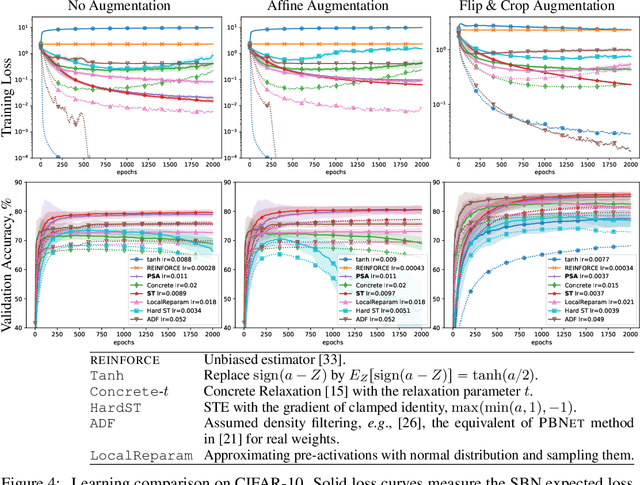
In networks with binary activations and or binary weights the training by gradient descent is complicated as the model has piecewise constant response. We consider stochastic binary networks, obtained by adding noises in front of activations. The expected model response becomes a smooth function of parameters, its gradient is well defined but is challenging to estimate accurately. We propose a new method for this estimation problem combining sampling and analytic approximation steps. The method has a significantly reduced variance at the price of a small bias which gives a very practical tradeoff in comparison with existing unbiased and biased estimators. We further show that one extra linearization step leads to a deep straight-through estimator previously known only as an ad-hoc heuristic. We experimentally show higher accuracy in gradient estimation and demonstrate a more stable and better performing training in deep convolutional models with both proposed methods.
Hamiltonian Monte-Carlo for Orthogonal Matrices
Jan 23, 2019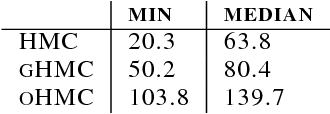
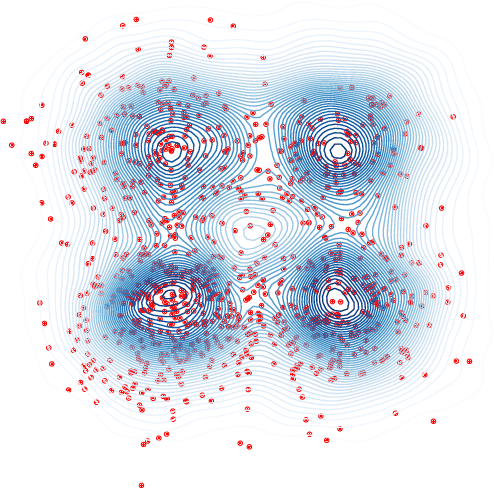
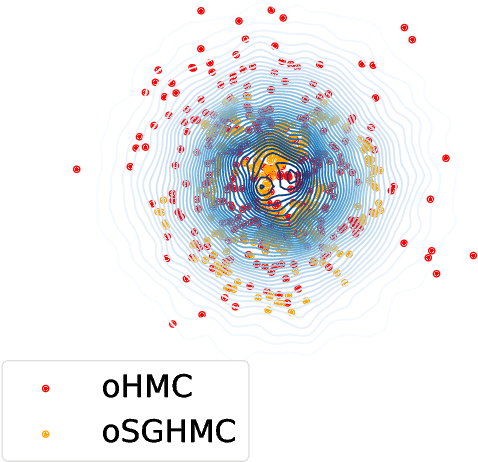
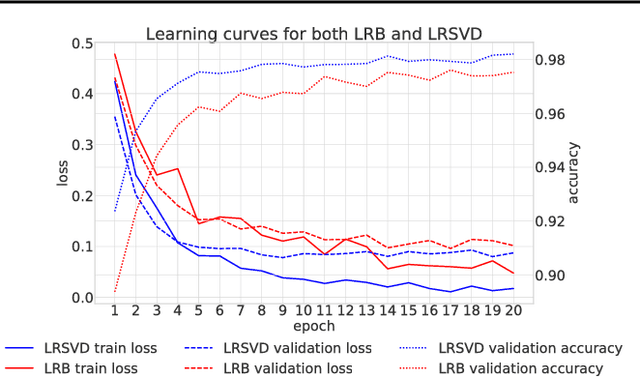
We consider the problem of sampling from posterior distributions for Bayesian models where some parameters are restricted to be orthogonal matrices. Such matrices are sometimes used in neural networks models for reasons of regularization and stabilization of training procedures, and also can parameterize matrices of bounded rank, positive-definite matrices and others. In \citet{byrne2013geodesic} authors have already considered sampling from distributions over manifolds using exact geodesic flows in a scheme similar to Hamiltonian Monte Carlo (HMC). We propose new sampling scheme for a set of orthogonal matrices that is based on the same approach, uses ideas of Riemannian optimization and does not require exact computation of geodesic flows. The method is theoretically justified by proof of symplecticity for the proposed iteration. In experiments we show that the new scheme is comparable or faster in time per iteration and more sample-efficient comparing to conventional HMC with explicit orthogonal parameterization and Geodesic Monte-Carlo. We also provide promising results of Bayesian ensembling for orthogonal neural networks and low-rank matrix factorization.