 Add to Chrome
 Add to Firefox
 Add to Edge
Mixing-Free and Signal-Optimal Learning of Gaussian Graphical Models from Glauber Dynamics
Jul 20, 2026
Gaussian graphical model selection is usually studied under independent sampling, but in many applications the data arise as a single trajectory of a dependent stochastic process. We study exact recovery of the graph from one trajectory of random-scan Gaussian Glauber dynamics. Existing techniques for this problem either inherit the mixing time of the chain, which can be super-polynomial in the dimension $p$ without strong assumptions, or are suboptimal in the minimum normalized edge strength $κ$. We propose two algorithms that are mixing-free and attain the $κ^{-2}$ dependence of the information-theoretic lower bounds. Both instantiate a shared dueling-neighborhood search meta-algorithm with a local statistic built directly from the update sequence. The first fits a least-squares regression at the updates of each node and recovers the graph from $\widetilde O(pd^{2}/κ^{2})$ updates, where $d$ is the maximum degree. This algorithm's data requirement depends on a local conditioning quantity, but only logarithmically and is provably optimal even when the underlying chain mixes slowly. The second algorithm is based on counting occurences of a specific update pattern and requires $\widetilde O(pd^{4}/κ^{2})$ updates, with no dependence on any condition number. The central technical challenge is that both statistics are built from dependent, non-stationary observations. Our analysis tackles this by demonstrating how to extract fresh Gaussian innovations from the update sequence, which yields mixing-free control of appropriate quantities. Neither the algorithms nor their analyses invoke stationarity, a spectral gap, or mixing conditions, and all guarantees hold from an arbitrary initialization.

Structure Learning in Gaussian Graphical Models from Glauber Dynamics
Dec 24, 2024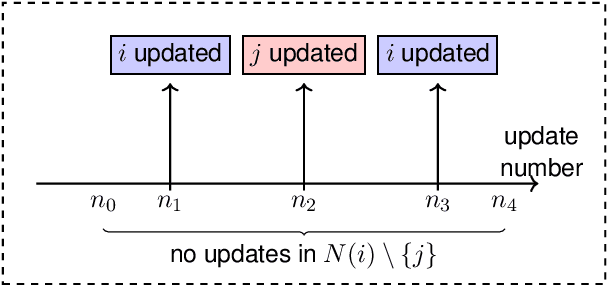
Gaussian graphical model selection is an important paradigm with numerous applications, including biological network modeling, financial network modeling, and social network analysis. Traditional approaches assume access to independent and identically distributed (i.i.d) samples, which is often impractical in real-world scenarios. In this paper, we address Gaussian graphical model selection under observations from a more realistic dependent stochastic process known as Glauber dynamics. Glauber dynamics, also called the Gibbs sampler, is a Markov chain that sequentially updates the variables of the underlying model based on the statistics of the remaining model. Such models, aside from frequently being employed to generate samples from complex multivariate distributions, naturally arise in various settings, such as opinion consensus in social networks and clearing/stock-price dynamics in financial networks. In contrast to the extensive body of existing work, we present the first algorithm for Gaussian graphical model selection when data are sampled according to the Glauber dynamics. We provide theoretical guarantees on the computational and statistical complexity of the proposed algorithm's structure learning performance. Additionally, we provide information-theoretic lower bounds on the statistical complexity and show that our algorithm is nearly minimax optimal for a broad class of problems.