 Add to Chrome
 Add to Firefox
 Add to Edge
Geometric and Stochastic Analysis of Discontinuities in Sparse Mixture-of-Experts
Jun 17, 2026
Sparse Mixture-of-Experts (SMoE) architectures are now widely deployed in state-of-the-art language and vision models, where conditional routing allows scaling to very large networks. However, this very Top-$k$ expert selection that enables conditional routing also renders the SMoE map inherently discontinuous. In the vicinity of these discontinuity surfaces, even inputs that are arbitrarily close may activate substantially different sets of experts resulting in significantly different outputs. In this work we give a rigorous geometric and stochastic analysis of these discontinuities. We first classify them by order, determined by the number of tied experts at a switching event. Using measure-theoretic slicing arguments, we establish asymptotic volume estimates for the thickened discontinuity surfaces, showing that lower-order discontinuity sets dominate, whereas higher-order ones occupy a vanishingly small relative volume. Next, modeling random perturbations in the input space via a diffusion process, we prove that the path eventually encounter a discontinuity, and moreover that the first hit almost surely occurs on an order-1 discontinuity with explicit finite-time probability bounds. We further derive occupation-time bounds that quantify the duration the random path spend in the neighborhoods of each discontinuity order. These theoretical results imply that inputs are more likely to lie near lower order discontinuities. Motivated by this insight, we propose a simple smoothing mechanism that can be directly applied to existing SMoEs, softly incorporating experts near discontinuities; our analysis guarantees that the added computational overhead remains small while providing localized smoothing near discontinuities, and experiments across language and vision tasks show that smoothing not only enforces continuity of the SMoE map but also enhances empirical performance.

Conservation Laws for Modern Neural Architectures
Jun 16, 2026Understanding gradient descent dynamics is key to explaining the success of over-parameterized models, where implicit bias manifests through conservation laws in gradient flow. While such laws are well understood for linear and ReLU networks, they remain largely unexplored for modern architectures. This work develops a unified framework to characterize conservation laws for contemporary models, including feedforward networks with GELU, SiLU, and SwiGLU activations, multihead attention with sinusoidal and rotary positional encodings, and Mixture-of-Experts architectures under diverse gating designs. Our theoretical findings are supported by experiments that validate the predicted invariants.
Functional Equivalence in Attention: A Comprehensive Study with Applications to Linear Mode Connectivity
Jun 16, 2026Neural network parameter spaces are inherently non-injective, as distinct parameter configurations can realize identical functions through functional equivalence. While this symmetry is well understood in classical fully connected and convolutional models, it becomes substantially more intricate in modern attention-based architectures. Existing analyses of multihead attention have largely focused on the vanilla formulation, overlooking positional encodings that fundamentally reshape architectural symmetries. In this work, we provide a formal study of functional equivalence in Transformers with positional encodings. Focusing on the two most widely used variants--sinusoidal and rotary positional encodings (RoPE)--we show that sinusoidal encodings preserve the equivalence structure of vanilla attention, whereas rotary encodings significantly reduce the symmetry group, thereby enhancing expressivity. This offers a principled explanation for the growing prominence of RoPE in practice. We further examine how positional encodings affect linear mode connectivity, and through an alignment algorithm, empirically demonstrate that the presence and variability of connectivity across Transformer settings crucially depend on the positional encoding.
Quasi-Equivariant Metanetworks
Apr 26, 2026Metanetworks are neural architectures designed to operate directly on pretrained weights to perform downstream tasks. However, the parameter space serves only as a proxy for the underlying function class, and the parameter-function mapping is inherently non-injective: distinct parameter configurations may yield identical input-output behaviors. As a result, metanetworks that rely solely on raw parameters risk overlooking the intrinsic symmetries of the architecture. Reasoning about functional identity is therefore essential for effective metanetwork design, motivating the development of equivariant metanetworks, which incorporate equivariance principles to respect architectural symmetries. Existing approaches, however, typically enforce strict equivariance, which imposes rigid constraints and often leads to sparse and less expressive models. To address this limitation, we introduce the novel concept of quasi-equivariance, which allows metanetworks to move beyond the rigidity of strict equivariance while still preserving functional identity. We lay down a principled basis for this framework and demonstrate its broad applicability across diverse neural architectures, including feedforward, convolutional, and transformer networks. Through empirical evaluation, we show that quasi-equivariant metanetworks achieve good trade-offs between symmetry preservation and representational expressivity. These findings advance the theoretical understanding of weight-space learning and provide a principled foundation for the design of more expressive and functionally robust metanetworks.
Tree-Sliced Wasserstein Distance with Nonlinear Projection
May 02, 2025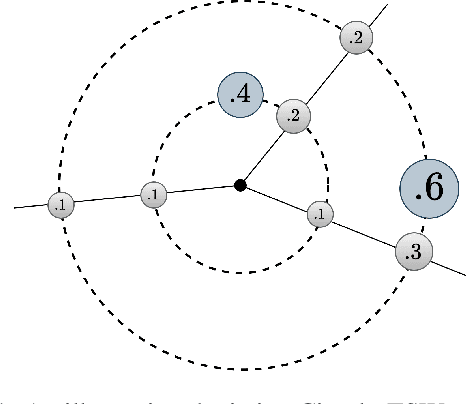
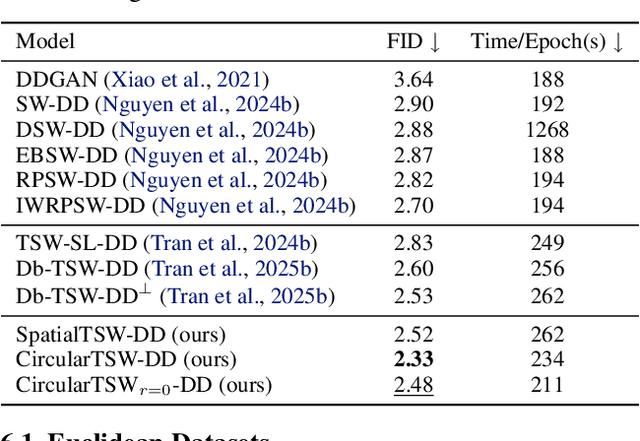
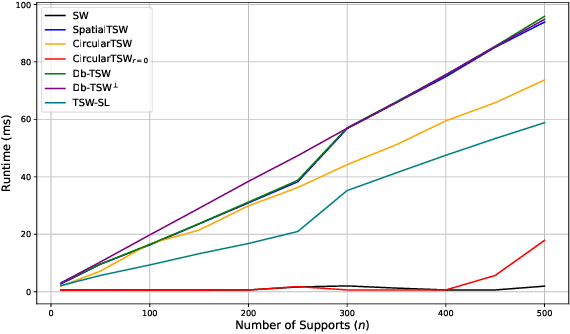
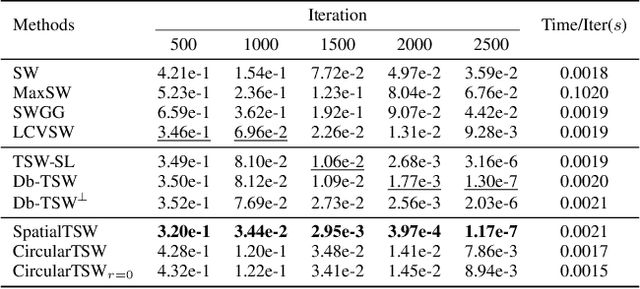
Tree-Sliced methods have recently emerged as an alternative to the traditional Sliced Wasserstein (SW) distance, replacing one-dimensional lines with tree-based metric spaces and incorporating a splitting mechanism for projecting measures. This approach enhances the ability to capture the topological structures of integration domains in Sliced Optimal Transport while maintaining low computational costs. Building on this foundation, we propose a novel nonlinear projectional framework for the Tree-Sliced Wasserstein (TSW) distance, substituting the linear projections in earlier versions with general projections, while ensuring the injectivity of the associated Radon Transform and preserving the well-definedness of the resulting metric. By designing appropriate projections, we construct efficient metrics for measures on both Euclidean spaces and spheres. Finally, we validate our proposed metric through extensive numerical experiments for Euclidean and spherical datasets. Applications include gradient flows, self-supervised learning, and generative models, where our methods demonstrate significant improvements over recent SW and TSW variants.
Equivariant Polynomial Functional Networks
Oct 05, 2024
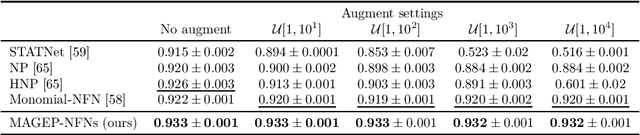


Neural Functional Networks (NFNs) have gained increasing interest due to their wide range of applications, including extracting information from implicit representations of data, editing network weights, and evaluating policies. A key design principle of NFNs is their adherence to the permutation and scaling symmetries inherent in the connectionist structure of the input neural networks. Recent NFNs have been proposed with permutation and scaling equivariance based on either graph-based message-passing mechanisms or parameter-sharing mechanisms. However, graph-based equivariant NFNs suffer from high memory consumption and long running times. On the other hand, parameter-sharing-based NFNs built upon equivariant linear layers exhibit lower memory consumption and faster running time, yet their expressivity is limited due to the large size of the symmetric group of the input neural networks. The challenge of designing a permutation and scaling equivariant NFN that maintains low memory consumption and running time while preserving expressivity remains unresolved. In this paper, we propose a novel solution with the development of MAGEP-NFN (Monomial mAtrix Group Equivariant Polynomial NFN). Our approach follows the parameter-sharing mechanism but differs from previous works by constructing a nonlinear equivariant layer represented as a polynomial in the input weights. This polynomial formulation enables us to incorporate additional relationships between weights from different input hidden layers, enhancing the model's expressivity while keeping memory consumption and running time low, thereby addressing the aforementioned challenge. We provide empirical evidence demonstrating that MAGEP-NFN achieves competitive performance and efficiency compared to existing baselines.
Equivariant Neural Functional Networks for Transformers
Oct 05, 2024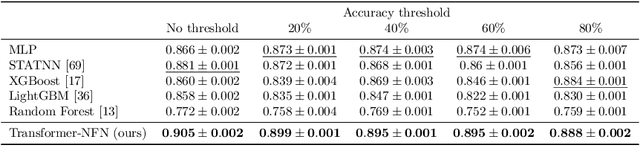
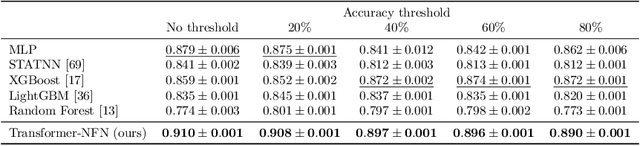
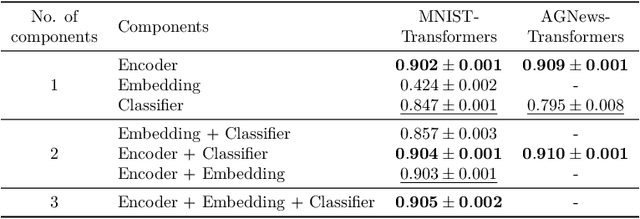
This paper systematically explores neural functional networks (NFN) for transformer architectures. NFN are specialized neural networks that treat the weights, gradients, or sparsity patterns of a deep neural network (DNN) as input data and have proven valuable for tasks such as learnable optimizers, implicit data representations, and weight editing. While NFN have been extensively developed for MLP and CNN, no prior work has addressed their design for transformers, despite the importance of transformers in modern deep learning. This paper aims to address this gap by providing a systematic study of NFN for transformers. We first determine the maximal symmetric group of the weights in a multi-head attention module as well as a necessary and sufficient condition under which two sets of hyperparameters of the multi-head attention module define the same function. We then define the weight space of transformer architectures and its associated group action, which leads to the design principles for NFN in transformers. Based on these, we introduce Transformer-NFN, an NFN that is equivariant under this group action. Additionally, we release a dataset of more than 125,000 Transformers model checkpoints trained on two datasets with two different tasks, providing a benchmark for evaluating Transformer-NFN and encouraging further research on transformer training and performance.
Tree-Sliced Wasserstein Distance on a System of Lines
Jun 19, 2024
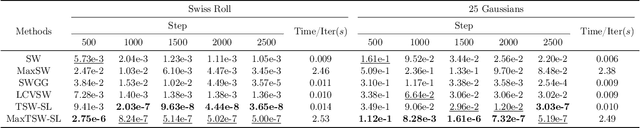
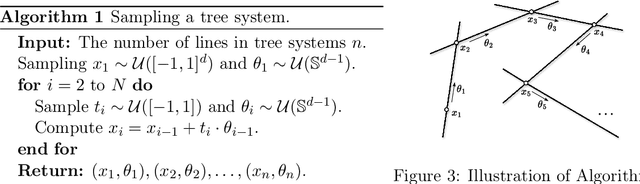

Sliced Wasserstein (SW) distance in Optimal Transport (OT) is widely used in various applications thanks to its statistical effectiveness and computational efficiency. On the other hand, Tree Wassenstein (TW) and Tree-sliced Wassenstein (TSW) are instances of OT for probability measures where its ground cost is a tree metric. TSW also has a low computational complexity, i.e. linear to the number of edges in the tree. Especially, TSW is identical to SW when the tree is a chain. While SW is prone to loss of topological information of input measures due to relying on one-dimensional projection, TSW is more flexible and has a higher degree of freedom by choosing a tree rather than a line to alleviate the curse of dimensionality in SW. However, for practical applications, popular tree metric sampling methods are heavily built upon given supports, which limits their capacity to adapt to new supports. In this paper, we propose the Tree-Sliced Wasserstein distance on a System of Lines (TSW-SL), which brings a connection between SW and TSW. Compared to SW and TSW, our TSW-SL benefits from the higher degree of freedom of TSW while being suitable to dynamic settings as SW. In TSW-SL, we use a variant of the Radon Transform to project measures onto a system of lines, resulting in measures on a space with a tree metric, then leverage TW to efficiently compute distances between them. We empirically verify the advantages of TSW-SL over the traditional SW by conducting a variety of experiments on gradient flows, image style transfer, and generative models.