 Add to Chrome
 Add to Firefox
 Add to Edge
Volumetric Radar Echo Motion Estimation Using Physics-Informed Deep Learning: A Case Study Over Slovakia
Mar 13, 2026
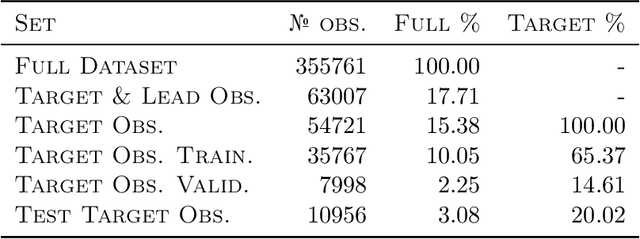
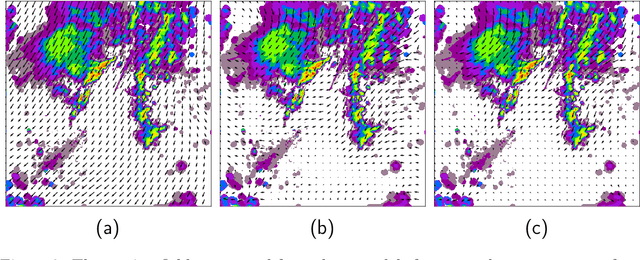
In precipitation nowcasting, most extrapolation-based methods rely on two-dimensional radar composites to estimate the horizontal motion of precipitation systems. However, in some cases, precipitation systems can exhibit varying motion at different heights. We propose a physics-informed convolutional neural network that estimates independent horizontal motion fields for multiple altitude layers directly from volumetric radar reflectivity data and investigate the practical benefits of altitude-wise motion field estimation for precipitation nowcasting. The model is trained end-to-end on volumetric observations from the Slovak radar network and its extrapolation nowcasting performance is evaluated. We compare the proposed model against an architecturally identical baseline operating on vertically pooled two-dimensional radar composites. Our results show that, although the model successfully learns altitude-wise motion fields, the estimated displacement is highly correlated across vertical levels for the vast majority of precipitation events. Consequently, the volumetric approach does not yield systematic improvements in nowcasting accuracy. While categorical metrics indicate increased precipitation detection at longer lead times, this gain is largely attributable to non-physical artifacts and is accompanied by a growing positive bias. A comprehensive inter-altitude motion field correlation analysis further confirms that events exhibiting meaningful vertical variability in horizontal motion are rare in the studied region. We conclude that, for the Slovak radar dataset, the additional complexity of three-dimensional motion field estimation is not justified by questionable gains in predictive skill. Nonetheless, the proposed framework remains applicable in climates where precipitation systems exhibit stronger vertical variability in horizontal motion.

Do Echo Top Heights Improve Deep Learning Nowcasts?
Jul 01, 2025Precipitation nowcasting -- the short-term prediction of rainfall using recent radar observations -- is critical for weather-sensitive sectors such as transportation, agriculture, and disaster mitigation. While recent deep learning models have shown promise in improving nowcasting skill, most approaches rely solely on 2D radar reflectivity fields, discarding valuable vertical information available in the full 3D radar volume. In this work, we explore the use of Echo Top Height (ETH), a 2D projection indicating the maximum altitude of radar reflectivity above a given threshold, as an auxiliary input variable for deep learning-based nowcasting. We examine the relationship between ETH and radar reflectivity, confirming its relevance for predicting rainfall intensity. We implement a single-pass 3D U-Net that processes both the radar reflectivity and ETH as separate input channels. While our models are able to leverage ETH to improve skill at low rain-rate thresholds, results are inconsistent at higher intensities and the models with ETH systematically underestimate precipitation intensity. Three case studies are used to illustrate how ETH can help in some cases, but also confuse the models and increase the error variance. Nonetheless, the study serves as a foundation for critically assessing the potential contribution of additional variables to nowcasting performance.
Fully Differentiable Lagrangian Convolutional Neural Network for Continuity-Consistent Physics-Informed Precipitation Nowcasting
Feb 16, 2024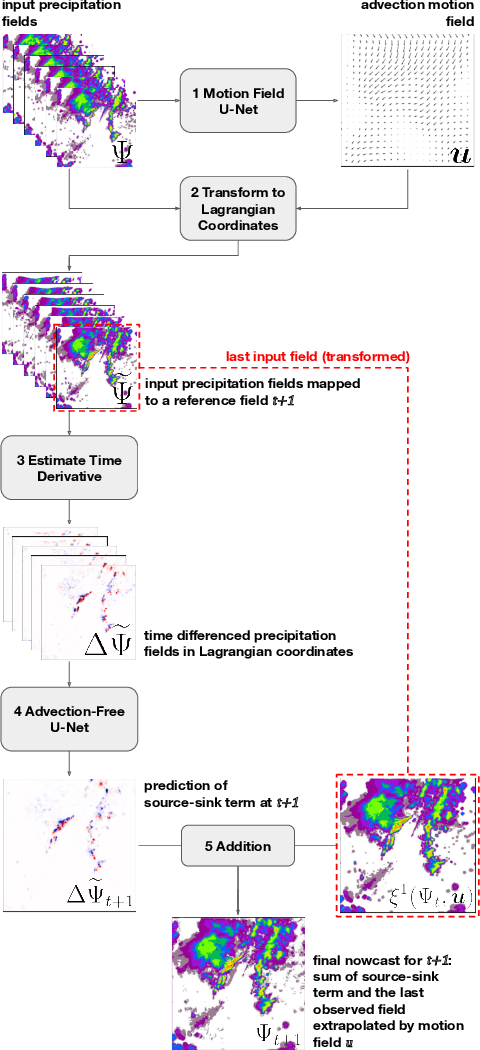
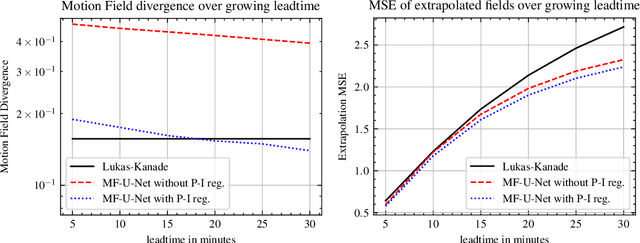
This paper presents a convolutional neural network model for precipitation nowcasting that combines data-driven learning with physics-informed domain knowledge. We propose LUPIN, a Lagrangian Double U-Net for Physics-Informed Nowcasting, that draws from existing extrapolation-based nowcasting methods and implements the Lagrangian coordinate system transformation of the data in a fully differentiable and GPU-accelerated manner to allow for real-time end-to-end training and inference. Based on our evaluation, LUPIN matches and exceeds the performance of the chosen benchmark, opening the door for other Lagrangian machine learning models.
Automatic question generation based on sentence structure analysis using machine learning approach
May 25, 2022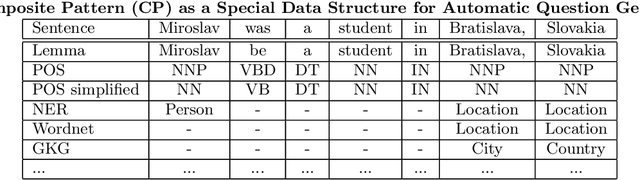
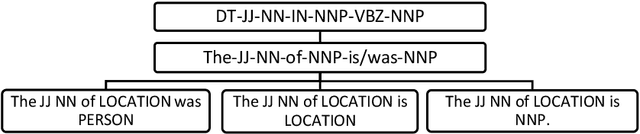
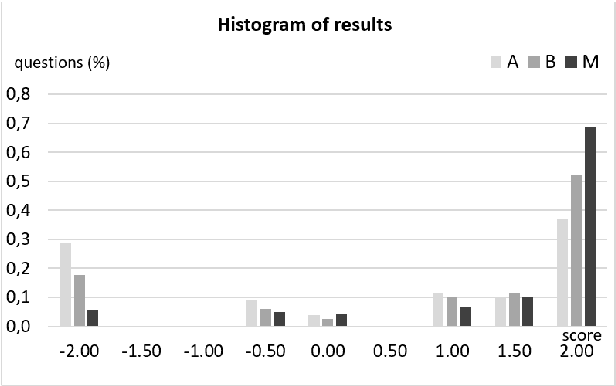
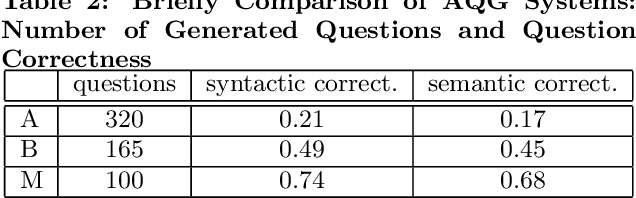
Automatic question generation is one of the most challenging tasks of Natural Language Processing. It requires "bidirectional" language processing: firstly, the system has to understand the input text (Natural Language Understanding) and it then has to generate questions also in the form of text (Natural Language Generation). In this article, we introduce our framework for generating the factual questions from unstructured text in the English language. It uses a combination of traditional linguistic approaches based on sentence patterns with several machine learning methods. We firstly obtain lexical, syntactic and semantic information from an input text and we then construct a hierarchical set of patterns for each sentence. The set of features is extracted from the patterns and it is then used for automated learning of new transformation rules. Our learning process is totally data-driven because the transformation rules are obtained from a set of initial sentence-question pairs. The advantages of this approach lie in a simple expansion of new transformation rules which allows us to generate various types of questions and also in the continuous improvement of the system by reinforcement learning. The framework also includes a question evaluation module which estimates the quality of generated questions. It serves as a filter for selecting the best questions and eliminating incorrect ones or duplicates. We have performed several experiments to evaluate the correctness of generated questions and we have also compared our system with several state-of-the-art systems. Our results indicate that the quality of generated questions outperforms the state-of-the-art systems and our questions are also comparable to questions created by humans. We have also created and published an interface with all created datasets and evaluated questions, so it is possible to follow up on our work.