 Add to Chrome
 Add to Firefox
 Add to Edge
Capturing Multivariate Dependencies of EV Charging Events: From Parametric Copulas to Neural Density Estimation
Mar 31, 2026
Accurate event-based modeling of electric vehicle (EV) charging is essential for grid reliability and smart-charging design. While traditional statistical methods capture marginal distributions, they often fail to model the complex, non-linear dependencies between charging variables, specifically arrival times, durations, and energy demand. This paper addresses this gap by introducing the first application of Vine copulas and Copula Density Neural Estimation framework (CODINE) to the EV domain. We evaluate these high-capacity dependence models across three diverse real-world datasets. Our results demonstrate that by explicitly focusing on modeling the joint dependence structure, Vine copulas and CODINE outperform established parametric families and remain highly competitive against state-of-the-art benchmarks like conditional Gaussian Mixture Model Networks. We show that these methods offer superior preservation of tail behaviors and correlation structures, providing a robust framework for synthetic charging event generation in varied infrastructure contexts.

Latent Space Representation of Electricity Market Curves for Improved Prediction Efficiency
Mar 14, 2025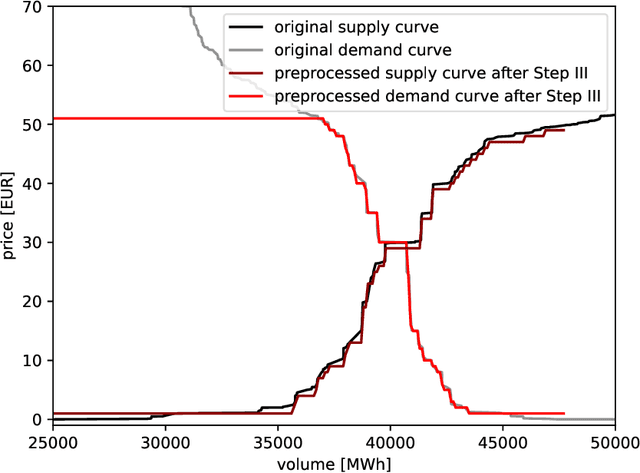

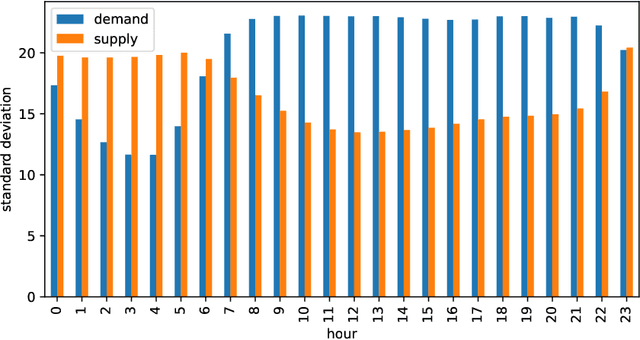
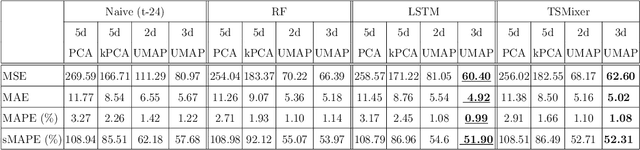
This work presents a three-phase ML prediction framework designed to handle a high dimensionality and multivariate time series character of the electricity market curves. In the preprocessing phase, we transform the original data to achieve a unified structure and mitigate the effect of possible outliers. Further, to address the challenge of high dimensionality, we test three dimensionality reduction techniques (PCA, kPCA, UMAP). Finally, we predict supply and demand curves, once represented in a latent space, with a variety of machine learning methods (RF, LSTM, TSMixer). As our results on the MIBEL dataset show, a high dimensional structure of the market curves can be best handled by the nonlinear reduction technique UMAP. Regardless of the ML technique used for prediction, we achieved the lowest values for all considered precision metrics with a UMAP latent space representation in only two or three dimensions, even when compared to PCA and kPCA with five or six dimensions. Further, we demonstrate that the most promising machine learning technique to handle the complex structure of the electricity market curves is a novel TSMixer architecture. Finally, we fill the gap in the field of electricity market curves prediction literature: in addition to standard analysis on the supply side, we applied the ML framework and predicted demand curves too. We discussed the differences in the achieved results for these two types of curves.
Fully Differentiable Lagrangian Convolutional Neural Network for Continuity-Consistent Physics-Informed Precipitation Nowcasting
Feb 16, 2024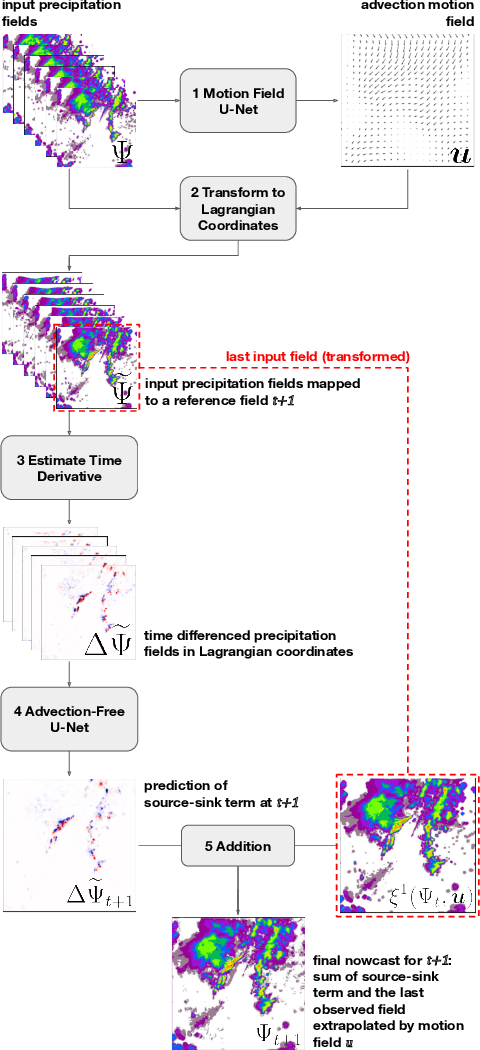
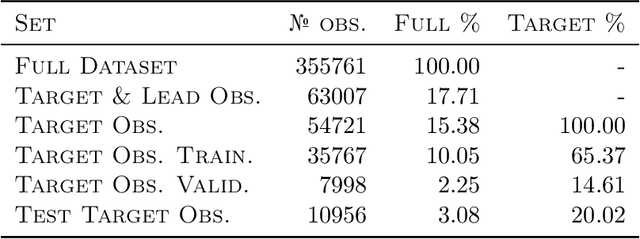
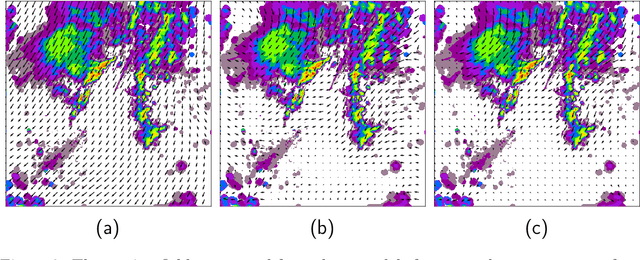
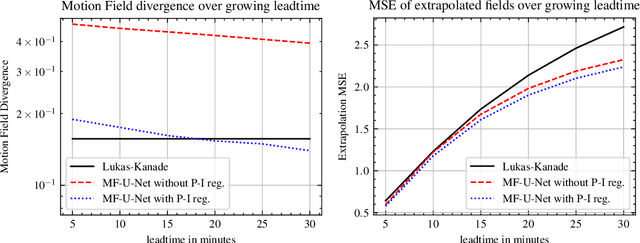
This paper presents a convolutional neural network model for precipitation nowcasting that combines data-driven learning with physics-informed domain knowledge. We propose LUPIN, a Lagrangian Double U-Net for Physics-Informed Nowcasting, that draws from existing extrapolation-based nowcasting methods and implements the Lagrangian coordinate system transformation of the data in a fully differentiable and GPU-accelerated manner to allow for real-time end-to-end training and inference. Based on our evaluation, LUPIN matches and exceeds the performance of the chosen benchmark, opening the door for other Lagrangian machine learning models.