 Add to Chrome
 Add to Firefox
 Add to Edge
Sona Technical Report
Aug 12, 2026
We introduce Sona, a single-model generative recommender for Yandex Music. In an online A/B test, Sona replaced the entire production cascade, comprising more than 15 candidate generators followed by pre-ranking and ranking models that consume hundreds of features, including signals from large transformer models such as Argus and target-attention scorers, while significantly improving key engagement metrics. The architecture of Sona unifies candidate generation and ranking around a shared user representation. Its encoder transforms the user's chronological sequence of logged engagement events into hidden states consumed by both the autoregressive decoder and the Ranking Module. The next-token-prediction and distillation objectives jointly update the encoder, coupling generation and ranking through the same user state. Neither Sona nor its Teacher Ranker uses hand-engineered features; both operate on logged event fields and learned item representations. In the final Sona configuration, the larger teacher supplies ranking targets during training but is absent from serving, leaving the encoder, decoder, and Ranking Module as a single deployed model. We evaluate Sona in an online A/B experiment using live traffic from My Vibe on smart speakers, one of Yandex Music's largest recommendation surfaces. Relative to the production control, Sona produced statistically significant uplifts of 4.53% in Active Users, the primary metric, 6.30% in Total Listening Time, and 11.42% in Likes. These effects were incremental to improvements retained from preceding deployments. The Active Users uplift was 2.35 times the increment previously delivered by Argus, the strongest model deployed on this surface before Sona. These results show that a single jointly trained model can replace a mature multi-stage recommendation cascade while improving recommendation quality on live traffic.

Long-History User Transformers for Real-Time Ad Ranking
Jul 15, 2026Long interaction histories are among the most informative inputs for click-through rate (CTR) prediction, yet in online advertising they collide with a hard serving constraint: ads must be scored within a few hundred milliseconds to enter the auction, which rules out running a large sequence encoder at request time. We describe how a production advertising system resolves this conflict by decoupling history encoding from real-time inference. A high-capacity offline transformer asynchronously encodes the user's full cross-surface interaction history into a compact representation cached in a feature store, while a lightweight runtime model combines this cached representation with the user's most recent events and the request context at serving time. The offline encoder is pre-trained autoregressively on large-scale interaction logs with a dual objective - feedback prediction and next-item prediction - and the two-stage architecture is then fine-tuned for CTR prediction on the target advertising surface. Offline, the split design recovers 72-80% of the quality of a full-history runtime transformer that would be too expensive to deploy, and the cached representation is robust enough to staleness to permit inexpensive refresh policies. In production A/B experiments, the system improves the primary ranking metric by +2.77% in search advertising and +2.1% on the Yandex Advertising Network, with revenue gains of +2.26% and +0.43% respectively - without increasing serving latency.
Benefiting from Negative yet Informative Feedback by Contrasting Opposing Sequential Patterns
Aug 20, 2025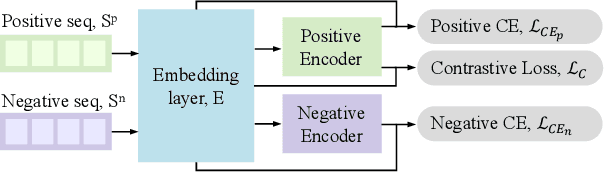
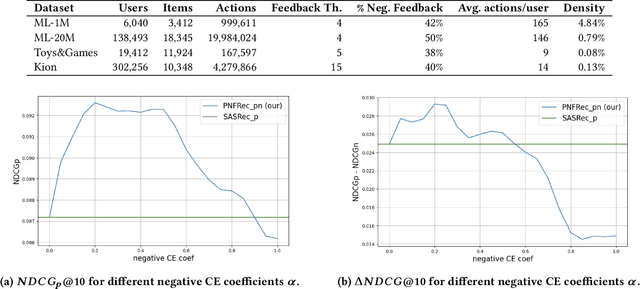
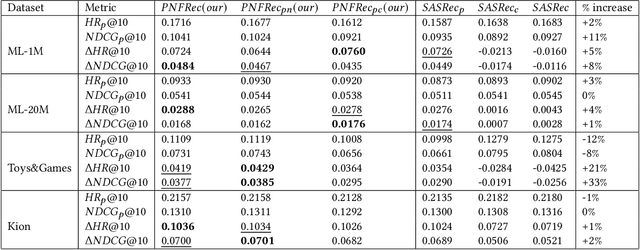
We consider the task of learning from both positive and negative feedback in a sequential recommendation scenario, as both types of feedback are often present in user interactions. Meanwhile, conventional sequential learning models usually focus on considering and predicting positive interactions, ignoring that reducing items with negative feedback in recommendations improves user satisfaction with the service. Moreover, the negative feedback can potentially provide a useful signal for more accurate identification of true user interests. In this work, we propose to train two transformer encoders on separate positive and negative interaction sequences. We incorporate both types of feedback into the training objective of the sequential recommender using a composite loss function that includes positive and negative cross-entropy as well as a cleverly crafted contrastive term, that helps better modeling opposing patterns. We demonstrate the effectiveness of this approach in terms of increasing true-positive metrics compared to state-of-the-art sequential recommendation methods while reducing the number of wrongly promoted negative items.
RecBaselines2023: a new dataset for choosing baselines for recommender models
Jun 25, 2023

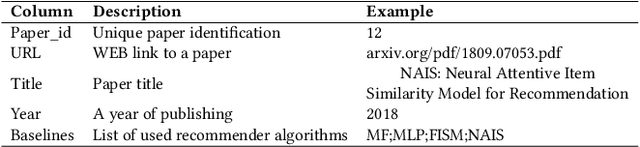

The number of proposed recommender algorithms continues to grow. The authors propose new approaches and compare them with existing models, called baselines. Due to the large number of recommender models, it is difficult to estimate which algorithms to choose in the article. To solve this problem, we have collected and published a dataset containing information about the recommender models used in 903 papers, both as baselines and as proposed approaches. This dataset can be seen as a typical dataset with interactions between papers and previously proposed models. In addition, we provide a descriptive analysis of the dataset and highlight possible challenges to be investigated with the data. Furthermore, we have conducted extensive experiments using a well-established methodology to build a good recommender algorithm under the dataset. Our experiments show that the selection of the best baselines for proposing new recommender approaches can be considered and successfully solved by existing state-of-the-art collaborative filtering models. Finally, we discuss limitations and future work.