 Add to Chrome
 Add to Firefox
 Add to Edge
PubMed-Ophtha: An open resource for training ophthalmology vision-language models on scientific literature
May 04, 2026
Vision-language models hold considerable promise for ophthalmology, but their development depends on large-scale, high-quality image-text datasets that remain scarce. We present PubMed-Ophtha, a hierarchical dataset of 102,023 ophthalmological image-caption pairs extracted from 15,842 open-access articles in PubMed Central. Unlike existing datasets, figures are extracted directly from article PDFs at full resolution and decomposed into their constituent panels, panel identifiers, and individual images. Each image is annotated with its imaging modality -- color fundus photography, optical coherence tomography, retinal imaging, or other -- and a mark status indicating the presence of annotation marks such as arrows. Figure captions are split into panel-level subcaptions using a two-step LLM approach, achieving a mean average sentence BLEU score of 0.913 on human-annotated data. Panel and image detection models reach a mAP@0.50 of 0.909 and 0.892, respectively, and figure extraction achieves a median IoU of 0.997. To support reproducibility, we additionally release the human-annotated ground-truth data, all trained models, and the full dataset generation pipeline.

Multimodal Interactive Lung Lesion Segmentation: A Framework for Annotating PET/CT Images based on Physiological and Anatomical Cues
Jan 24, 2023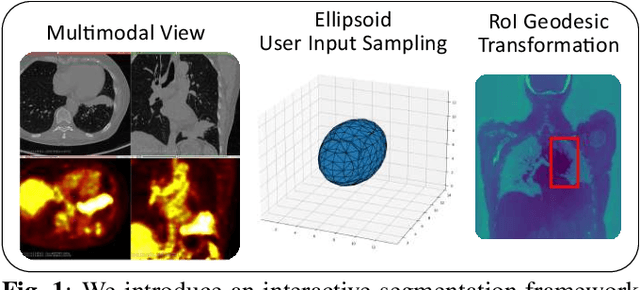
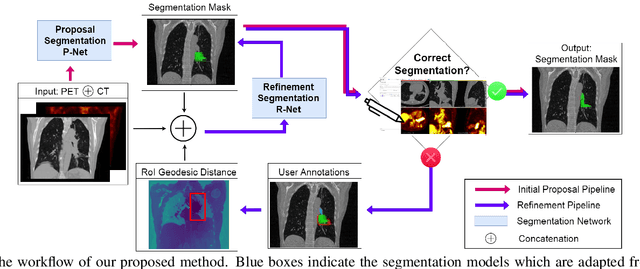
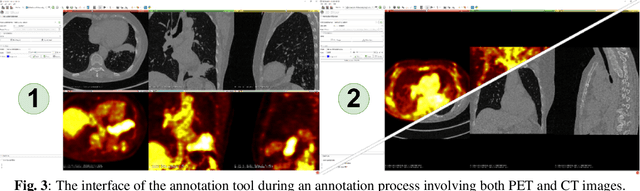
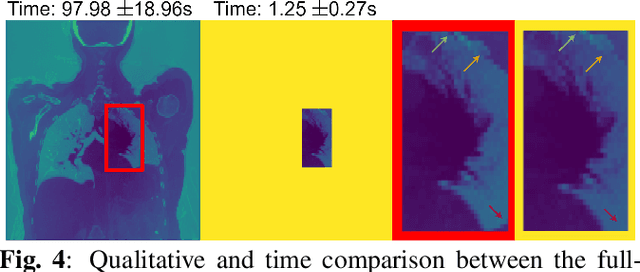
Recently, deep learning enabled the accurate segmentation of various diseases in medical imaging. These performances, however, typically demand large amounts of manual voxel annotations. This tedious process for volumetric data becomes more complex when not all required information is available in a single imaging domain as is the case for PET/CT data. We propose a multimodal interactive segmentation framework that mitigates these issues by combining anatomical and physiological cues from PET/CT data. Our framework utilizes the geodesic distance transform to represent the user annotations and we implement a novel ellipsoid-based user simulation scheme during training. We further propose two annotation interfaces and conduct a user study to estimate their usability. We evaluated our model on the in-domain validation dataset and an unseen PET/CT dataset. We make our code publicly available: https://github.com/verena-hallitschke/pet-ct-annotate.