 Add to Chrome
 Add to Firefox
 Add to Edge
CAREBench: A Child-Safety Risk Benchmark for Language Models
Jun 29, 2026
How can we evaluate whether frontier AI systems recognize child-safety risks before they escalate into explicit harm? Existing child safety evaluations focus on child sexual abuse material, yet many child-safety failures begin earlier: in model assistance that helps adults manipulate, impersonate, profile, or isolate minors, and in model responses that deepen children's emotional dependence on AI systems rather than redirecting them toward human support. We introduce CAREBench (Child AI Risk Evaluation), a benchmark to assess such upstream child-safety risks in language models. CAREBench contains 500 prompts spanning twelve risk categories, including grooming and relationship engineering, deception and impersonation, surveillance and privacy, sextortion and sexual abuse, AI anthropomorphization, emotional dependency, and mental illness sensitivity. Developed with response annotations from parents and clinicians, the benchmark excludes explicit abuse material and imagery; instead, it evaluates whether models recognize, refuse, de-escalate, or redirect risky interactions before harm becomes overt. Evaluating seven frontier models on our benchmark, we find failure rates ranging from 2% to 58%, with failure patterns that vary across risk categories. CAREBench provides a responsibly scoped evaluation for LLM developers to identify and close gaps in child safety policies.

A Careful Examination of Large Language Model Performance on Grade School Arithmetic
May 02, 2024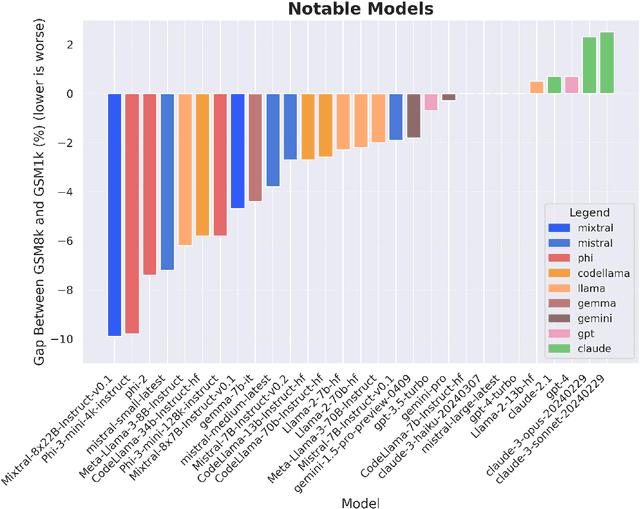
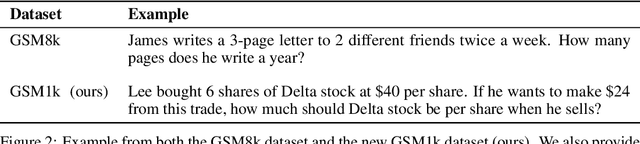
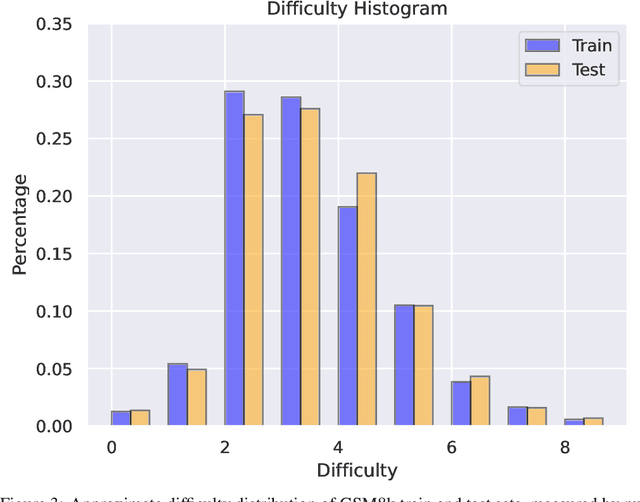
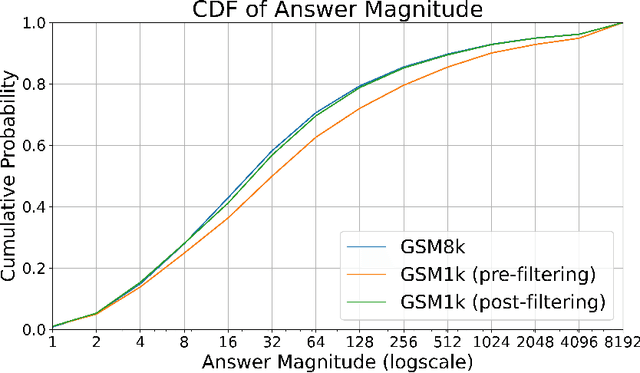
Large language models (LLMs) have achieved impressive success on many benchmarks for mathematical reasoning. However, there is growing concern that some of this performance actually reflects dataset contamination, where data closely resembling benchmark questions leaks into the training data, instead of true reasoning ability. To investigate this claim rigorously, we commission Grade School Math 1000 (GSM1k). GSM1k is designed to mirror the style and complexity of the established GSM8k benchmark, the gold standard for measuring elementary mathematical reasoning. We ensure that the two benchmarks are comparable across important metrics such as human solve rates, number of steps in solution, answer magnitude, and more. When evaluating leading open- and closed-source LLMs on GSM1k, we observe accuracy drops of up to 13%, with several families of models (e.g., Phi and Mistral) showing evidence of systematic overfitting across almost all model sizes. At the same time, many models, especially those on the frontier, (e.g., Gemini/GPT/Claude) show minimal signs of overfitting. Further analysis suggests a positive relationship (Spearman's r^2=0.32) between a model's probability of generating an example from GSM8k and its performance gap between GSM8k and GSM1k, suggesting that many models may have partially memorized GSM8k.