 Add to Chrome
 Add to Firefox
 Add to Edge
Subspace Projection Methods for Fast Spectral Embeddings of Evolving Graphs
Mar 19, 2026
Several graph data mining, signal processing, and machine learning downstream tasks rely on information related to the eigenvectors of the associated adjacency or Laplacian matrix. Classical eigendecomposition methods are powerful when the matrix remains static but cannot be applied to problems where the matrix entries are updated or the number of rows and columns increases frequently. Such scenarios occur routinely in graph analytics when the graph is changing dynamically and either edges and/or nodes are being added and removed. This paper puts forth a new algorithmic framework to update the eigenvectors associated with the leading eigenvalues of an initial adjacency or Laplacian matrix as the graph evolves dynamically. The proposed algorithm is based on Rayleigh-Ritz projections, in which the original eigenvalue problem is projected onto a restricted subspace which ideally encapsulates the invariant subspace associated with the sought eigenvectors. Following ideas from eigenvector perturbation analysis, we present a new methodology to build the projection subspace. The proposed framework features lower computational and memory complexity with respect to competitive alternatives while empirical results show strong qualitative performance, both in terms of eigenvector approximation and accuracy of downstream learning tasks of central node identification and node clustering.

Projection techniques to update the truncated SVD of evolving matrices
Oct 13, 2020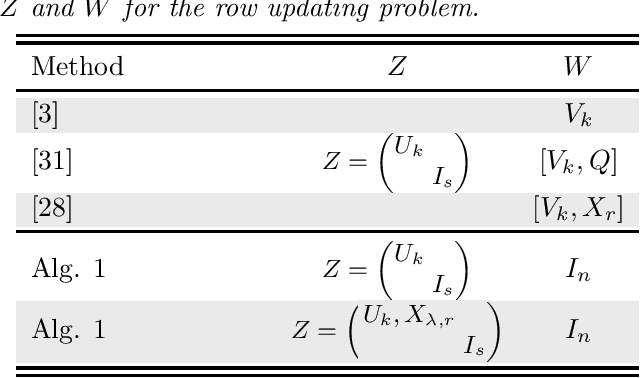
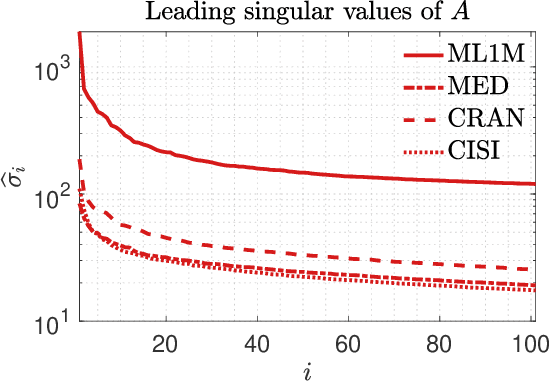
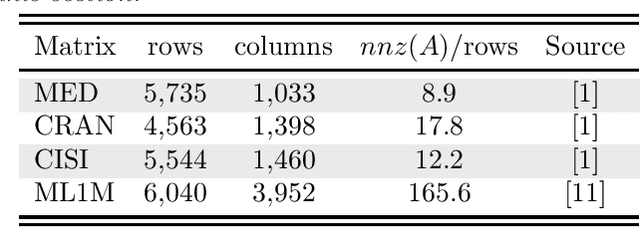
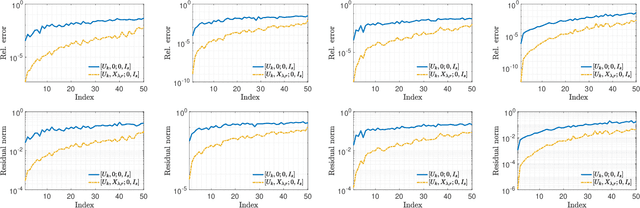
This paper considers the problem of updating the rank-k truncated Singular Value Decomposition (SVD) of matrices subject to the addition of new rows and/or columns over time. Such matrix problems represent an important computational kernel in applications such as Latent Semantic Indexing and Recommender Systems. Nonetheless, the proposed framework is purely algebraic and targets general updating problems. The algorithm presented in this paper undertakes a projection view-point and focuses on building a pair of subspaces which approximate the linear span of the sought singular vectors of the updated matrix. We discuss and analyze two different choices to form the projection subspaces. Results on matrices from real applications suggest that the proposed algorithm can lead to higher accuracy, especially for the singular triplets associated with the largest modulus singular values. Several practical details and key differences with other approaches are also discussed.