 Add to Chrome
 Add to Firefox
 Add to Edge
Optimal Control Approach for Non-prehensile Ball Juggling Using a 7-DoF Manipulator
Jun 04, 2026
Non-prehensile object manipulation skills are important for real-world robot interactions, enabling highly dynamic tasks such as balancing a glass on a tray or the controlled sliding of items on a table. Among such tasks, those characterised by high-speed manipulation requirements and general sensitivity of the resulting hybrid dynamics are particularly hard to accomplish. Within these, juggling can be seen as a highly challenging maneuver to be solved. The key to robotic juggling is achieving dynamic stabilisation of an underactuated object. Since the object does not possess the ability of self-correction, its stability is entirely dependent on the forces applied to it. This creates a system that is sensitive to control inputs, where timing is critical to continuously counteract deviations and maintain the desired behavior. We develop a systematic method to control a 7-degree-of-freedom manipulator performing non-prehensile ball juggling with a tool. Our primary contribution is a model-based framework for generating juggling trajectories and stabilizing a periodic juggling motion for this hybrid system. The framework incorporates a two-stage optimal control approach to compute the underlying feasible motion patterns required for stable juggling. Offline-computed trajectories are then organised to enable real-time error correction without solving optimal control problems online. We demonstrate the effectiveness of the resulting controller by first evaluating its performance in a simulation environment and performing an experiment using a Franka Emika Panda robot.

Optimal Control for Clutched-Elastic Robots: A Contact-Implicit Approach
Jul 17, 2024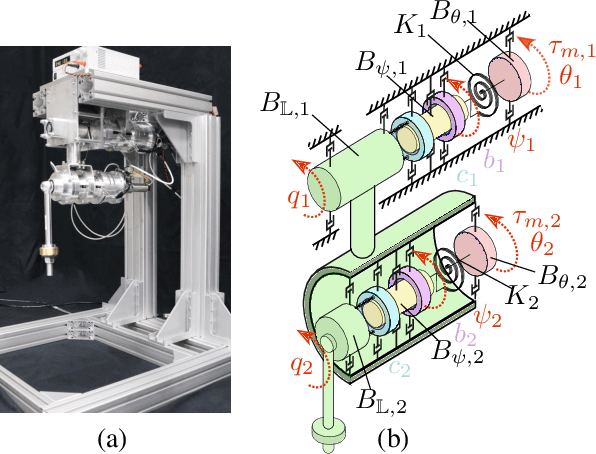
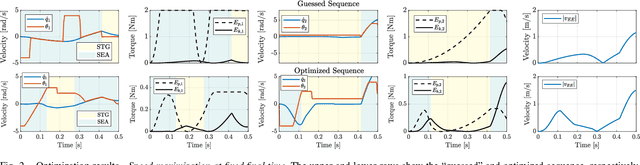


Intrinsically elastic robots surpass their rigid counterparts in a range of different characteristics. By temporarily storing potential energy and subsequently converting it to kinetic energy, elastic robots are capable of highly dynamic motions even with limited motor power. However, the time-dependency of this energy storage and release mechanism remains one of the major challenges in controlling elastic robots. A possible remedy is the introduction of locking elements (i.e. clutches and brakes) in the drive train. This gives rise to a new class of robots, so-called clutched-elastic robots (CER), with which it is possible to precisely control the energy-transfer timing. A prevalent challenge in the realm of CERs is the automatic discovery of clutch sequences. Due to complexity, many methods still rely on pre-defined modes. In this paper, we introduce a novel contact-implicit scheme designed to optimize both control input and clutch sequence simultaneously. A penalty in the objective function ensures the prevention of unnecessary clutch transitions. We empirically demonstrate the effectiveness of our proposed method on a double pendulum equipped with two of our newly proposed clutch-based Bi-Stiffness Actuators (BSA).