 Add to Chrome
 Add to Firefox
 Add to Edge
A Framework for Generating Semantically Ambiguous Images to Probe Human and Machine Perception
Mar 25, 2026
The classic duck-rabbit illusion reveals that when visual evidence is ambiguous, the human brain must decide what it sees. But where exactly do human observers draw the line between ''duck'' and ''rabbit'', and do machine classifiers draw it in the same place? We use semantically ambiguous images as interpretability probes to expose how vision models represent the boundaries between concepts. We present a psychophysically-informed framework that interpolates between concepts in the CLIP embedding space to generate continuous spectra of ambiguous images, allowing us to precisely measure where and how humans and machine classifiers place their semantic boundaries. Using this framework, we show that machine classifiers are more biased towards seeing ''rabbit'', whereas humans are more aligned with the CLIP embedding used for synthesis, and the guidance scale seems to affect human sensitivity more strongly than machine classifiers. Our framework demonstrates how controlled ambiguity can serve as a diagnostic tool to bridge the gap between human psychophysical analysis, image classification, and generative image models, offering insight into human-model alignment, robustness, model interpretability, and image synthesis methods.

Seeing Faces in Things: A Model and Dataset for Pareidolia
Sep 24, 2024

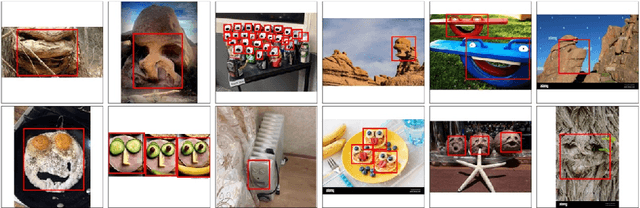

The human visual system is well-tuned to detect faces of all shapes and sizes. While this brings obvious survival advantages, such as a better chance of spotting unknown predators in the bush, it also leads to spurious face detections. ``Face pareidolia'' describes the perception of face-like structure among otherwise random stimuli: seeing faces in coffee stains or clouds in the sky. In this paper, we study face pareidolia from a computer vision perspective. We present an image dataset of ``Faces in Things'', consisting of five thousand web images with human-annotated pareidolic faces. Using this dataset, we examine the extent to which a state-of-the-art human face detector exhibits pareidolia, and find a significant behavioral gap between humans and machines. We find that the evolutionary need for humans to detect animal faces, as well as human faces, may explain some of this gap. Finally, we propose a simple statistical model of pareidolia in images. Through studies on human subjects and our pareidolic face detectors we confirm a key prediction of our model regarding what image conditions are most likely to induce pareidolia. Dataset and Website: https://aka.ms/faces-in-things