 Add to Chrome
 Add to Firefox
 Add to Edge
Tight Information Complexity of the Coin Problem in the Broadcast Model
Aug 03, 2026
We study distributed testing of $\mathrm{Ber}(α)$ versus $\mathrm{Ber}(β)$ in the broadcast, or shared-blackboard, model. For protocols with constant advantage, we characterise up to universal constant factors the information complexity under either hypothesis for every pair $β<α$. The characterisation shows that the two information costs can be quite different and identifies three parameter regimes, with optimal protocols based respectively on clean samples, a noisy binary symmetric channel, and an asymmetric $Z$-channel. The lower bounds rely on a novel mixed Hellinger--Jensen--Shannon inequality that may be of independent interest. We also characterise the constant-advantage information complexity of testing arbitrary discrete distributions via an optimisation problem over channels, and show that binary-output channels suffice. We obtain bounds for bounded likelihood-ratio distributions, and give general upper bounds in terms of $χ^2$ divergence. As applications, we recover the broadcast-model set-disjointness lower bound, and derive stronger lower bounds in the multi-pass streaming setting for some problems considered in prior work.

On the Sample Complexity of Robust Binary Hypothesis Testing
May 23, 2026We study the sample complexity of robust binary hypothesis testing under three standard contamination models: $\varepsilon$-additive (Huber), $\varepsilon$-subtractive, and $\varepsilon$-total variation (TV), denoted by $n^*_{\mathrm{Hub}}(\varepsilon)$, $n^*_{\mathrm{Sub}}(\varepsilon)$, and $n^*_{\mathrm{TV}}(\varepsilon)$, respectively. For subtractive contamination, we show that least favourable distributions exist and provide explicit formulas for the same, bringing this model in line with the classical Huber and TV models. Next we show that in all three models, sample complexity may be highly unstable in the contamination parameter $\varepsilon$, increasing by polynomial factors even for $o(\varepsilon)$ perturbations. Similarly, there may be polynomial factor gaps between the sample complexities when $\varepsilon$ is known exactly versus when it is known up to $o(\varepsilon)$ error. Despite the instability of the sample complexity in all models, we show that the sample complexities across models are comparable up to constant-factor rescaling of $\varepsilon$. Specifically, for any fixed $δ_0>0$, the following hold for all distributions $p$ and $q$: (i) $n^*_{\mathrm{Hub}}(\varepsilon) \lesssim n^*_{\mathrm{TV}}(\varepsilon) \lesssim n^*_{\mathrm{Hub}}(2\varepsilon)$, (ii) $n^*_{\mathrm{Sub}}(\varepsilon) \lesssim n^*_{\mathrm{TV}}(\varepsilon) \lesssim n^*_{\mathrm{Sub}}((2+δ_0)\varepsilon)$, and (iii) $n^*_{\mathrm{Sub}}(\varepsilon) \lesssim n^*_{\mathrm{Hub}}(\varepsilon) \lesssim n^*_{\mathrm{Sub}}((1+δ_0)\varepsilon)$, and the scaling constants are tight. Finally, we extend our results to adaptive versions of the contamination models.
The Sample Complexity of Simple Binary Hypothesis Testing
Mar 25, 2024The sample complexity of simple binary hypothesis testing is the smallest number of i.i.d. samples required to distinguish between two distributions $p$ and $q$ in either: (i) the prior-free setting, with type-I error at most $\alpha$ and type-II error at most $\beta$; or (ii) the Bayesian setting, with Bayes error at most $\delta$ and prior distribution $(\alpha, 1-\alpha)$. This problem has only been studied when $\alpha = \beta$ (prior-free) or $\alpha = 1/2$ (Bayesian), and the sample complexity is known to be characterized by the Hellinger divergence between $p$ and $q$, up to multiplicative constants. In this paper, we derive a formula that characterizes the sample complexity (up to multiplicative constants that are independent of $p$, $q$, and all error parameters) for: (i) all $0 \le \alpha, \beta \le 1/8$ in the prior-free setting; and (ii) all $\delta \le \alpha/4$ in the Bayesian setting. In particular, the formula admits equivalent expressions in terms of certain divergences from the Jensen--Shannon and Hellinger families. The main technical result concerns an $f$-divergence inequality between members of the Jensen--Shannon and Hellinger families, which is proved by a combination of information-theoretic tools and case-by-case analyses. We explore applications of our results to robust and distributed (locally-private and communication-constrained) hypothesis testing.
Simple Binary Hypothesis Testing under Local Differential Privacy and Communication Constraints
Jan 09, 2023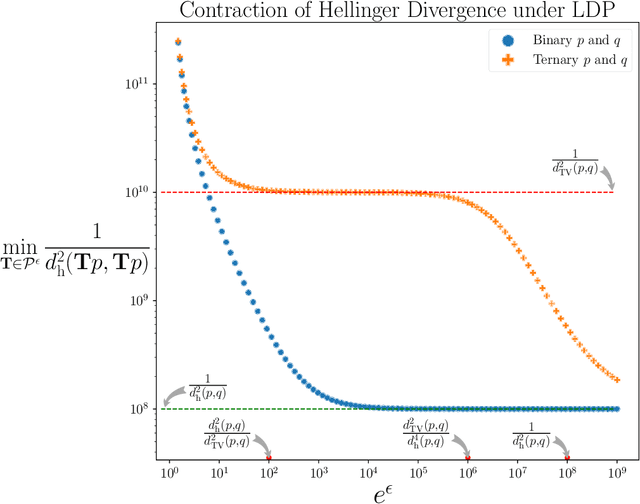
We study simple binary hypothesis testing under both local differential privacy (LDP) and communication constraints. We qualify our results as either minimax optimal or instance optimal: the former hold for the set of distribution pairs with prescribed Hellinger divergence and total variation distance, whereas the latter hold for specific distribution pairs. For the sample complexity of simple hypothesis testing under pure LDP constraints, we establish instance-optimal bounds for distributions with binary support; minimax-optimal bounds for general distributions; and (approximately) instance-optimal, computationally efficient algorithms for general distributions. When both privacy and communication constraints are present, we develop instance-optimal, computationally efficient algorithms that achieve the minimum possible sample complexity (up to universal constants). Our results on instance-optimal algorithms hinge on identifying the extreme points of the joint range set $\mathcal A$ of two distributions $p$ and $q$, defined as $\mathcal A := \{(\mathbf T p, \mathbf T q) | \mathbf T \in \mathcal C\}$, where $\mathcal C$ is the set of channels characterizing the constraints.
Communication-constrained hypothesis testing: Optimality, robustness, and reverse data processing inequalities
Jun 06, 2022We study hypothesis testing under communication constraints, where each sample is quantized before being revealed to a statistician. Without communication constraints, it is well known that the sample complexity of simple binary hypothesis testing is characterized by the Hellinger distance between the distributions. We show that the sample complexity of simple binary hypothesis testing under communication constraints is at most a logarithmic factor larger than in the unconstrained setting and this bound is tight. We develop a polynomial-time algorithm that achieves the aforementioned sample complexity. Our framework extends to robust hypothesis testing, where the distributions are corrupted in the total variation distance. Our proofs rely on a new reverse data processing inequality and a reverse Markov inequality, which may be of independent interest. For simple $M$-ary hypothesis testing, the sample complexity in the absence of communication constraints has a logarithmic dependence on $M$. We show that communication constraints can cause an exponential blow-up leading to $\Omega(M)$ sample complexity even for adaptive algorithms.
The Many Faces of Adversarial Risk
Jan 22, 2022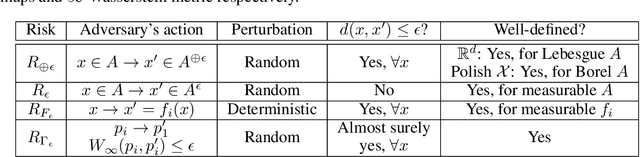
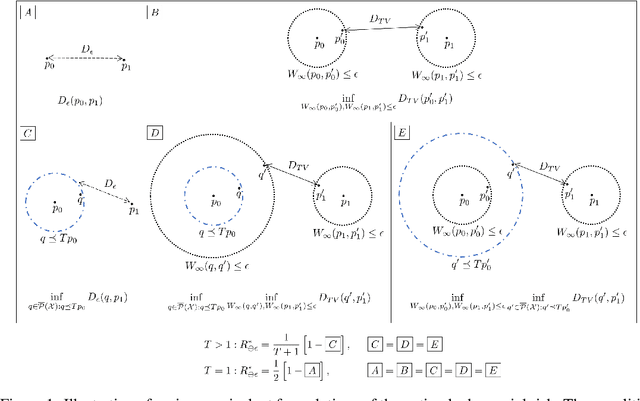

Adversarial risk quantifies the performance of classifiers on adversarially perturbed data. Numerous definitions of adversarial risk -- not all mathematically rigorous and differing subtly in the details -- have appeared in the literature. In this paper, we revisit these definitions, make them rigorous, and critically examine their similarities and differences. Our technical tools derive from optimal transport, robust statistics, functional analysis, and game theory. Our contributions include the following: generalizing Strassen's theorem to the unbalanced optimal transport setting with applications to adversarial classification with unequal priors; showing an equivalence between adversarial robustness and robust hypothesis testing with $\infty$-Wasserstein uncertainty sets; proving the existence of a pure Nash equilibrium in the two-player game between the adversary and the algorithm; and characterizing adversarial risk by the minimum Bayes error between a pair of distributions belonging to the $\infty$-Wasserstein uncertainty sets. Our results generalize and deepen recently discovered connections between optimal transport and adversarial robustness and reveal new connections to Choquet capacities and game theory.
Robust regression with covariate filtering: Heavy tails and adversarial contamination
Sep 27, 2020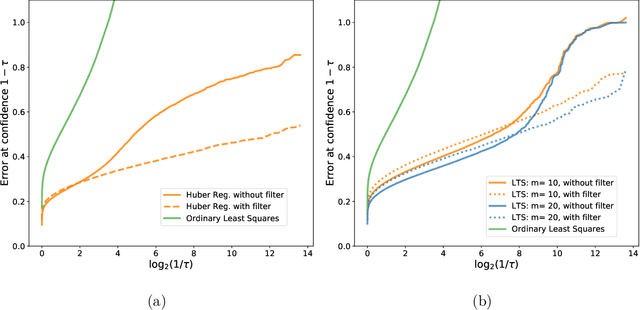
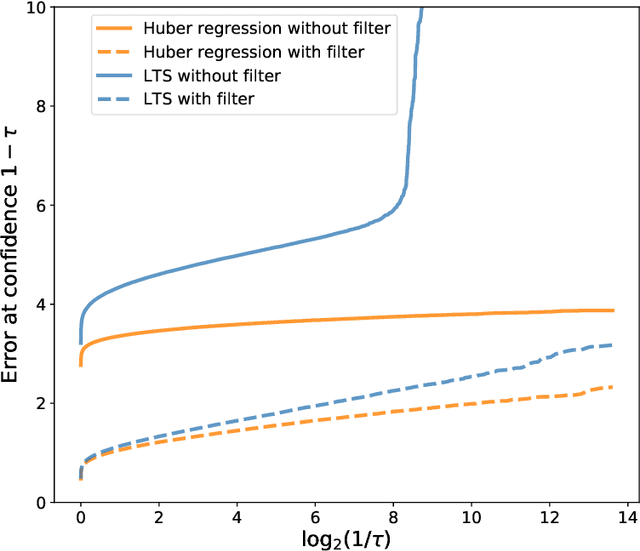
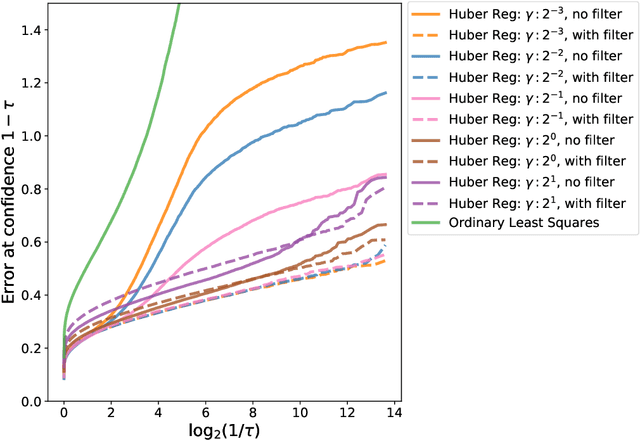
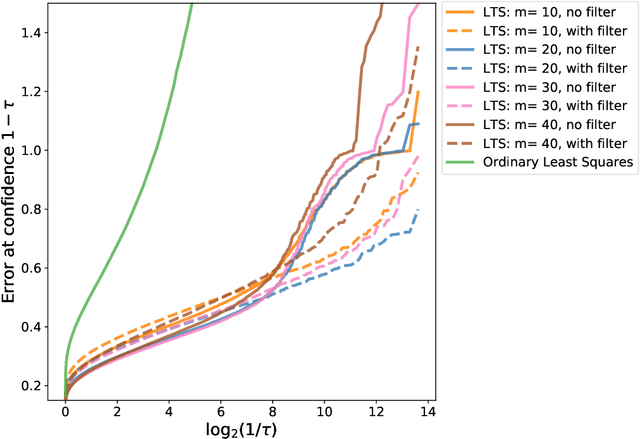
We study the problem of linear regression where both covariates and responses are potentially (i) heavy-tailed and (ii) adversarially contaminated. Several computationally efficient estimators have been proposed for the simpler setting where the covariates are sub-Gaussian and uncontaminated; however, these estimators may fail when the covariates are either heavy-tailed or contain outliers. In this work, we show how to modify the Huber regression, least trimmed squares, and least absolute deviation estimators to obtain estimators which are simultaneously computationally and statistically efficient in the stronger contamination model. Our approach is quite simple, and consists of applying a filtering algorithm to the covariates, and then applying the classical robust regression estimators to the remaining data. We show that the Huber regression estimator achieves near-optimal error rates in this setting, whereas the least trimmed squares and least absolute deviation estimators can be made to achieve near-optimal error after applying a postprocessing step.
Reverse Lebesgue and Gaussian isoperimetric inequalities for parallel sets with applications
Jun 16, 2020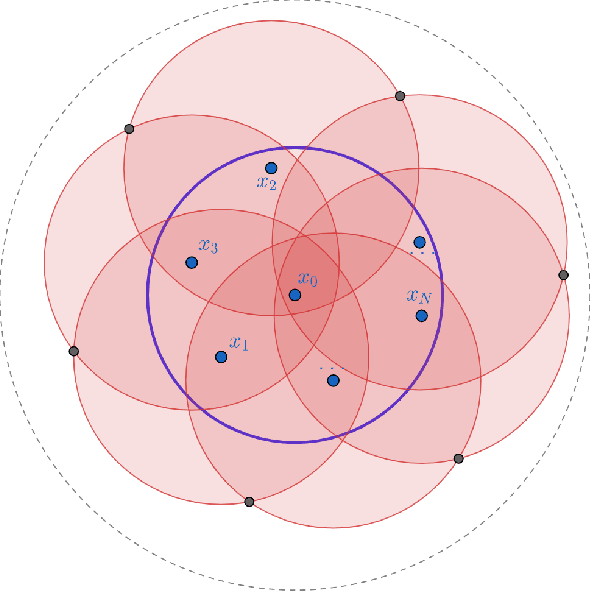
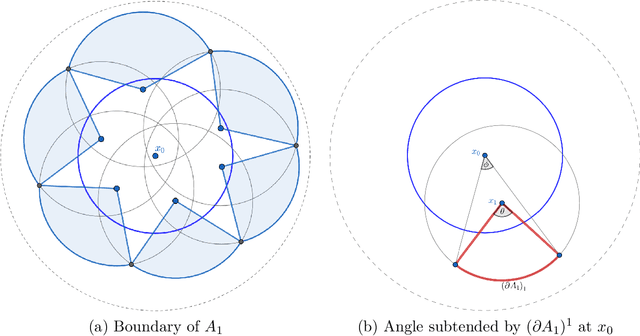
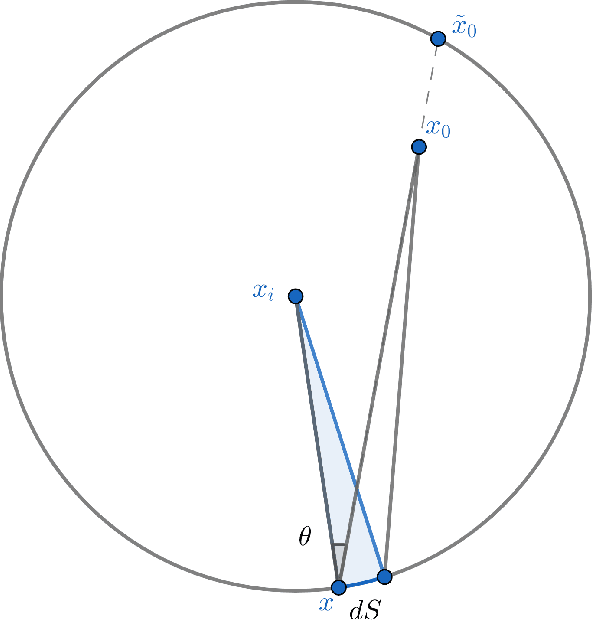
The $r$-parallel set of a measurable set $A \subseteq \mathbb R^d$ is the set of all points whose distance from $A$ is at most $r$. In this paper, we show that the surface area of an $r$-parallel set in $\mathbb R^d$ with volume at most $V$ is upper-bounded by $e^{\Theta(d)}V/r$. We also show that the Gaussian surface area of any $r$-parallel set in $\mathbb R^d$ is upper-bounded by $\max(e^{\Theta(d)}, e^{\Theta(d)}/r)$. We apply our results to two problems in theoretical machine learning: (1) bounding the computational complexity of learning $r$-parallel sets under a Gaussian distribution; and (2) bounding the sample complexity of estimating robust risk, which is a notion of risk in the adversarial machine learning literature that is analogous to the Bayes risk in hypothesis testing.
Adversarial Risk via Optimal Transport and Optimal Couplings
Dec 05, 2019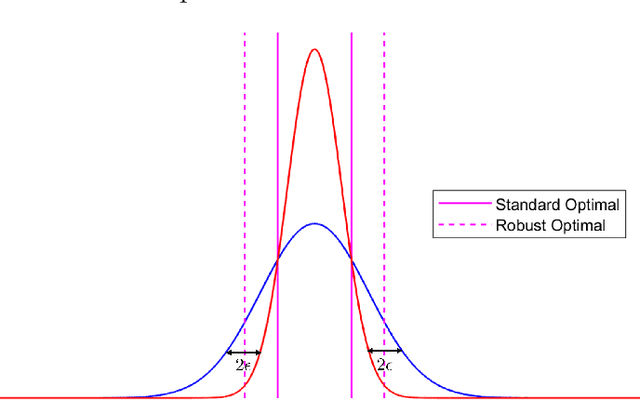
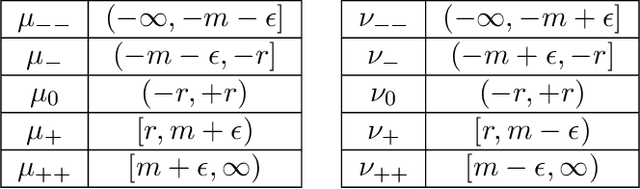
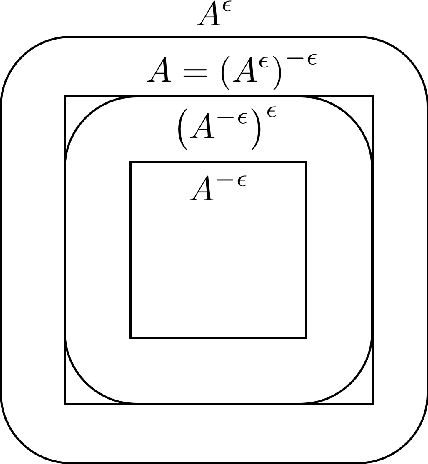
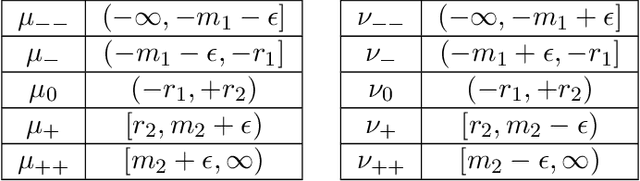
The accuracy of modern machine learning algorithms deteriorates severely on adversarially manipulated test data. Optimal adversarial risk quantifies the best error rate of any classifier in the presence of adversaries, and optimal adversarial classifiers are sought that minimize adversarial risk. In this paper, we investigate the optimal adversarial risk and optimal adversarial classifiers from an optimal transport perspective. We present a new and simple approach to show that the optimal adversarial risk for binary classification with $0-1$ loss function is completely characterized by an optimal transport cost between the probability distributions of the two classes, for a suitably defined cost function. We propose a novel coupling strategy that achieves the optimal transport cost for several univariate distributions like Gaussian, uniform and triangular. Using the optimal couplings, we obtain the optimal adversarial classifiers in these settings and show how they differ from optimal classifiers in the absence of adversaries. Based on our analysis, we evaluate algorithm-independent fundamental limits on adversarial risk for CIFAR-10, MNIST, Fashion-MNIST and SVHN datasets, and Gaussian mixtures based on them. In addition to the $0-1$ loss, we also derive bounds on the deviation of optimal risk and optimal classifier in the presence of adversaries for continuous loss functions, that are based on the convexity and smoothness of the loss functions.
Extracting robust and accurate features via a robust information bottleneck
Oct 15, 2019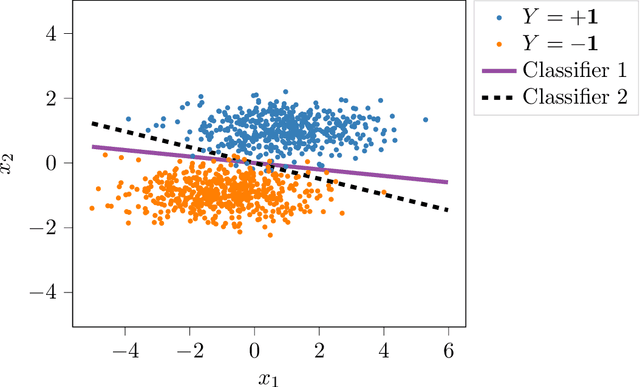
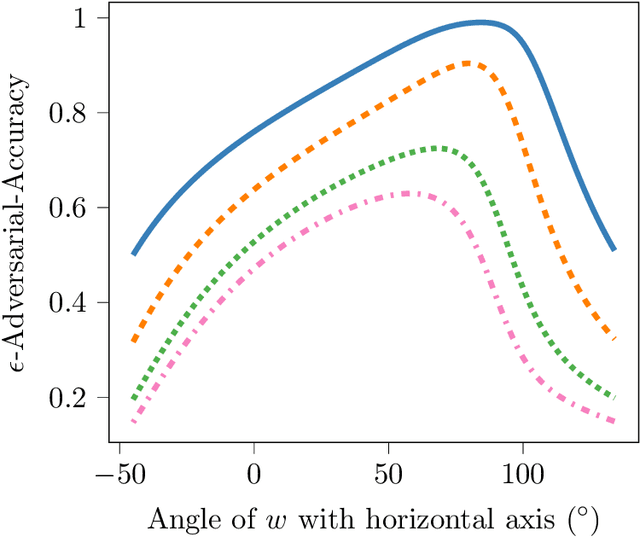
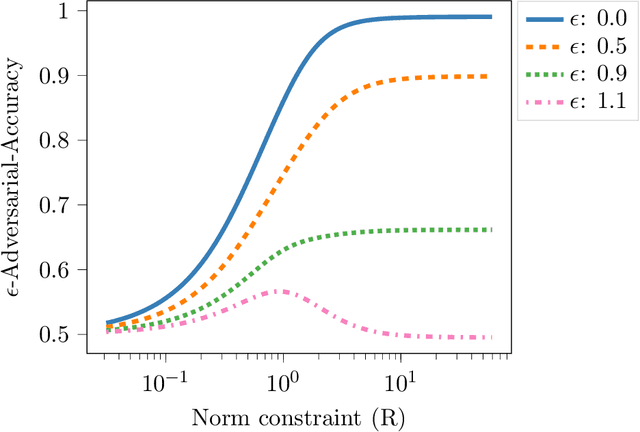
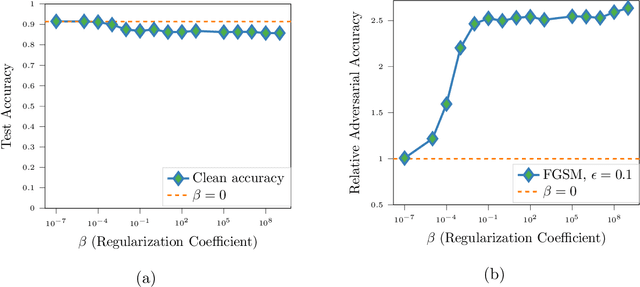
We propose a novel strategy for extracting features in supervised learning that can be used to construct a classifier which is more robust to small perturbations in the input space. Our method builds upon the idea of the information bottleneck by introducing an additional penalty term that encourages the Fisher information of the extracted features to be small, when parametrized by the inputs. By tuning the regularization parameter, we can explicitly trade off the opposing desiderata of robustness and accuracy when constructing a classifier. We derive the optimal solution to the robust information bottleneck when the inputs and outputs are jointly Gaussian, proving that the optimally robust features are also jointly Gaussian in that setting. Furthermore, we propose a method for optimizing a variational bound on the robust information bottleneck objective in general settings using stochastic gradient descent, which may be implemented efficiently in neural networks. Our experimental results for synthetic and real data sets show that the proposed feature extraction method indeed produces classifiers with increased robustness to perturbations.