 Add to Chrome
 Add to Firefox
 Add to Edge
Inferring Height from Earth Embeddings: First insights using Google AlphaEarth
Feb 19, 2026
This study investigates whether the geospatial and multimodal features encoded in \textit{Earth Embeddings} can effectively guide deep learning (DL) regression models for regional surface height mapping. In particular, we focused on AlphaEarth Embeddings at 10 m spatial resolution and evaluated their capability to support terrain height inference using a high-quality Digital Surface Model (DSM) as reference. U-Net and U-Net++ architectures were thus employed as lightweight convolutional decoders to assess how well the geospatial information distilled in the embeddings can be translated into accurate surface height estimates. Both architectures achieved strong training performance (both with $R^2 = 0.97$), confirming that the embeddings encode informative and decodable height-related signals. On the test set, performance decreased due to distribution shifts in height frequency between training and testing areas. Nevertheless, U-Net++ shows better generalization ($R^2 = 0.84$, median difference = -2.62 m) compared with the standard U-Net ($R^2 = 0.78$, median difference = -7.22 m), suggesting enhanced robustness to distribution mismatch. While the testing RMSE (approximately 16 m for U-Net++) and residual bias highlight remaining challenges in generalization, strong correlations indicate that the embeddings capture transferable topographic patterns. Overall, the results demonstrate the promising potential of AlphaEarth Embeddings to guide DL-based height mapping workflows, particularly when combined with spatially aware convolutional architectures, while emphasizing the need to address bias for improved regional transferability.

TACK Tunnel Data (TTD): A Benchmark Dataset for Deep Learning-Based Defect Detection in Tunnels
Dec 16, 2025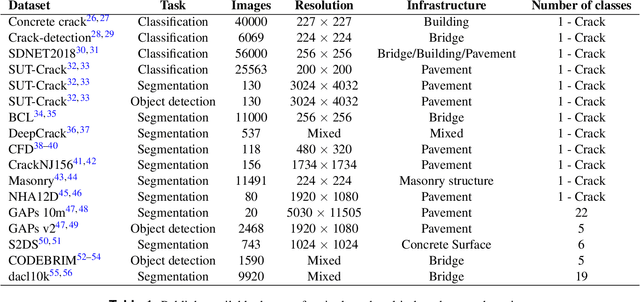
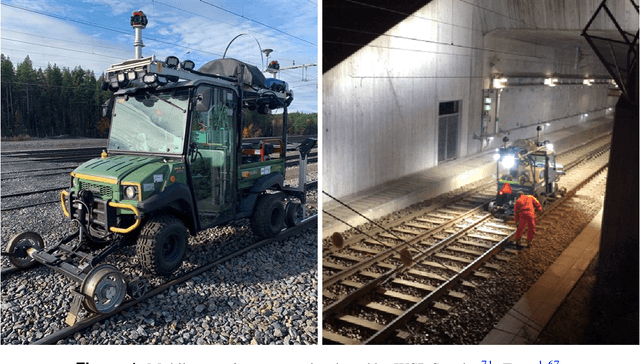
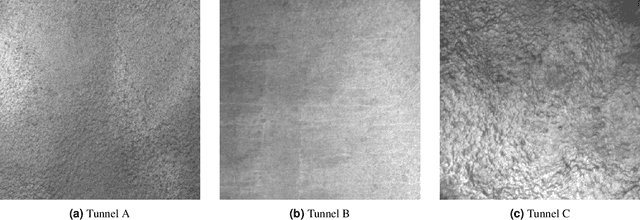

Tunnels are essential elements of transportation infrastructure, but are increasingly affected by ageing and deterioration mechanisms such as cracking. Regular inspections are required to ensure their safety, yet traditional manual procedures are time-consuming, subjective, and costly. Recent advances in mobile mapping systems and Deep Learning (DL) enable automated visual inspections. However, their effectiveness is limited by the scarcity of tunnel datasets. This paper introduces a new publicly available dataset containing annotated images of three different tunnel linings, capturing typical defects: cracks, leaching, and water infiltration. The dataset is designed to support supervised, semi-supervised, and unsupervised DL methods for defect detection and segmentation. Its diversity in texture and construction techniques also enables investigation of model generalization and transferability across tunnel types. By addressing the critical lack of domain-specific data, this dataset contributes to advancing automated tunnel inspection and promoting safer, more efficient infrastructure maintenance strategies.