 Add to Chrome
 Add to Firefox
 Add to Edge
Interpretable Quantile Regression by Optimal Decision Trees
Apr 22, 2026
The field of machine learning is subject to an increasing interest in models that are not only accurate but also interpretable and robust, thus allowing their end users to understand and trust AI systems. This paper presents a novel method for learning a set of optimal quantile regression trees. The advantages of this method are that (1) it provides predictions about the complete conditional distribution of a target variable without prior assumptions on this distribution; (2) it provides predictions that are interpretable; (3) it learns a set of optimal quantile regression trees without compromising algorithmic efficiency compared to learning a single tree.

SANGEA: Scalable and Attributed Network Generation
Sep 27, 2023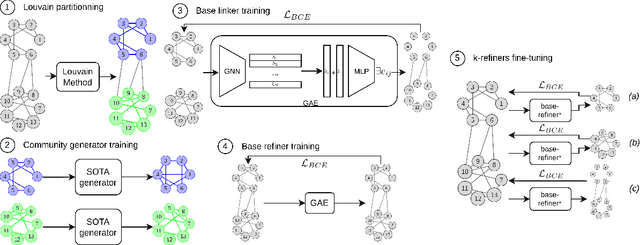
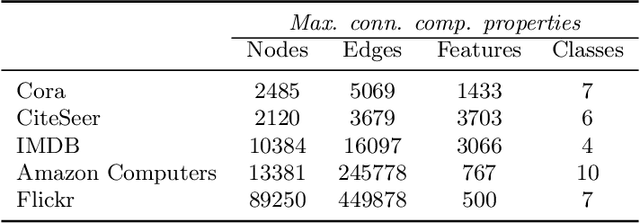
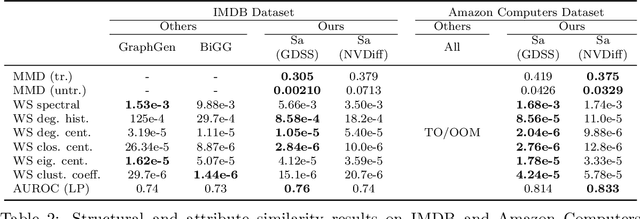
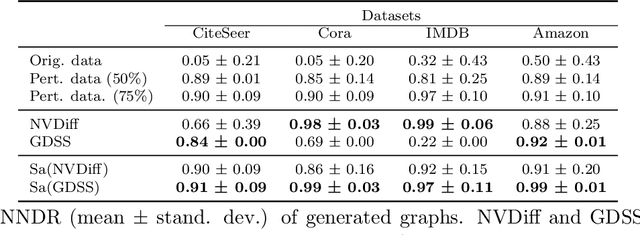
The topic of synthetic graph generators (SGGs) has recently received much attention due to the wave of the latest breakthroughs in generative modelling. However, many state-of-the-art SGGs do not scale well with the graph size. Indeed, in the generation process, all the possible edges for a fixed number of nodes must often be considered, which scales in $\mathcal{O}(N^2)$, with $N$ being the number of nodes in the graph. For this reason, many state-of-the-art SGGs are not applicable to large graphs. In this paper, we present SANGEA, a sizeable synthetic graph generation framework which extends the applicability of any SGG to large graphs. By first splitting the large graph into communities, SANGEA trains one SGG per community, then links the community graphs back together to create a synthetic large graph. Our experiments show that the graphs generated by SANGEA have high similarity to the original graph, in terms of both topology and node feature distribution. Additionally, these generated graphs achieve high utility on downstream tasks such as link prediction. Finally, we provide a privacy assessment of the generated graphs to show that, even though they have excellent utility, they also achieve reasonable privacy scores.