 Add to Chrome
 Add to Firefox
 Add to Edge
Correcting Stochastic Update Bias in Preconditioned Language Model Optimizers
May 20, 2026
Preconditioned optimizers are central to language model training, but their stochastic update rules are usually treated as direct approximations to population preconditioned descent. We show that this view misses two finite-sample biases. First, the gradient and preconditioner are typically estimated from the same minibatch, introducing gradient--preconditioner coupling bias. Second, even when the preconditioner estimate is unbiased, its inverse or inverse-root is generally biased because inversion is nonlinear. We propose a single-batch bias-correction framework that addresses both effects: cross-fitted preconditioning estimates the numerator and preconditioner from independent microbatch groups, while variance-corrected inversion uses microbatch variability to subtract the leading delta-method bias term. The framework applies to diagonal moment, diagonal curvature, and matrix preconditioning methods, instantiated in AdamW, Sophia, and Shampoo. Bias correction reduces held-out pretraining loss on Qwen2.5-0.5B by $0.15$, $0.07$, and $0.11$ nats, respectively; the effects on mixed-quality pretraining and downstream instruction tuning are consistently neutral-to-positive. Together, these results establish bias correction as a practical mechanism for reducing finite-sample update bias and improving the performance of preconditioned optimizers.

GLiNER2-PII: A Multilingual Model for Personally Identifiable Information Extraction
May 11, 2026Reliable detection of personally identifiable information (PII) is increasingly important across modern data-processing systems, yet the task remains difficult: PII spans are heterogeneous, locale-dependent, context-sensitive, and often embedded in noisy or semi-structured documents. We present GLiNER2-PII, a small 0.3B-parameter model adapted from GLiNER2 and designed to recognize a broad taxonomy of 42 PII entity types at character-span resolution. Training such systems, however, is constrained by the scarcity of shareable annotated data and the privacy risks associated with collecting real PII at scale. To address this challenge, we construct a multilingual synthetic corpus of 4,910 annotated texts using a constraint-driven generation pipeline that produces diverse, realistic examples across languages, domains, formats, and entity distributions. On the challenging SPY benchmark, GLiNER2-PII achieves the highest span-level F1 among five compared systems, including OpenAI Privacy Filter and three GLiNER-based detectors. We publicly release the model on Hugging Face to support further research and practical deployment of open PII detection systems.
Pioneer Agent: Continual Improvement of Small Language Models in Production
Apr 10, 2026Small language models are attractive for production deployment due to their low cost, fast inference, and ease of specialization. However, adapting them to a specific task remains a challenging engineering loop, driven not by training itself but by surrounding decisions: data curation, failure diagnosis, regression avoidance, and iteration control. We present Pioneer Agent, a closed-loop system that automates this lifecycle. In cold-start mode, given only a natural-language task description, the agent acquires data, constructs evaluation sets, and iteratively trains models by jointly optimizing data, hyperparameters, and learning strategy. In production mode, given a deployed model with labeled failures, it diagnoses error patterns, constructs targeted training data, and retrains under explicit regression constraints. To evaluate this setting, we introduce AdaptFT-Bench, a benchmark of synthetic inference logs with progressively increasing noise, designed to test the full adaptation loop: diagnosis, curriculum synthesis, retraining, and verification. Across eight cold-start benchmarks spanning reasoning, math, code generation, summarization, and classification, Pioneer Agent improves over base models by 1.6-83.8 points. On AdaptFT-Bench, it improves or preserves performance in all seven scenarios, while naive retraining degrades by up to 43 points. On two production-style deployments built from public benchmark tasks, it raises intent classification from 84.9% to 99.3% and Entity F1 from 0.345 to 0.810. Beyond performance gains, the agent often discovers effective training strategies, including chain-of-thought supervision, task-specific optimization, and quality-focused data curation, purely from downstream feedback.
EnriCo: Enriched Representation and Globally Constrained Inference for Entity and Relation Extraction
Apr 18, 2024Joint entity and relation extraction plays a pivotal role in various applications, notably in the construction of knowledge graphs. Despite recent progress, existing approaches often fall short in two key aspects: richness of representation and coherence in output structure. These models often rely on handcrafted heuristics for computing entity and relation representations, potentially leading to loss of crucial information. Furthermore, they disregard task and/or dataset-specific constraints, resulting in output structures that lack coherence. In our work, we introduce EnriCo, which mitigates these shortcomings. Firstly, to foster rich and expressive representation, our model leverage attention mechanisms that allow both entities and relations to dynamically determine the pertinent information required for accurate extraction. Secondly, we introduce a series of decoding algorithms designed to infer the highest scoring solutions while adhering to task and dataset-specific constraints, thus promoting structured and coherent outputs. Our model demonstrates competitive performance compared to baselines when evaluated on Joint IE datasets.
GraphER: A Structure-aware Text-to-Graph Model for Entity and Relation Extraction
Apr 18, 2024Information extraction (IE) is an important task in Natural Language Processing (NLP), involving the extraction of named entities and their relationships from unstructured text. In this paper, we propose a novel approach to this task by formulating it as graph structure learning (GSL). By formulating IE as GSL, we enhance the model's ability to dynamically refine and optimize the graph structure during the extraction process. This formulation allows for better interaction and structure-informed decisions for entity and relation prediction, in contrast to previous models that have separate or untied predictions for these tasks. When compared against state-of-the-art baselines on joint entity and relation extraction benchmarks, our model, GraphER, achieves competitive results.
An Autoregressive Text-to-Graph Framework for Joint Entity and Relation Extraction
Jan 15, 2024In this paper, we propose a novel method for joint entity and relation extraction from unstructured text by framing it as a conditional sequence generation problem. In contrast to conventional generative information extraction models that are left-to-right token-level generators, our approach is \textit{span-based}. It generates a linearized graph where nodes represent text spans and edges represent relation triplets. Our method employs a transformer encoder-decoder architecture with pointing mechanism on a dynamic vocabulary of spans and relation types. Our model can capture the structural characteristics and boundaries of entities and relations through span representations while simultaneously grounding the generated output in the original text thanks to the pointing mechanism. Evaluation on benchmark datasets validates the effectiveness of our approach, demonstrating competitive results. Code is available at https://github.com/urchade/ATG.
Filtered Semi-Markov CRF
Nov 29, 2023
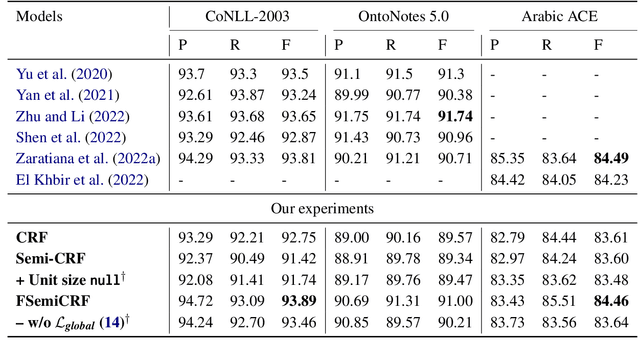
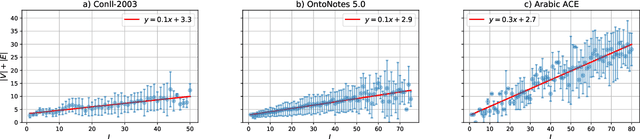
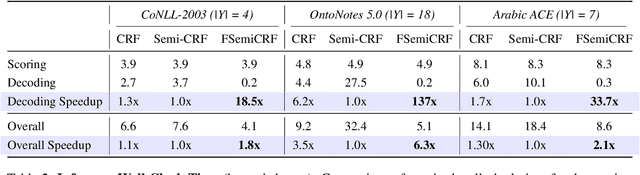
Semi-Markov CRF has been proposed as an alternative to the traditional Linear Chain CRF for text segmentation tasks such as Named Entity Recognition (NER). Unlike CRF, which treats text segmentation as token-level prediction, Semi-CRF considers segments as the basic unit, making it more expressive. However, Semi-CRF suffers from two major drawbacks: (1) quadratic complexity over sequence length, as it operates on every span of the input sequence, and (2) inferior performance compared to CRF for sequence labeling tasks like NER. In this paper, we introduce Filtered Semi-Markov CRF, a variant of Semi-CRF that addresses these issues by incorporating a filtering step to eliminate irrelevant segments, reducing complexity and search space. Our approach is evaluated on several NER benchmarks, where it outperforms both CRF and Semi-CRF while being significantly faster. The implementation of our method is available on \href{https://github.com/urchade/Filtered-Semi-Markov-CRF}{Github}.
GLiNER: Generalist Model for Named Entity Recognition using Bidirectional Transformer
Nov 14, 2023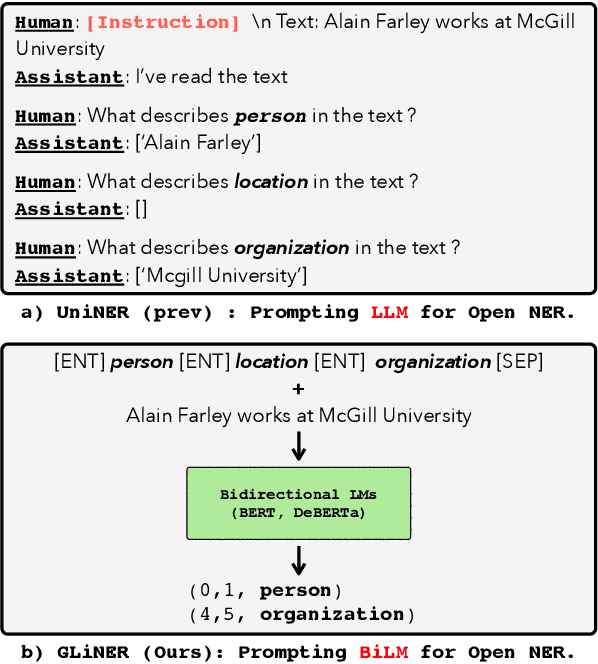
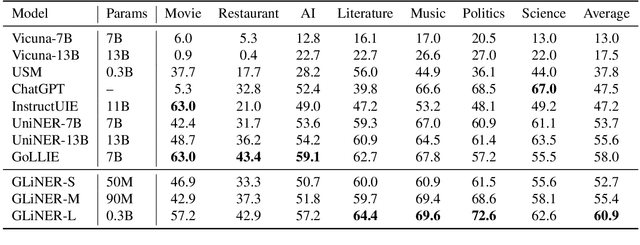
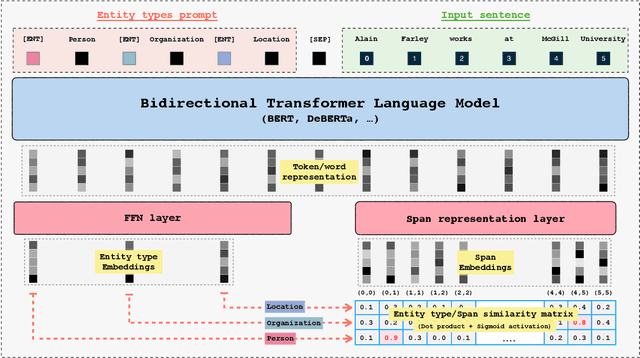
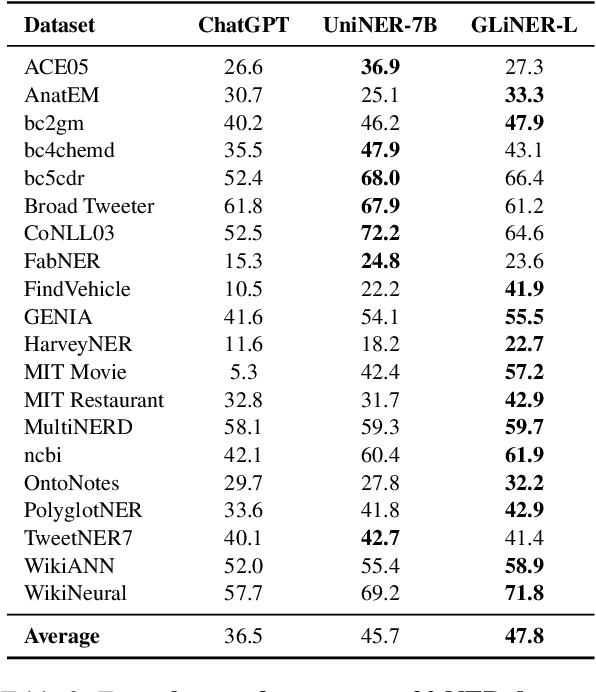
Named Entity Recognition (NER) is essential in various Natural Language Processing (NLP) applications. Traditional NER models are effective but limited to a set of predefined entity types. In contrast, Large Language Models (LLMs) can extract arbitrary entities through natural language instructions, offering greater flexibility. However, their size and cost, particularly for those accessed via APIs like ChatGPT, make them impractical in resource-limited scenarios. In this paper, we introduce a compact NER model trained to identify any type of entity. Leveraging a bidirectional transformer encoder, our model, GLiNER, facilitates parallel entity extraction, an advantage over the slow sequential token generation of LLMs. Through comprehensive testing, GLiNER demonstrate strong performance, outperforming both ChatGPT and fine-tuned LLMs in zero-shot evaluations on various NER benchmarks.
DyREx: Dynamic Query Representation for Extractive Question Answering
Oct 26, 2022Extractive question answering (ExQA) is an essential task for Natural Language Processing. The dominant approach to ExQA is one that represents the input sequence tokens (question and passage) with a pre-trained transformer, then uses two learned query vectors to compute distributions over the start and end answer span positions. These query vectors lack the context of the inputs, which can be a bottleneck for the model performance. To address this problem, we propose \textit{DyREx}, a generalization of the \textit{vanilla} approach where we dynamically compute query vectors given the input, using an attention mechanism through transformer layers. Empirical observations demonstrate that our approach consistently improves the performance over the standard one. The code and accompanying files for running the experiments are available at \url{https://github.com/urchade/DyReX}.
Hierarchical Transformer Model for Scientific Named Entity Recognition
Mar 28, 2022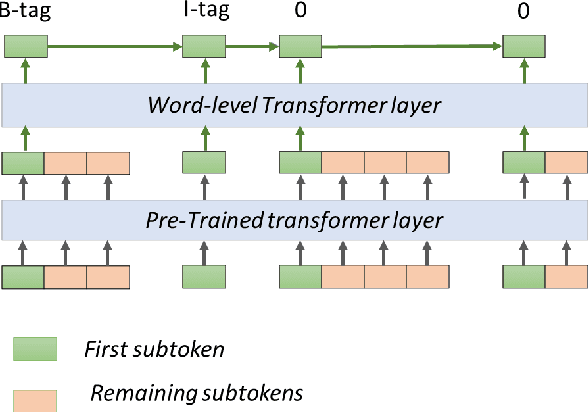
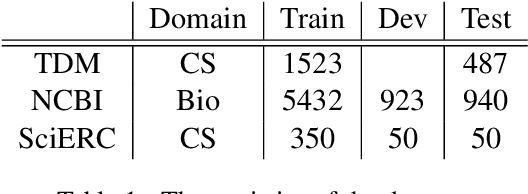
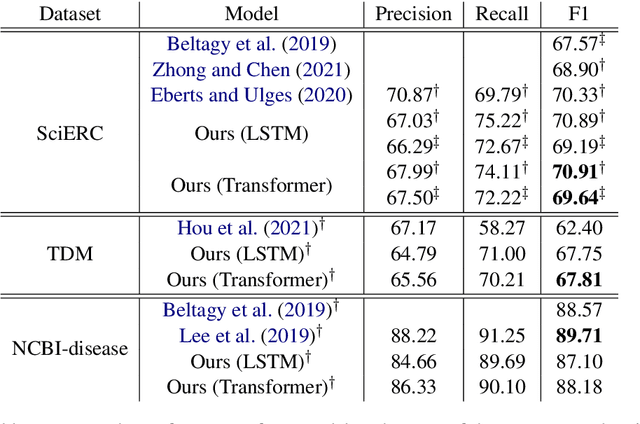
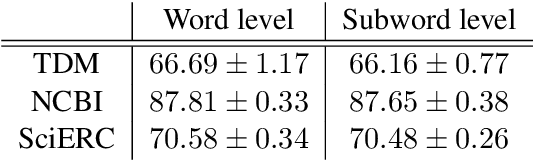
The task of Named Entity Recognition (NER) is an important component of many natural language processing systems, such as relation extraction and knowledge graph construction. In this work, we present a simple and effective approach for Named Entity Recognition. The main idea of our approach is to encode the input subword sequence with a pre-trained transformer such as BERT, and then, instead of directly classifying the word labels, another layer of transformer is added to the subword representation to better encode the word-level interaction. We evaluate our approach on three benchmark datasets for scientific NER, particularly in the computer science and biomedical domains. Experimental results show that our model outperforms the current state-of-the-art on SciERC and TDM datasets without requiring external resources or specific data augmentation. Code is available at \url{https://github.com/urchade/HNER}.