 Add to Chrome
 Add to Firefox
 Add to Edge
LLM Driven Design of Continuous Optimization Problems with Controllable High-level Properties
Jan 26, 2026
Benchmarking in continuous black-box optimisation is hindered by the limited structural diversity of existing test suites such as BBOB. We explore whether large language models embedded in an evolutionary loop can be used to design optimisation problems with clearly defined high-level landscape characteristics. Using the LLaMEA framework, we guide an LLM to generate problem code from natural-language descriptions of target properties, including multimodality, separability, basin-size homogeneity, search-space homogeneity and globallocal optima contrast. Inside the loop we score candidates through ELA-based property predictors. We introduce an ELA-space fitness-sharing mechanism that increases population diversity and steers the generator away from redundant landscapes. A complementary basin-of-attraction analysis, statistical testing and visual inspection, verifies that many of the generated functions indeed exhibit the intended structural traits. In addition, a t-SNE embedding shows that they expand the BBOB instance space rather than forming an unrelated cluster. The resulting library provides a broad, interpretable, and reproducible set of benchmark problems for landscape analysis and downstream tasks such as automated algorithm selection.

PS-AAS: Portfolio Selection for Automated Algorithm Selection in Black-Box Optimization
Oct 14, 2023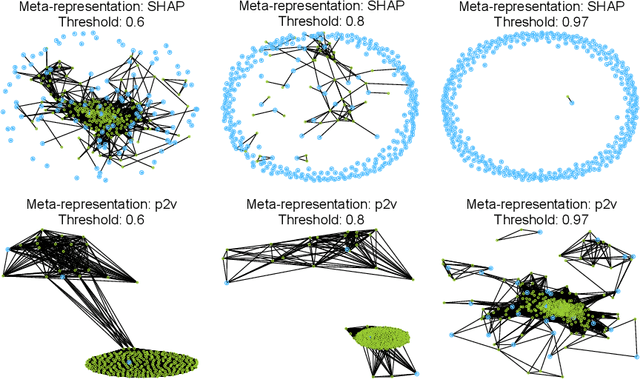


The performance of automated algorithm selection (AAS) strongly depends on the portfolio of algorithms to choose from. Selecting the portfolio is a non-trivial task that requires balancing the trade-off between the higher flexibility of large portfolios with the increased complexity of the AAS task. In practice, probably the most common way to choose the algorithms for the portfolio is a greedy selection of the algorithms that perform well in some reference tasks of interest. We set out in this work to investigate alternative, data-driven portfolio selection techniques. Our proposed method creates algorithm behavior meta-representations, constructs a graph from a set of algorithms based on their meta-representation similarity, and applies a graph algorithm to select a final portfolio of diverse, representative, and non-redundant algorithms. We evaluate two distinct meta-representation techniques (SHAP and performance2vec) for selecting complementary portfolios from a total of 324 different variants of CMA-ES for the task of optimizing the BBOB single-objective problems in dimensionalities 5 and 30 with different cut-off budgets. We test two types of portfolios: one related to overall algorithm behavior and the `personalized' one (related to algorithm behavior per each problem separately). We observe that the approach built on the performance2vec-based representations favors small portfolios with negligible error in the AAS task relative to the virtual best solver from the selected portfolio, whereas the portfolios built from the SHAP-based representations gain from higher flexibility at the cost of decreased performance of the AAS. Across most considered scenarios, personalized portfolios yield comparable or slightly better performance than the classical greedy approach. They outperform the full portfolio in all scenarios.