 Add to Chrome
 Add to Firefox
 Add to Edge
Quality Diversity for Reliable Data Driven Time-Use Optimization
Aug 05, 2026
The daily allocation of the finite 24-hour time budget is strongly associated with physical, mental, and cognitive health. While predictive models can estimate the relationship between time-use compositions and health outcomes such as body mass index, life satisfaction, and cognition, most optimization approaches focus only on maximizing expected benefit and do not consider the uncertainty inherent in data-driven prediction. Ignoring uncertainty in health-related decisions can lead to unrealistic time-use recommendations. To address this gap, we introduce an uncertainty quantification Quality Diversity (QD) framework for a more reliable time-use recommendation. Objective functions are derived using compositional data analysis using a large child cohort dataset n > 1000, to capture the relationship between daily activity compositions and multiple health indicators. We develop a new approach that incorporates predictive uncertainty into QD processes and produces more reliable recommendations that balance the expected health benefits with the confidence of the model. We explore the solution space through variable-based and objective-based behavioral representations, revealing diverse high-quality time-use composition and explicit relationships between health outcomes under uncertainty. By embedding uncertainty directly into optimization, our framework shifts the time-use recommendations toward regions of lower uncertainty while preserving high-quality structures for more reliable decision-making in behavioral health.

Evolutionary Time-Use Optimization for Improving Children's Health Outcomes
Jun 23, 2022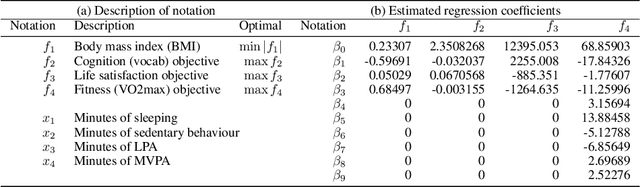
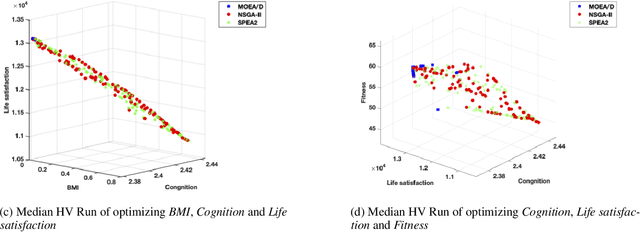
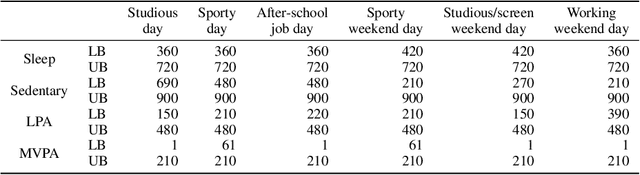
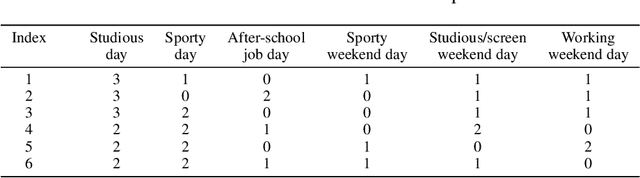
How someone allocates their time is important to their health and well-being. In this paper, we show how evolutionary algorithms can be used to promote health and well-being by optimizing time usage. Based on data from a large population-based child cohort, we design fitness functions to explain health outcomes and introduce constraints for viable time plans. We then investigate the performance of evolutionary algorithms to optimize time use for four individual health outcomes with hypothetical children with different day structures. As the four health outcomes are competing for time allocations, we study how to optimize multiple health outcomes simultaneously in the form of a multi-objective optimization problem. We optimize one-week time-use plans using evolutionary multi-objective algorithms and point out the trade-offs achievable with respect to different health outcomes.