 Add to Chrome
 Add to Firefox
 Add to Edge
Clarifying Shampoo: Adapting Spectral Descent to Stochasticity and the Parameter Trajectory
Feb 10, 2026
Optimizers leveraging the matrix structure in neural networks, such as Shampoo and Muon, are more data-efficient than element-wise algorithms like Adam and Signum. While in specific settings, Shampoo and Muon reduce to spectral descent analogous to how Adam and Signum reduce to sign descent, their general relationship and relative data efficiency under controlled settings remain unclear. Through extensive experiments on language models, we demonstrate that Shampoo achieves higher token efficiency than Muon, mirroring Adam's advantage over Signum. We show that Shampoo's update applied to weight matrices can be decomposed into an adapted Muon update. Consistent with this, Shampoo's benefits can be exclusively attributed to its application to weight matrices, challenging interpretations agnostic to parameter shapes. This admits a new perspective that also avoids shortcomings of related interpretations based on variance adaptation and whitening: rather than enforcing semi-orthogonality as in spectral descent, Shampoo's updates are time-averaged semi-orthogonal in expectation.

A Distributed Data-Parallel PyTorch Implementation of the Distributed Shampoo Optimizer for Training Neural Networks At-Scale
Sep 12, 2023
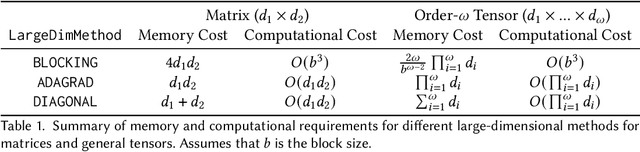


Shampoo is an online and stochastic optimization algorithm belonging to the AdaGrad family of methods for training neural networks. It constructs a block-diagonal preconditioner where each block consists of a coarse Kronecker product approximation to full-matrix AdaGrad for each parameter of the neural network. In this work, we provide a complete description of the algorithm as well as the performance optimizations that our implementation leverages to train deep networks at-scale in PyTorch. Our implementation enables fast multi-GPU distributed data-parallel training by distributing the memory and computation associated with blocks of each parameter via PyTorch's DTensor data structure and performing an AllGather primitive on the computed search directions at each iteration. This major performance enhancement enables us to achieve at most a 10% performance reduction in per-step wall-clock time compared against standard diagonal-scaling-based adaptive gradient methods. We validate our implementation by performing an ablation study on training ImageNet ResNet50, demonstrating Shampoo's superiority over standard training recipes with minimal hyperparameter tuning.