 Add to Chrome
 Add to Firefox
 Add to Edge
Regime Mapping of Oscillatory States in Balanced Spiking Networks with Multiple Time Scales
Apr 06, 2026
Balanced spiking networks can transition between silent, asynchronous-irregular, and oscillatory states depending on interacting synaptic and temporal time scales, while their joint parameter structure remains incompletely characterized. In this work, we systematically map how postsynaptic decay (τs), conduction delay (d), and plasticity rate (λp) jointly shape oscillatory regimes in recurrent leaky integrate-and-fire networks. By combining Brian2 simulations across the (τs, d, λp) space with a coarse Hopf-reference boundary, we construct regime maps that directly visualize SIL-AI-OSC transitions and corresponding spectral prominence landscapes. The mapped results show that increasing λp expands oscillatory regions toward shorter τs and moderate-to-long delays, while prominence maps identify parameter regions with the strongest rhythmic coherence. Representative control experiments further connect this global landscape to local rhythm-forming mechanisms, showing that STDP freezing weakens rhythmic coherence whereas delay jitter enhances it with minimal change in mean firing rate. As a result, these findings provide a useful reference for operating-point selection, synchrony modulation studies, and future biologically grounded spiking-network modeling within similar balanced-network settings.

BiTrackGAN: Cascaded CycleGANs to Constraint Face Aging
Apr 22, 2023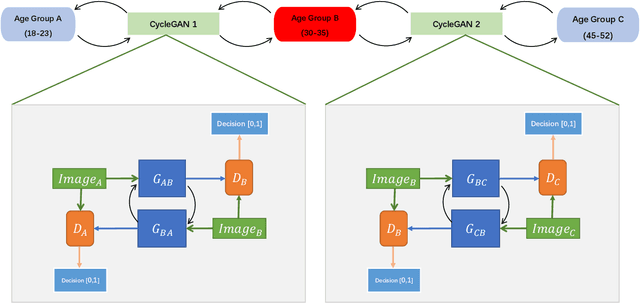
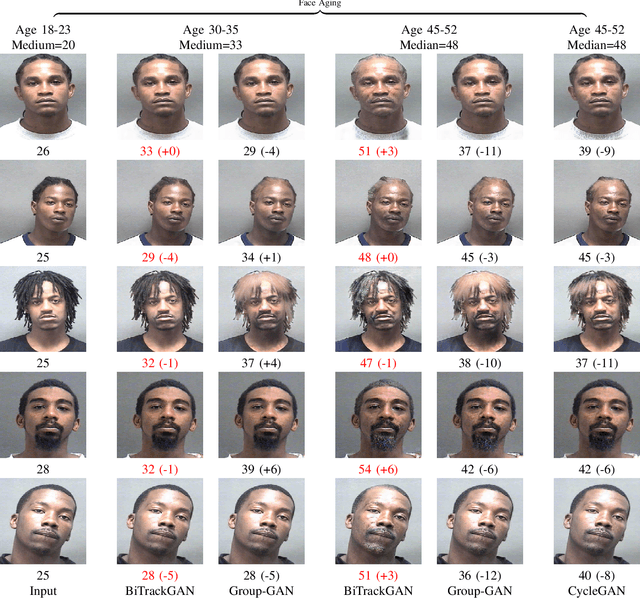
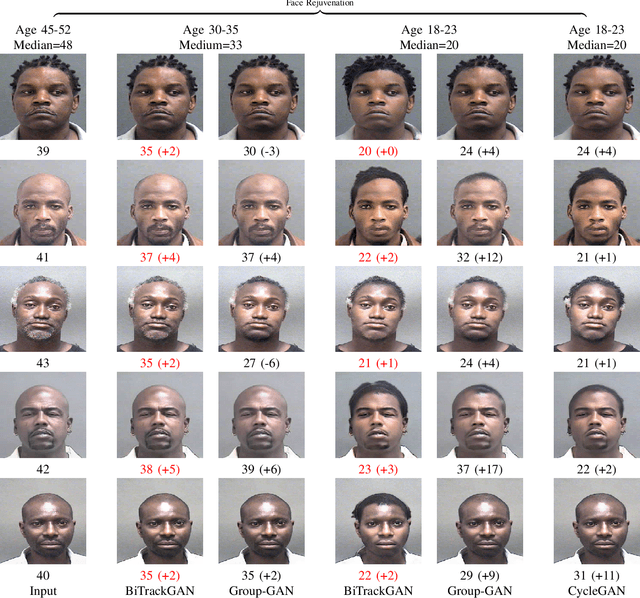
With the increased accuracy of modern computer vision technology, many access control systems are equipped with face recognition functions for faster identification. In order to maintain high recognition accuracy, it is necessary to keep the face database up-to-date. However, it is impractical to collect the latest facial picture of the system's user through human effort. Thus, we propose a bottom-up training method for our proposed network to address this challenge. Essentially, our proposed network is a translation pipeline that cascades two CycleGAN blocks (a widely used unpaired image-to-image translation generative adversarial network) called BiTrackGAN. By bottom-up training, it induces an ideal intermediate state between these two CycleGAN blocks, namely the constraint mechanism. Experimental results show that BiTrackGAN achieves more reasonable and diverse cross-age facial synthesis than other CycleGAN-related methods. As far as we know, it is a novel and effective constraint mechanism for more reason and accurate aging synthesis through the CycleGAN approach.