 Add to Chrome
 Add to Firefox
 Add to Edge
Non-negative Elastic Net Decoding for Information Retrieval
Jun 16, 2026
Dense retrieval has become the dominant paradigm in information retrieval, in which each document is scored against a query by the inner product of their vector embeddings, and the top-$k$ documents by score are retrieved for this query. However, since each document's score depends solely on the embedding of the query and itself, the retrieval process is oblivious to the content of the entire corpus. Therefore, dense retrieval cannot avoid selecting semantically similar documents from the corpus, which may result in a non-diverse, redundant set of retrieved documents. To this end, we approach retrieval as a joint decoding problem, in which documents are selected as a set with regard to the context of the rest of the corpus. To achieve this, we propose Non-Negative elastic Net (NNN) decoding, which selects documents whose embeddings jointly reconstruct the query embedding as a sparse non-negative linear combination. Our main theoretical result establishes a strict separation between dense retrieval and NNN decoding. For any corpus, every query correctly handled by dense retrieval is also handled by NNN decoding, while on corpora containing correlated documents, NNN decoding additionally handles queries that dense retrieval cannot. Experimental results indicate that applying NNN decoding to frozen embeddings trained for inner-product scoring yields consistent improvements across several benchmarks. Moreover, we introduce an end-to-end training procedure which optimizes the embeddings for NNN decoding, producing significant performance gains surpassing in all metrics and benchmarks compared to dense retrieval. Our work establishes a new paradigm for leveraging dense embeddings in information retrieval, beyond the standard practice of inner-product scoring.

What Limits Does Quantization Place on Dense Top-$k$ Retrieval? A Theoretical Study
Jun 10, 2026We establish conditions for embedding a corpus of $N$ documents as $d$-dimensional vectors such that every $k$-subset $S \subseteq [N]$ is realizable as a result of top-$k$ retrieval by some query vector. Recent work shows that $d = O(k)$ suffices for such embeddings to exist in $\mathbb{R}^d$, independently of $N$. We theoretically prove that this corpus-independent bound is specific to infinite precision. With $B$ bits per coordinate, perfect top-$k$ retrieval requires $Bd = Ω(k \ln N)$; thus, at any fixed precision, the dimension must grow at least logarithmically with $N$. Specializing to a $\ell_2$-normalized $B$-bit uniform scalar quantization model, we also identify a threshold on the precision $B^{*} = O(\ln \ln N)$ below which no dimension suffices, together with two further regimes that bound the feasible $(B, d)$ pairs. Our result implies that in practical vector databases and dense retrieval systems where quantization is standard, the embedding dimension and possibly the precision must grow with the corpus size.
Test-Time Alignment of LLMs via Sampling-Based Optimal Control in pre-logit space
Oct 30, 2025Test-time alignment of large language models (LLMs) attracts attention because fine-tuning LLMs requires high computational costs. In this paper, we propose a new test-time alignment method called adaptive importance sampling on pre-logits (AISP) on the basis of the sampling-based model predictive control with the stochastic control input. AISP applies the Gaussian perturbation into pre-logits, which are outputs of the penultimate layer, so as to maximize expected rewards with respect to the mean of the perturbation. We demonstrate that the optimal mean is obtained by importance sampling with sampled rewards. AISP outperforms best-of-n sampling in terms of rewards over the number of used samples and achieves higher rewards than other reward-based test-time alignment methods.
Empirical Bayes Estimation for Lasso-Type Regularizers: Analysis of Automatic Relevance Determination
Jan 20, 2025This paper focuses on linear regression models with non-conjugate sparsity-inducing regularizers such as lasso and group lasso. Although empirical Bayes approach enables us to estimate the regularization parameter, little is known on the properties of the estimators. In particular, there are many unexplained aspects regarding the specific conditions under which the mechanism of automatic relevance determination (ARD) occurs. In this paper, we derive the empirical Bayes estimators for the group lasso regularized linear regression models with a limited number of parameters. It is shown that the estimators diverge under a certain condition, giving rise to the ARD mechanism. We also prove that empirical Bayes methods can produce ARD mechanism in general regularized linear regression models and clarify the conditions under which models such as ridge, lasso, and group lasso can produce ARD mechanism.
Evaluating Time-Series Training Dataset through Lens of Spectrum in Deep State Space Models
Aug 29, 2024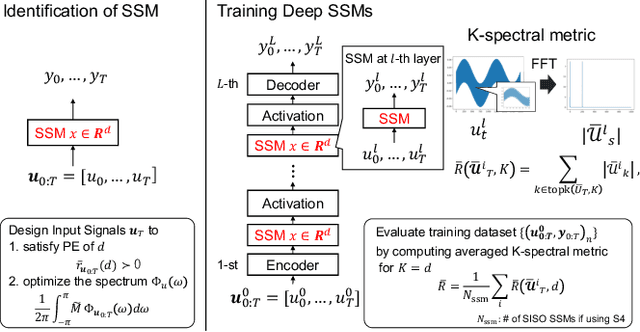
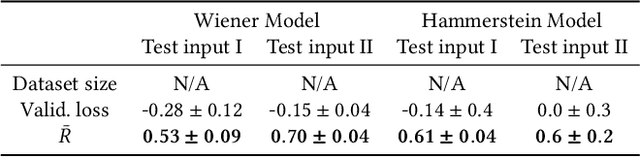
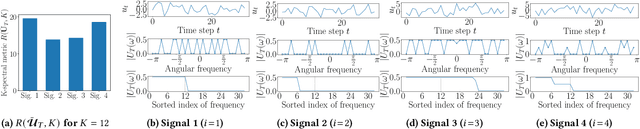
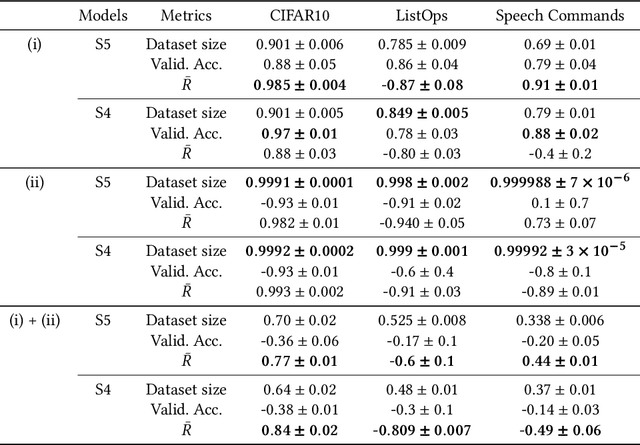
This study investigates a method to evaluate time-series datasets in terms of the performance of deep neural networks (DNNs) with state space models (deep SSMs) trained on the dataset. SSMs have attracted attention as components inside DNNs to address time-series data. Since deep SSMs have powerful representation capacities, training datasets play a crucial role in solving a new task. However, the effectiveness of training datasets cannot be known until deep SSMs are actually trained on them. This can increase the cost of data collection for new tasks, as a trial-and-error process of data collection and time-consuming training are needed to achieve the necessary performance. To advance the practical use of deep SSMs, the metric of datasets to estimate the performance early in the training can be one key element. To this end, we introduce the concept of data evaluation methods used in system identification. In system identification of linear dynamical systems, the effectiveness of datasets is evaluated by using the spectrum of input signals. We introduce this concept to deep SSMs, which are nonlinear dynamical systems. We propose the K-spectral metric, which is the sum of the top-K spectra of signals inside deep SSMs, by focusing on the fact that each layer of a deep SSM can be regarded as a linear dynamical system. Our experiments show that the K-spectral metric has a large absolute value of the correlation coefficient with the performance and can be used to evaluate the quality of training datasets.