 Add to Chrome
 Add to Firefox
 Add to Edge
High-dimensional inference for the $γ$-ray sky with differentiable programming
Apr 09, 2026
We motivate the use of differentiable probabilistic programming techniques in order to account for the large model-space inherent to astrophysical $γ$-ray analyses. Targeting the longstanding Galactic Center $γ$-ray Excess (GCE) puzzle, we construct differentiable forward model and likelihood that make liberal use of GPU acceleration and vectorization in order to simultaneously account for a continuum of possible spatial morphologies consistent with the GCE emission in a fully probabilistic manner. Our setup allows for efficient inference over the large model space using variational methods. Beyond application to $γ$-ray data, a goal of this work is to showcase how differentiable probabilistic programming can be used as a tool to enable flexible analyses of astrophysical datasets.

Inferring the Morphology of the Galactic Center Excess with Gaussian Processes
Oct 28, 2024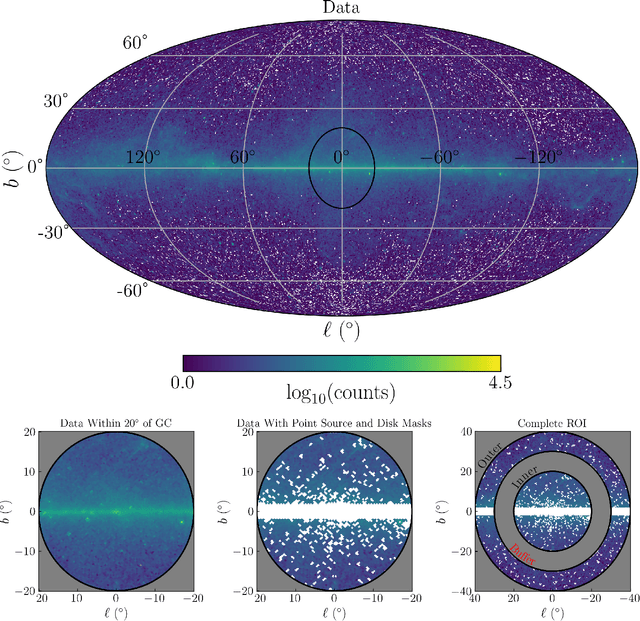
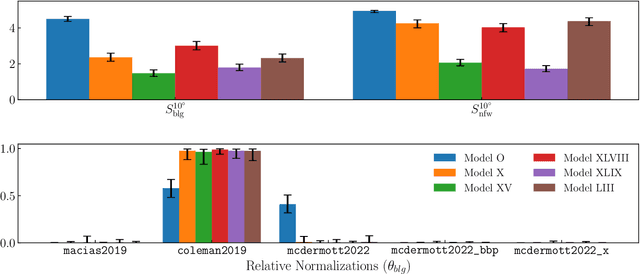
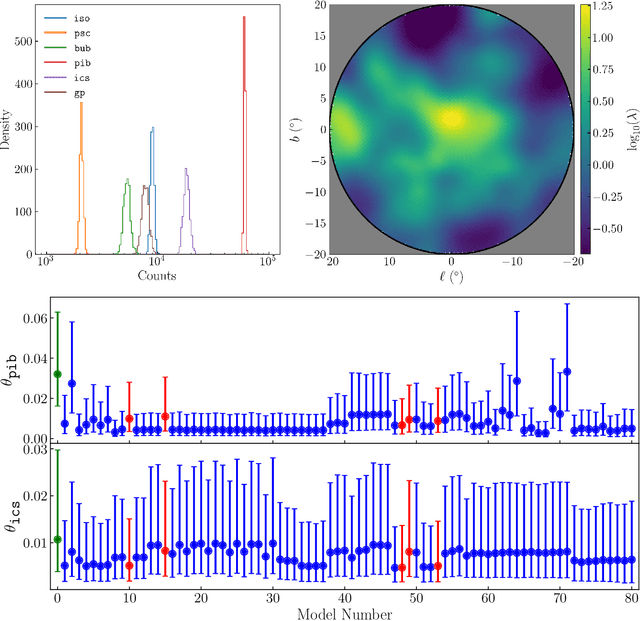
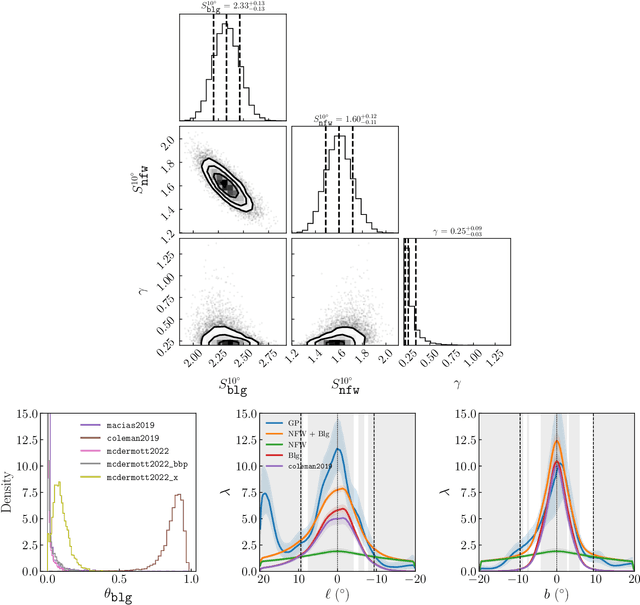
Descriptions of the Galactic Center using Fermi gamma-ray data have so far modeled the Galactic Center Excess (GCE) as a template with fixed spatial morphology or as a linear combination of such templates. Although these templates are informed by various physical expectations, the morphology of the excess is a priori unknown. For the first time, we describe the GCE using a flexible, non-parametric machine learning model -- the Gaussian process (GP). We assess our model's performance on synthetic data, demonstrating that the model can recover the templates used to generate the data. We then fit the \Fermi data with our model in a single energy bin from 2-20 GeV (leaving a spectral GP analysis of the GCE for future work) using a variety of template models of diffuse gamma-ray emission to quantify our fits' systematic uncertainties associated with diffuse emission modeling. We interpret our best-fit GP in terms of GCE templates consisting of an NFW squared template and a bulge component to determine which bulge models can best describe the fitted GP and to what extent the best-fit GP is described better by an NFW squared template versus a bulge template. The best-fit GP contains morphological features that are typically not associated with traditional GCE studies. These include a localized bright source at around $(\ell,b) = (20^{\circ}, 0^{\circ})$ and a diagonal arm extending Northwest from the Galactic Center. In spite of these novel features, the fitted GP is explained best by a template-based model consisting of the bulge presented in Coleman et al. (2020) and a squared NFW component. Our results suggest that the physical interpretation of the GCE in terms of stellar bulge and NFW-like components is highly sensitive to the assumed morphologies, background models, and the region of the sky used for inference.