 Add to Chrome
 Add to Firefox
 Add to Edge
On the Complexity of Electromagnetic Far-Field Modeling
Jan 09, 2026
Modern wireless systems are envisioned to employ antenna architectures that not only transmit and receive electromagnetic (EM) waves, but also intentionally reflect and possibly transform incident EM waves. In this paper, we propose a mathematically rigorous framework grounded in Maxwell's equations for analyzing the complexity of EM far-field modeling of general antenna architectures. We show that-under physically meaningful assumptions-such antenna architectures exhibit limited complexity, i.e., can be modeled by finite-rank operators using finitely many parameters. Furthermore, we construct a sequence of finite-rank operators whose approximation error decays super-exponentially once the operator rank exceeds an effective bandwidth associated with the antenna architecture and the analysis frequency. These results constitute a fundamental prerequisite for the efficient and accurate modeling of general antenna architectures on digital computing platforms.

Mitigating Smart Jammers in Multi-User MIMO
Aug 02, 2022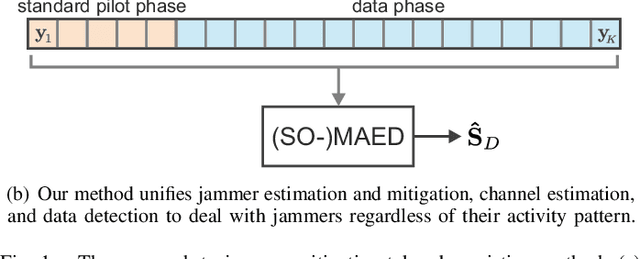
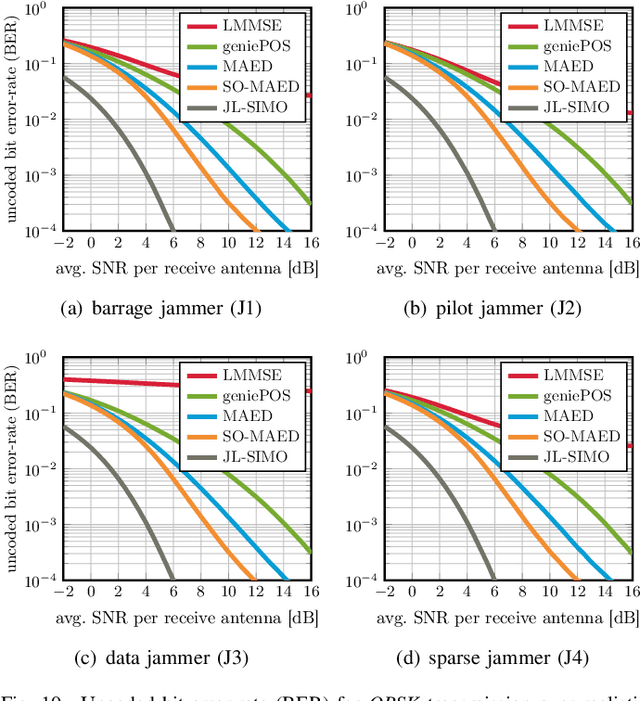
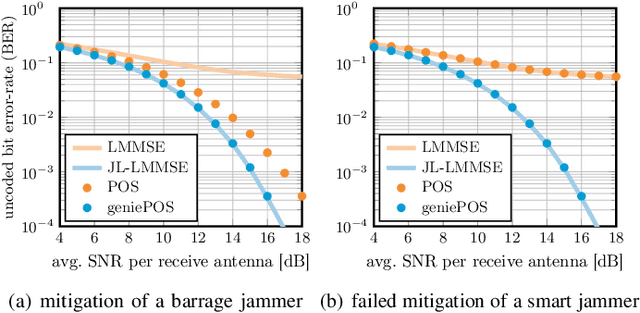
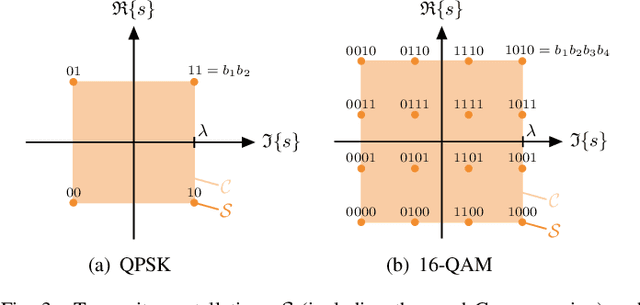
Wireless systems must be resilient to jamming attacks. Existing mitigation methods based on multi-antenna processing require knowledge of the jammer's transmit characteristics that may be difficult to acquire, especially for smart jammers that evade mitigation by transmitting only at specific instants. We propose a novel method to mitigate smart jamming attacks on the massive multi-user multiple-input multiple-output (MU-MIMO) uplink which does not require the jammer to be active at any specific instant. By formulating an optimization problem that unifies jammer estimation and mitigation, channel estimation, and data detection, we exploit that a jammer cannot change its subspace within a coherence interval. Theoretical results for our problem formulation show that its solution is guaranteed to recover the users' data symbols under certain conditions. We develop two efficient iterative algorithms for approximately solving the proposed problem formulation: MAED, a parameter-free algorithm which uses forward-backward splitting with a box symbol prior, and SO-MAED, which replaces the prior of MAED with soft-output symbol estimates that exploit the discrete transmit constellation and which uses deep unfolding to optimize algorithm parameters. We use simulations to demonstrate that the proposed algorithms effectively mitigate a wide range of smart jammers without a priori knowledge about the attack type.