 Add to Chrome
 Add to Firefox
 Add to Edge
On Near-Far-Field Boundaries in Wireless Systems
May 04, 2026
Near-field (NF) multi-antenna wireless communication and sensing have attracted growing research interest in recent years. A core question in this area is how to determine whether a wireless system is operating in the NF or far-field (FF) region. In this work, we propose a framework grounded in Maxwell's equations to analyze the transition region between the NF and FF, following the IEEE definition that specifies where the NF ends and the FF begins. Using this framework, we (i) compare a variety of traditional and recently introduced single-letter distance thresholds, often referred to as near-far-field boundaries, and (ii) conduct numerical experiments with both single- and multi-antenna wireless systems and with analytical models as well as full-wave electromagnetic simulations. Our results indicate that all of the considered single-letter distance thresholds are insufficient to predict the transition region between the NF and FF regions. Moreover, we highlight several important caveats associated with frequently (and recently) used NF and FF concepts.

Physically Consistent Evaluation of Commonly Used Near-Field Models
Feb 11, 2026Near-field multi-antenna wireless communication has attracted growing research interest in recent years. Despite this development, most of the current literature on antennas and reflecting structures relies on simplified models, whose validity for real systems remains unclear. In this paper, we introduce a physically consistent near-field model, which we use to evaluate commonly used models. Our results indicate that common models are sufficient for basic beamfocusing, but fail to accurately predict the sidelobes and frequency dependence of reflecting structures.
On the Complexity of Electromagnetic Far-Field Modeling
Jan 09, 2026Modern wireless systems are envisioned to employ antenna architectures that not only transmit and receive electromagnetic (EM) waves, but also intentionally reflect and possibly transform incident EM waves. In this paper, we propose a mathematically rigorous framework grounded in Maxwell's equations for analyzing the complexity of EM far-field modeling of general antenna architectures. We show that-under physically meaningful assumptions-such antenna architectures exhibit limited complexity, i.e., can be modeled by finite-rank operators using finitely many parameters. Furthermore, we construct a sequence of finite-rank operators whose approximation error decays super-exponentially once the operator rank exceeds an effective bandwidth associated with the antenna architecture and the analysis frequency. These results constitute a fundamental prerequisite for the efficient and accurate modeling of general antenna architectures on digital computing platforms.
Efficient and Physically-Consistent Modeling of Reconfigurable Electromagnetic Structures
Nov 20, 2024

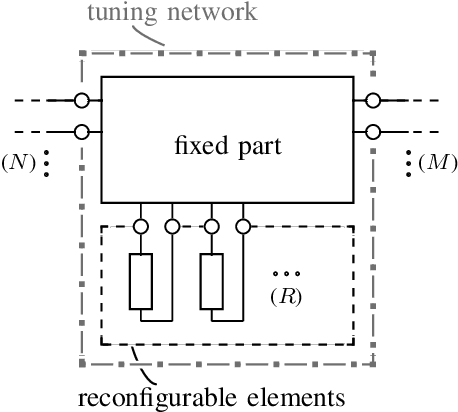

Reconfigurable electromagnetic structures (REMSs), such as reconfigurable reflectarrays (RRAs) or reconfigurable intelligent surfaces (RISs), hold significant potential to improve wireless communication and sensing systems. Even though several REMS modeling approaches have been proposed in recent years, the literature lacks models that are both computationally efficient and physically consistent. As a result, algorithms that control the reconfigurable elements of REMSs (e.g., the phase shifts of an RIS) are often built on simplistic models that are inaccurate. To enable physically accurate REMS-parameter tuning, we present a new framework for efficient and physically consistent modeling of general REMSs. Our modeling method combines a circuit-theoretic approach with a new formalism that describes a REMS's interaction with the electromagnetic (EM) waves in its far-field region. Our modeling method enables efficient computation of the entire far-field radiation pattern for arbitrary configurations of the REMS reconfigurable elements once a single full-wave EM simulation of the non-reconfigurable parts of the REMS has been performed. The predictions made by the proposed framework align with the physical laws of classical electrodynamics and model effects caused by inter-antenna coupling, non-reciprocal materials, polarization, ohmic losses, matching losses, influence of metallic housings, noise from low-noise amplifiers, and noise arising in or received by antennas. In order to validate the efficiency and accuracy of our modeling approach, we (i) compare our modeling method to EM simulations and (ii) conduct a case study involving a planar RRA that enables simultaneous multiuser beam- and null-forming using a new, computationally efficient, and physically accurate parameter tuning algorithm.