 Add to Chrome
 Add to Firefox
 Add to Edge
Statistical Inference on Gradient Flows
May 31, 2026
Gradient-based algorithms are central to modern statistical estimation, yet their statistical analysis is often restricted to fixed-time behavior, such as convergence to a population target or fluctuations at a prescribed iteration. In many applications, however, uncertainty quantification is needed along the entire optimization path, especially when the stopping time is data-dependent or divergent. In this paper, we develop a theory for time-uniform statistical inference on gradient flows arising from empirical risk minimization. We prove a uniform central limit theorem that characterizes the deviation between empirical and population gradient flows as a continuous-time Gaussian process over the entire nonnegative real line. Building on this result, we introduce an algorithm-aware covariance estimator that evolves jointly with the gradient flow and avoids matrix inversion, resampling, or sample splitting. We show that the covariance estimator is uniformly consistent over time and use it to construct confidence intervals for the target parameter with asymptotically valid coverage. Our results connect optimization dynamics with statistical inference and provide practical tools for uncertainty quantification in gradient-based methods.

DeepFilters: Scattering-Aware Pupil Engineering with Learned Digital Filter Reconstruction for Extended Depth of Field Microscopy
May 13, 2026Extended depth of field microscopy encodes axial information into a single acquisition through engineered point spread functions, but conventional and deep optics approaches are subject to degradation in scattering tissue. We introduce DeepFilters, a scattering-aware deep optics framework that jointly optimizes a parameterized pupil filter and a digital-filter-based reconstruction network through a calibrated differentiable forward model to achieve broad generalization without retraining. Incorporating empirical scattering kernels, physics-guided regularization, and a hybrid genetic-gradient initialization strategy, DeepFilters extends the PSF from 16 micron to >400 micron in clear media and enables signal recovery beyond 120 micron deep in biological tissues, validated across fixed brain slices and sea urchin embryos.
Whitened Score Diffusion: A Structured Prior for Imaging Inverse Problems
May 15, 2025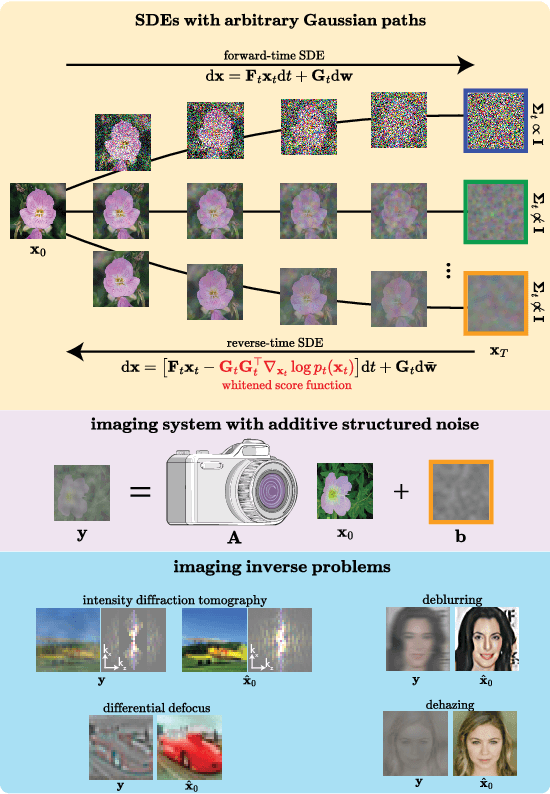
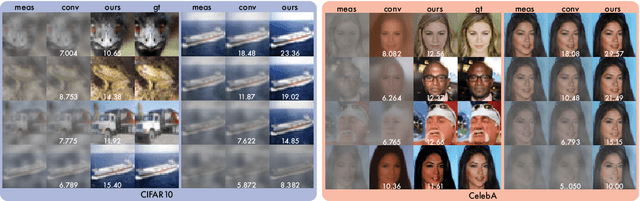

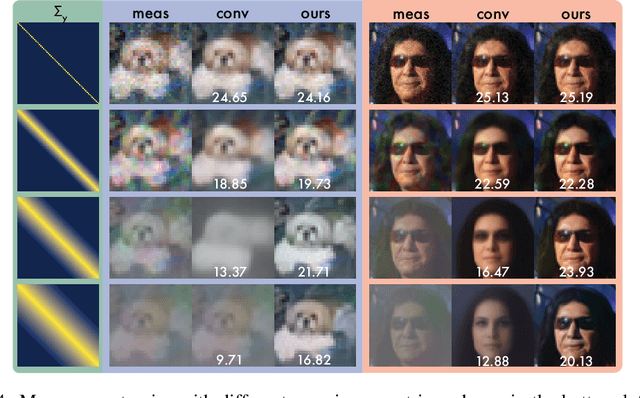
Conventional score-based diffusion models (DMs) may struggle with anisotropic Gaussian diffusion processes due to the required inversion of covariance matrices in the denoising score matching training objective \cite{vincent_connection_2011}. We propose Whitened Score (WS) diffusion models, a novel SDE-based framework that learns the Whitened Score function instead of the standard score. This approach circumvents covariance inversion, extending score-based DMs by enabling stable training of DMs on arbitrary Gaussian forward noising processes. WS DMs establish equivalence with FM for arbitrary Gaussian noise, allow for tailored spectral inductive biases, and provide strong Bayesian priors for imaging inverse problems with structured noise. We experiment with a variety of computational imaging tasks using the CIFAR and CelebA ($64\times64$) datasets and demonstrate that WS diffusion priors trained on anisotropic Gaussian noising processes consistently outperform conventional diffusion priors based on isotropic Gaussian noise.