 Add to Chrome
 Add to Firefox
 Add to Edge
A Methodology for Effective Surrogate Learning in Complex Optimization
Feb 09, 2026
Solving complex problems requires continuous effort in developing theory and practice to cope with larger, more difficult scenarios. Working with surrogates is normal for creating a proxy that realistically models the problem into the computer. Thus, the question of how to best define and characterize such a surrogate model is of the utmost importance. In this paper, we introduce the PTME methodology to study deep learning surrogates by analyzing their Precision, Time, Memory, and Energy consumption. We argue that only a combination of numerical and physical performance can lead to a surrogate that is both a trusted scientific substitute for the real problem and an efficient experimental artifact for scalable studies. Here, we propose different surrogates for a real problem in optimally organizing the network of traffic lights in European cities and perform a PTME study on the surrogates' sampling methods, dataset sizes, and resource consumption. We further use the built surrogates in new optimization metaheuristics for decision-making in real cities. We offer better techniques and conclude that the PTME methodology can be used as a guideline for other applications and solvers.

Energy-Aware Metaheuristics
Feb 09, 2026This paper presents a principled framework for designing energy-aware metaheuristics that operate under fixed energy budgets. We introduce a unified operator-level model that quantifies both numerical gain and energy usage, and define a robust Expected Improvement per Joule (EI/J) score that guides adaptive selection among operator variants during the search. The resulting energy-aware solvers dynamically choose between operators to self-control exploration and exploitation, aiming to maximize fitness gain under limited energy. We instantiate this framework with three representative metaheuristics - steady-state GA, PSO, and ILS - each equipped with both lightweight and heavy operator variants. Experiments on three heterogeneous combinatorial problems (Knapsack, NK-landscapes, and Error-Correcting Codes) show that the energy-aware variants consistently reach comparable fitness while requiring substantially less energy than their non-energy-aware baselines. EI/J values stabilize early and yield clear operator-selection patterns, with each solver reliably self-identifying the most improvement-per-Joule - efficient operator across problems.
Green Optimization: Energy-aware Design of Metaheuristics by Using Machine Learning Surrogates to Cope with Real Problems
Feb 09, 2026Addressing real-world optimization challenges requires not only advanced metaheuristics but also continuous refinement of their internal mechanisms. This paper explores the integration of machine learning in the form of neural surrogate models into metaheuristics through a recent lens: energy consumption. While surrogates are widely used to reduce the computational cost of expensive objective functions, their combined impact on energy efficiency, algorithmic performance, and solution accuracy remains largely unquantified. We provide a critical investigation into this intersection, aiming to advance the design of energy-aware, surrogate-assisted search algorithms. Our experiments reveal substantial benefits: employing a state-of-the-art pre-trained surrogate can reduce energy consumption by up to 98\%, execution time by approximately 98%, and memory usage by around 99\%. Moreover, increasing the training dataset size further enhances these gains by lowering the per-use computational cost, while static pre-training versus continuous (iterative) retraining have relatively different advantages depending on whether we aim at time/energy or accuracy and general cost across problems, respectively. Surrogates also have a negative impact on costs and accuracy at times, and then they cannot be blindly adopted. These findings support a more holistic approach to surrogate-assisted optimization, integrating energy with time and predictive accuracy into performance assessments.
An Evolutionary Framework for Automatic Optimization Benchmark Generation via Large Language Models
Jan 19, 2026Optimization benchmarks play a fundamental role in assessing algorithm performance; however, existing artificial benchmarks often fail to capture the diversity and irregularity of real-world problem structures, while benchmarks derived from real-world problems are costly and difficult to construct. To address these challenges, we propose an evolutionary automatic benchmark generation framework that leverages a large language model (LLM) as a generative operator, termed the LLM-driven evolutionary benchmark generator (LLM-EBG). In this framework, the LLM serves as an evolutionary operator that generates and evolves benchmark problems within a flexible, expressive representation space. As a case study, we generate unconstrained single-objective continuous minimization problems represented as mathematical expressions designed to induce significant performance differences between a genetic algorithm (GA) and differential evolution (DE). Experimental results show that LLM-EBG successfully produces benchmark problems in which the designated target algorithm consistently outperforms the comparative algorithm in more than 80\% of trials. Furthermore, exploratory landscape analysis reveals that benchmarks favoring GA are highly sensitive to variable scaling, demonstrating that the proposed framework can generate problems with distinct geometric characteristics that reflect the intrinsic search behaviors of different optimization algorithms.
Energy and Quality of Surrogate-Assisted Search Algorithms: a First Analysis
Aug 11, 2025Solving complex real problems often demands advanced algorithms, and then continuous improvements in the internal operations of a search technique are needed. Hybrid algorithms, parallel techniques, theoretical advances, and much more are needed to transform a general search algorithm into an efficient, useful one in practice. In this paper, we study how surrogates are helping metaheuristics from an important and understudied point of view: their energy profile. Even if surrogates are a great idea for substituting a time-demanding complex fitness function, the energy profile, general efficiency, and accuracy of the resulting surrogate-assisted metaheuristic still need considerable research. In this work, we make a first step in analyzing particle swarm optimization in different versions (including pre-trained and retrained neural networks as surrogates) for its energy profile (for both processor and memory), plus a further study on the surrogate accuracy to properly drive the search towards an acceptable solution. Our conclusions shed new light on this topic and could be understood as the first step towards a methodology for assessing surrogate-assisted algorithms not only accounting for time or numerical efficiency but also for energy and surrogate accuracy for a better, more holistic characterization of optimization and learning techniques.
* 8 pages, 8 figures, 2024 IEEE Congress on Evolutionary Computation (CEC)
A Frequency-based Parent Selection for Reducing the Effect of Evaluation Time Bias in Asynchronous Parallel Multi-objective Evolutionary Algorithms
Jul 26, 2021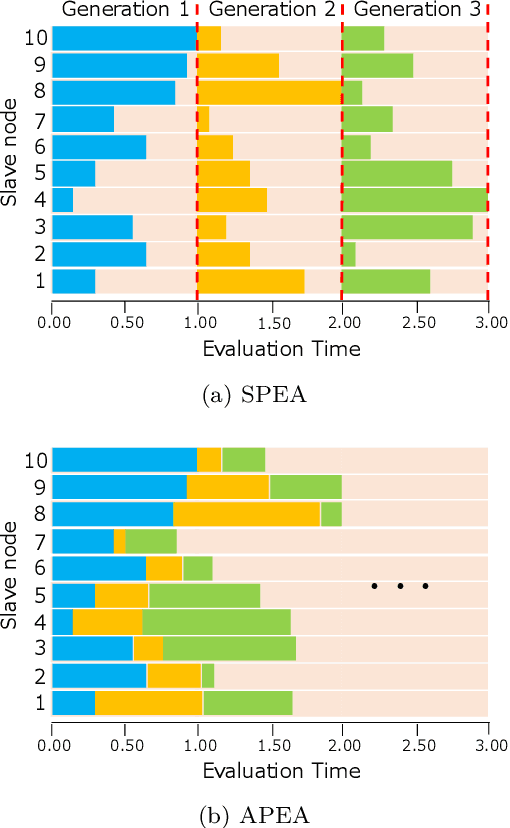
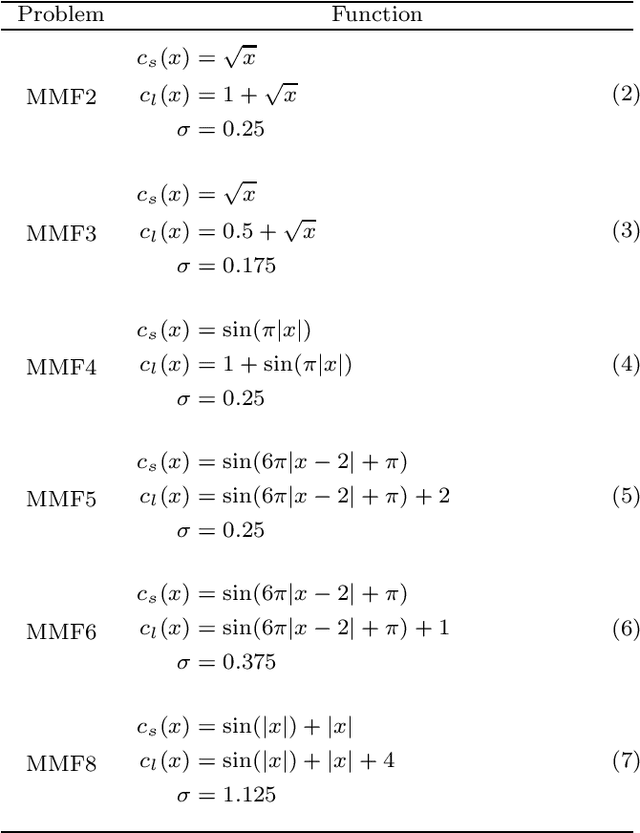
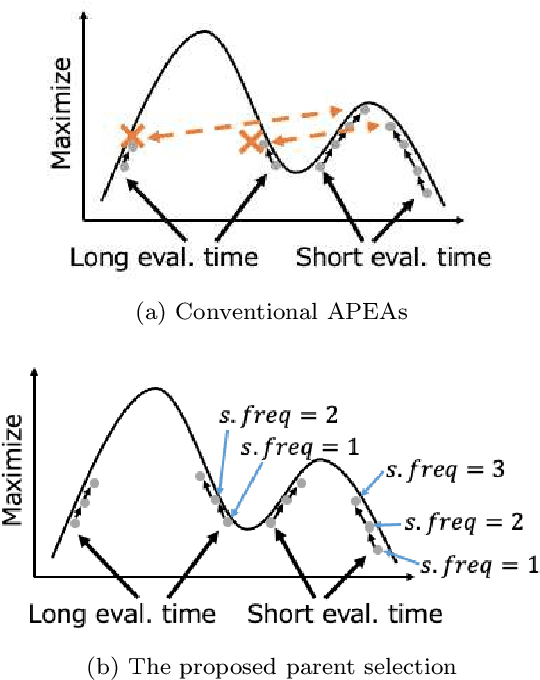
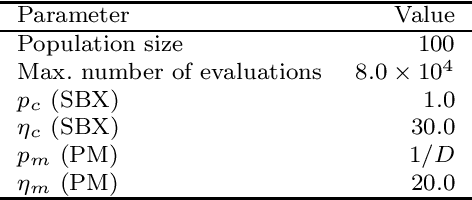
This paper proposes a new parent selection method for reducing the effect of evaluation time bias in asynchronous parallel evolutionary algorithms (APEAs). APEAs have the advantage of increasing computational efficiency even when the evaluation times of solutions differ. However, APEAs have a problem that their search direction is biased toward the search region with a short evaluation time. The proposed parent selection method considers the search frequency of solutions to reduce such an adverse influence of APEAs while maintaining their computational efficiency. We conduct experiments on toy problems that reproduce the evaluation time bias on multi-objective optimization problems to investigate the effectiveness of the proposed method. The experiments use NSGA-III, a well-known multi-objective evolutionary algorithm. In the experiments, we compare the proposed method with the synchronous and asynchronous methods. The experimental results reveal that the proposed method can reduce the effect of the evaluation time bias while reducing the computing time of the parallel NSGA-III.
A Fresh Approach to Evaluate Performance in Distributed Parallel Genetic Algorithms
Jun 18, 2021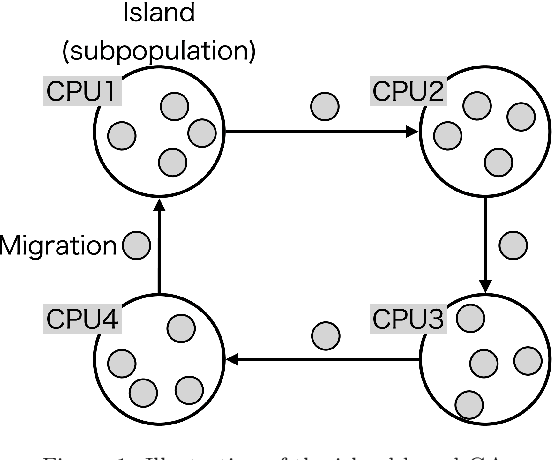
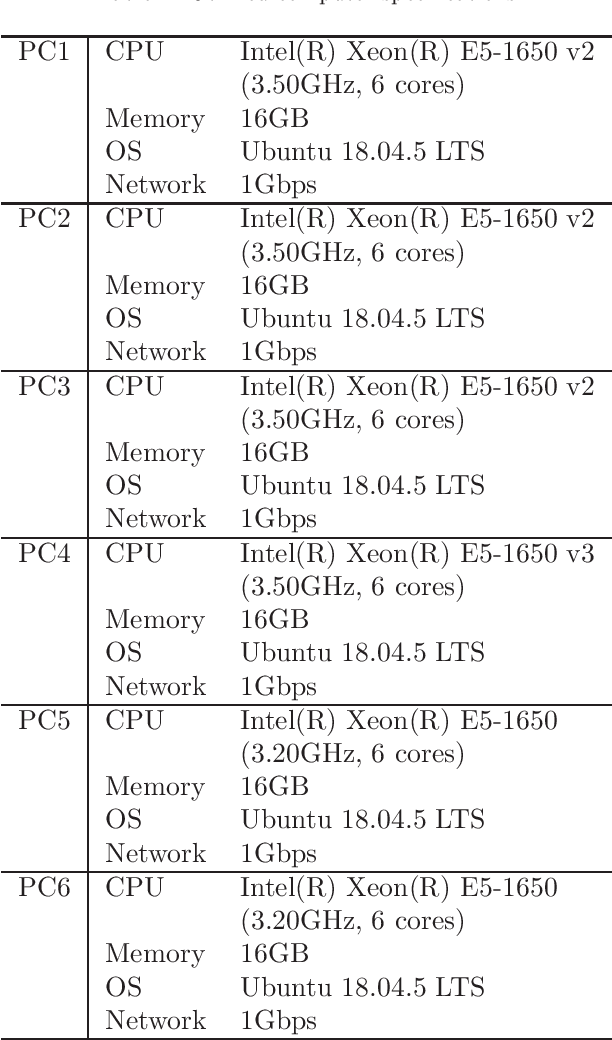
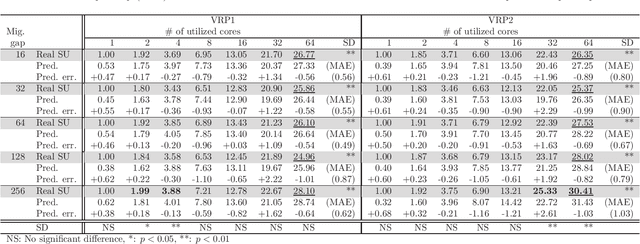
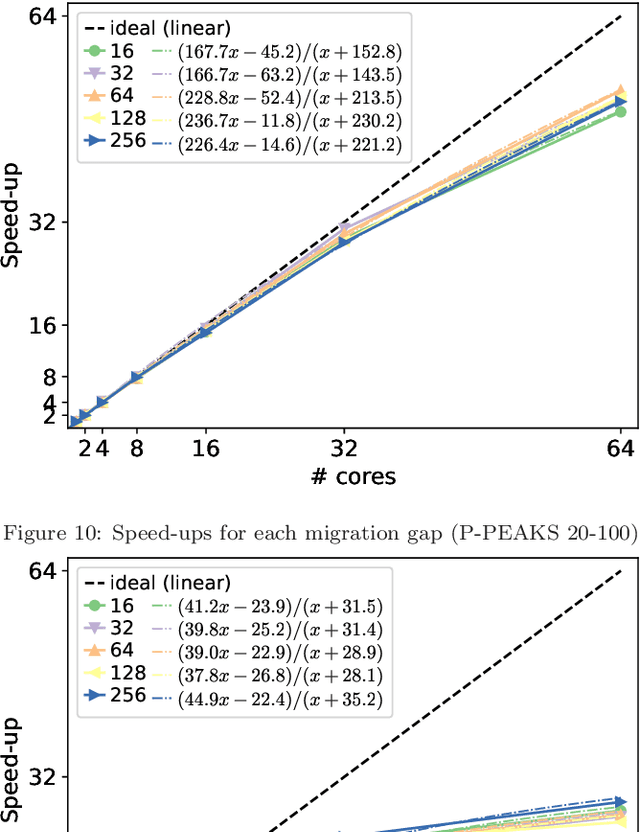
This work proposes a novel approach to evaluate and analyze the behavior of multi-population parallel genetic algorithms (PGAs) when running on a cluster of multi-core processors. In particular, we deeply study their numerical and computational behavior by proposing a mathematical model representing the observed performance curves. In them, we discuss the emerging mathematical descriptions of PGA performance instead of, e.g., individual isolated results subject to visual inspection, for a better understanding of the effects of the number of cores used (scalability), their migration policy (the migration gap, in this paper), and the features of the solved problem (type of encoding and problem size). The conclusions based on the real figures and the numerical models fitting them represent a fresh way of understanding their speed-up, running time, and numerical effort, allowing a comparison based on a few meaningful numeric parameters. This represents a set of conclusions beyond the usual textual lessons found in past works on PGAs. It can be used as an estimation tool for the future performance of the algorithms and a way of finding out their limitations.
Towards An Angry-Birds-like Game System for Promoting Mental Well-being of Players Using Art-Therapy-embedded PCG
Nov 07, 2019
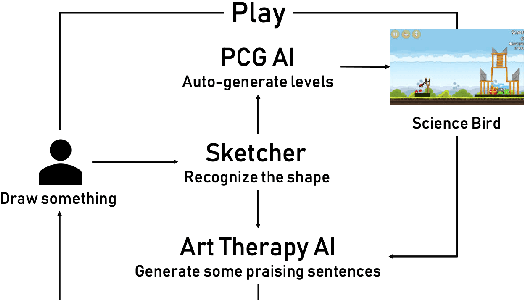
This paper presents an integration of a game system and the art therapy concept for promoting the mental well-being of video game players. In the proposed game system, the player plays an Angry-Birds-like game in which levels in the game are generated based on images they draw. Upon finishing a game level, the player also receives positive feedback (praising words) toward their drawing and the generated level from an Art Therapy AI. The proposed system is composed of three major parts: (1) a drawing recognizer that identifies what object is drawn by the player (Sketcher), (2) a level generator that converts the drawing image into a pixel image, then a set of blocks representing a game level (PCG AI), and (3) the Art Therapy AI that encourages the player and improves their emotion. This paper describes an overview of the system and explains how its major components function.
Adaptive Motion Gaming AI for Health Promotion
Apr 04, 2017
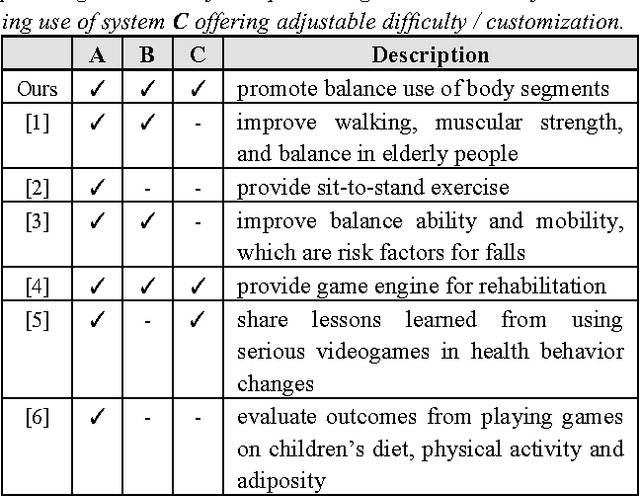
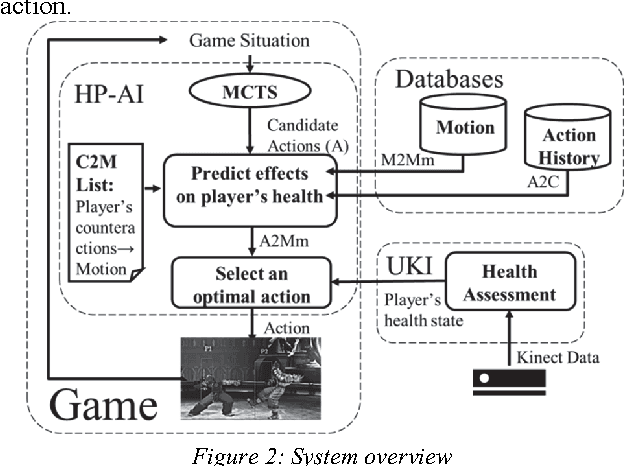

This paper presents a design of a non-player character (AI) for promoting balancedness in use of body segments when engaging in full-body motion gaming. In our experiment, we settle a battle between the proposed AI and a player by using FightingICE, a fighting game platform for AI development. A middleware called UKI is used to allow the player to control the game by using body motion instead of the keyboard and mouse. During gameplay, the proposed AI analyze health states of the player; it determines its next action by predicting how each candidate action, recommended by a Monte-Carlo tree search algorithm, will induce the player to move, and how the player's health tends to be affected. Our result demonstrates successful improvement in balancedness in use of body segments on 4 out of 5 subjects.
Procedural Generation of Angry Birds Levels using Building Constructive Grammar with Chinese-Style and/or Japanese-Style Models
Apr 27, 2016
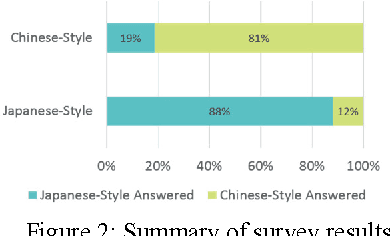
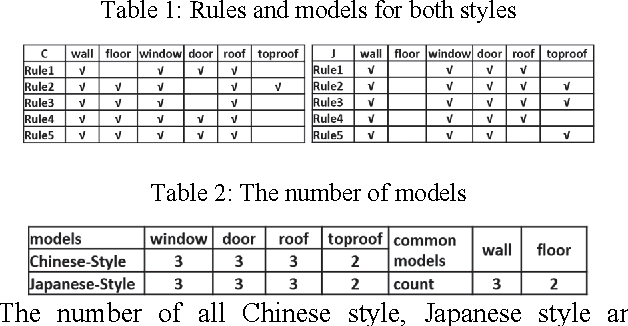
This paper presents a procedural generation method that creates visually attractive levels for the Angry Birds game. Besides being an immensely popular mobile game, Angry Birds has recently become a test bed for various artificial intelligence technologies. We propose a new approach for procedurally generating Angry Birds levels using Chinese style and Japanese style building structures. A conducted experiment confirms the effectiveness of our approach with statistical significance.