 Add to Chrome
 Add to Firefox
 Add to Edge
Impact of Connectivity on Laplacian Representations in Reinforcement Learning
Mar 09, 2026
Learning compact state representations in Markov Decision Processes (MDPs) has proven crucial for addressing the curse of dimensionality in large-scale reinforcement learning (RL) problems. Existing principled approaches leverage structural priors on the MDP by constructing state representations as linear combinations of the state-graph Laplacian eigenvectors. When the transition graph is unknown or the state space is prohibitively large, the graph spectral features can be estimated directly via sample trajectories. In this work, we prove an upper bound on the approximation error of linear value function approximation under the learned spectral features. We show how this error scales with the algebraic connectivity of the state-graph, grounding the approximation quality in the topological structure of the MDP. We further bound the error introduced by the eigenvector estimation itself, leading to an end-to-end error decomposition across the representation learning pipeline. Additionally, our expression of the Laplacian operator for the RL setting, although equivalent to existing ones, prevents some common misunderstandings, of which we show some examples from the literature. Our results hold for general (non-uniform) policies without any assumptions on the symmetry of the induced transition kernel. We validate our theoretical findings with numerical simulations on gridworld environments.

Human and LLM Biases in Hate Speech Annotations: A Socio-Demographic Analysis of Annotators and Targets
Oct 10, 2024


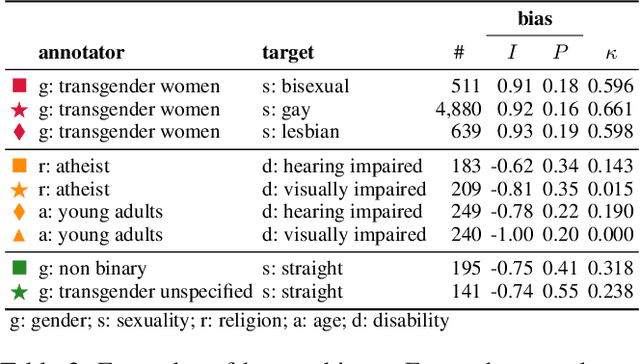
The rise of online platforms exacerbated the spread of hate speech, demanding scalable and effective detection. However, the accuracy of hate speech detection systems heavily relies on human-labeled data, which is inherently susceptible to biases. While previous work has examined the issue, the interplay between the characteristics of the annotator and those of the target of the hate are still unexplored. We fill this gap by leveraging an extensive dataset with rich socio-demographic information of both annotators and targets, uncovering how human biases manifest in relation to the target's attributes. Our analysis surfaces the presence of widespread biases, which we quantitatively describe and characterize based on their intensity and prevalence, revealing marked differences. Furthermore, we compare human biases with those exhibited by persona-based LLMs. Our findings indicate that while persona-based LLMs do exhibit biases, these differ significantly from those of human annotators. Overall, our work offers new and nuanced results on human biases in hate speech annotations, as well as fresh insights into the design of AI-driven hate speech detection systems.