 Add to Chrome
 Add to Firefox
 Add to Edge
Deep Sleep Classification via EEG Signal Criticality: A Passive BCI Approach for Sleep-Improvement Neurofeedback
Jun 11, 2026
Automated sleep staging is a fundamental application of passive Brain-Computer Interfaces (pBCI), decoding spontaneous neural states to enable closed-loop interventions independent of user intent. This study evaluates criticality features derived from Detrended Fluctuation Analysis (DFA) for the specific identification of deep sleep (N3). We analyzed $347,232$ EEG epochs from $290$ older women using UMAP manifold learning to visualize state transitions. Subsequently, six classifiers were benchmarked via 10-fold cross-validation, using balanced accuracy to determine the optimal "state-sensing" engine for neurofeedback.Naive Bayes achieved the highest mean balanced accuracy ($87.17\% \pm 0.24\%$), significantly outperforming a fully connected deep neural network (FNN: $81.58\%$) and Random Forest ($80.97\%$). Linear models (LDA: $57.21\%$; SVM: $51.01\%$) performed poorly, indicating that DFA-derived criticality features reside on a distinct, non-linear manifold. Probabilistic decoding of EEG criticality provides a high-accuracy sensing mechanism for pBCIs. This robust classification pipeline supports the development of state-dependent neurofeedback, such as targeted auditory stimulation, to enhance cognitive recovery.

End-to-End Machine Learning for Depressive State Classification via EEG and fNIRS
Jun 10, 2026The escalating demand for mental healthcare, driven by rising societal stress, highlights the limitations of traditional psychiatric diagnostics. Conventional methods - relying primarily on clinical interviews and patient self-reports - are inherently vulnerable to subjective bias and the varying empirical judgment of practitioners. To address the need for quantitative evaluation, biological signal-based detection, including electroencephalography (EEG) and functional near-infrared spectroscopy (fNIRS), has emerged as a promising objective alternative. Such technology is particularly vital for identifying latent depressive states that may be unrecognized by the subjects themselves. Furthermore, in aging populations, the high comorbidity between depression and dementia necessitates early differentiation to prevent mutual symptom exacerbation and maintain Quality of Life (QoL). This pilot study of eleven healthy students establishes a framework for biological signal-based depression detection, serving as a foundational step toward automated, objective diagnostic tools for clinical use.
Sleep EEG Signal Criticality as a Non-Invasive Predictor of Cognitive Decline in Dementia
Jun 09, 2026Early detection of neurodegeneration remains a critical clinical challenge. This study investigates whether sleep EEG signal criticality, quantified via Multifractal Detrended Fluctuation Analysis (MFDFA), serves as a non-invasive biomarker for future cognitive decline. We analyzed longitudinal data from the National Sleep Research Resource (NSRR) Study of Osteoporotic Fractures (SOF) cohort, comparing baseline sleep EEG dynamics between women who remained cognitively normal and those who later progressed to dementia-related impairment ($3MS < 78$).Our results reveal significant group-level differences in Hurst exponent $H(q)$ distributions, particularly during non-REM stages N2 and N3. Cognitively healthy individuals exhibited signal dynamics significantly closer to an optimally critical state across all electrode locations ($p \leqslant 0.001$), supporting the Brain Criticality Hypothesis. Supervised UMAP projections confirmed clear spatial separation between groups throughout the overnight sleep architecture.The dementia group demonstrated a shift in DFA exponents toward $1.0$, suggesting that a reconfiguration of scale-free neural dynamics during sleep precedes clinical symptoms. These findings highlight the potential for MFDFA-derived measures to be integrated into automated, sleep-based screening tools, enabling earlier preventative interventions during the prodromal window of dementia.
Early Detection of Cognitive Impairment in Elderly using a Passive FPVS-EEG BCI and Machine Learning -- Extended Version
Apr 15, 2025Early dementia diagnosis requires biomarkers sensitive to both structural and functional brain changes. While structural neuroimaging biomarkers have progressed significantly, objective functional biomarkers of early cognitive decline remain a critical unmet need. Current cognitive assessments often rely on behavioral responses, making them susceptible to factors like effort, practice effects, and educational background, thereby hindering early and accurate detection. This work introduces a novel approach, leveraging a lightweight convolutional neural network (CNN) to infer cognitive impairment levels directly from electroencephalography (EEG) data. Critically, this method employs a passive fast periodic visual stimulation (FPVS) paradigm, eliminating the need for explicit behavioral responses or task comprehension from the participant. This passive approach provides an objective measure of working memory function, independent of confounding factors inherent in active cognitive tasks, and offers a promising new avenue for early and unbiased detection of cognitive decline.
Cognitive Assessment Estimation from Behavioral Responses in Emotional Faces Evaluation Task -- AI Regression Approach for Dementia Onset Prediction in Aging Societies
Nov 25, 2019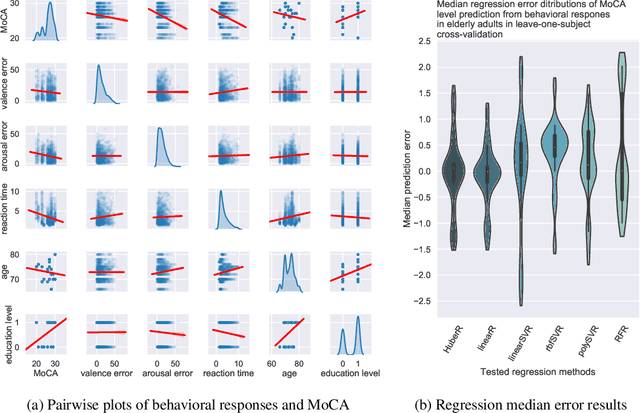
We present a practical health-theme machine learning (ML) application concerning `AI for social good' domain for `Producing Good Outcomes' track. In particular, the solution is concerning the problem of a potential elderly adult dementia onset prediction in aging societies. The paper discusses our attempt and encouraging preliminary study results of behavioral responses analysis in a working memory-based emotional evaluation experiment. We focus on the development of digital biomarkers for dementia progress detection and monitoring. We present a behavioral data collection concept for a subsequent AI-based application together with a range of regression encouraging results of Montreal Cognitive Assessment (MoCA) scores in the leave-one-subject-out cross-validation setup. The regressor input variables include experimental subject's emotional valence and arousal recognition responses, as well as reaction times, together with self-reported education levels and ages, obtained from a group of twenty older adults taking part in the reported data collection project. The presented results showcase the potential social benefits of artificial intelligence application for elderly and establish a step forward to develop ML approaches, for the subsequent application of simple behavioral objective testing for dementia onset diagnostics replacing subjective MoCA.
Brain correlates of task-load and dementia elucidation with tensor machine learning using oddball BCI paradigm
Jun 19, 2019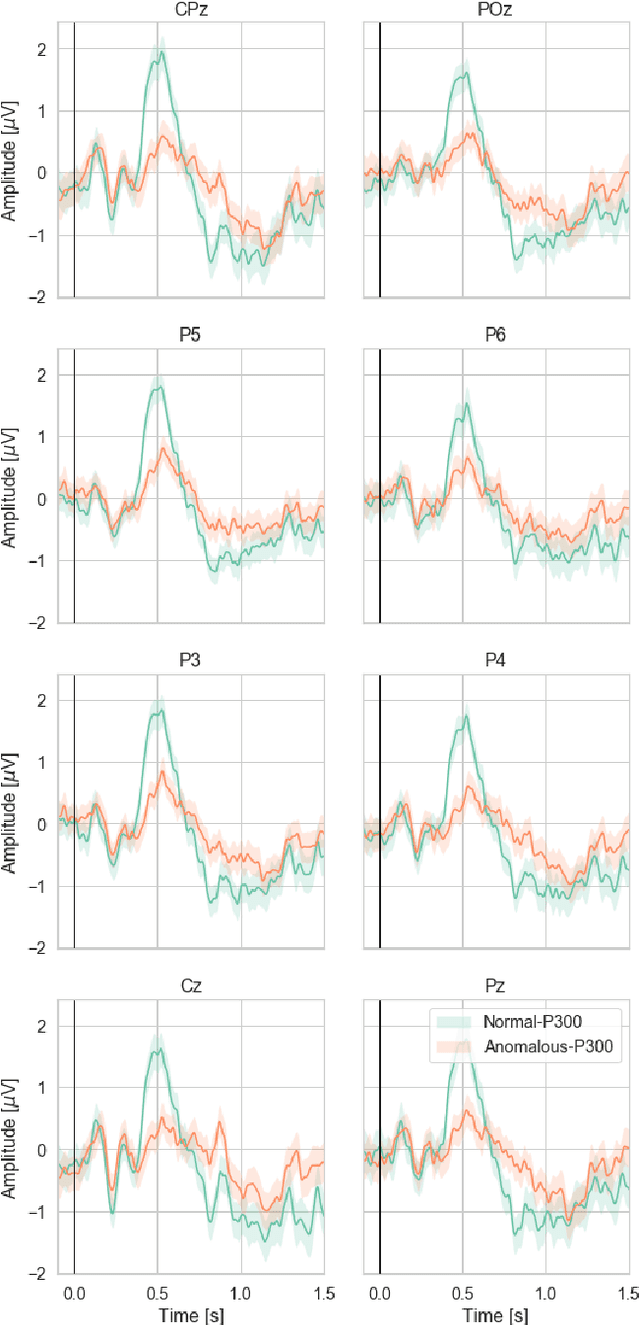
Dementia in the elderly has recently become the most usual cause of cognitive decline. The proliferation of dementia cases in aging societies creates a remarkable economic as well as medical problems in many communities worldwide. A recently published report by The World Health Organization (WHO) estimates that about 47 million people are suffering from dementia-related neurocognitive declines worldwide. The number of dementia cases is predicted by 2050 to triple, which requires the creation of an AI-based technology application to support interventions with early screening for subsequent mental wellbeing checking as well as preservation with digital-pharma (the so-called beyond a pill) therapeutical approaches. We present an attempt and exploratory results of brain signal (EEG) classification to establish digital biomarkers for dementia stage elucidation. We discuss a comparison of various machine learning approaches for automatic event-related potentials (ERPs) classification of a high and low task-load sound stimulus recognition. These ERPs are similar to those in dementia. The proposed winning method using tensor-based machine learning in a deep fully connected neural network setting is a step forward to develop AI-based approaches for a subsequent application for subjective- and mild-cognitive impairment (SCI and MCI) diagnostics.
AI Neurotechnology for Aging Societies -- Task-load and Dementia EEG Digital Biomarker Development Using Information Geometry Machine Learning Methods
Nov 30, 2018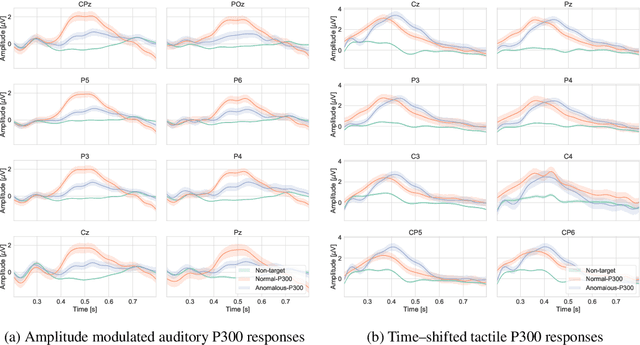
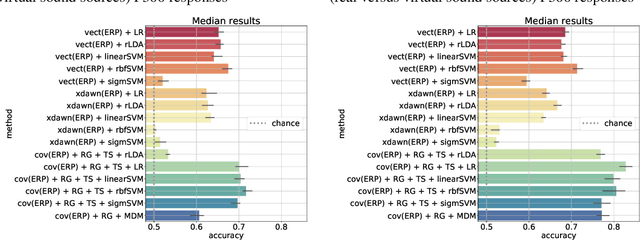
Dementia and especially Alzheimer's disease (AD) are the most common causes of cognitive decline in elderly people. A spread of the above mentioned mental health problems in aging societies is causing a significant medical and economic burden in many countries around the world. According to a recent World Health Organization (WHO) report, it is approximated that currently, worldwide, about 47 million people live with a dementia spectrum of neurocognitive disorders. This number is expected to triple by 2050, which calls for possible application of AI-based technologies to support an early screening for preventive interventions and a subsequent mental wellbeing monitoring as well as maintenance with so-called digital-pharma or beyond a pill therapeutical approaches. This paper discusses our attempt and preliminary results of brainwave (EEG) techniques to develop digital biomarkers for dementia progress detection and monitoring. We present an information geometry-based classification approach for automatic EEG-derived event related responses (ERPs) discrimination of low versus high task-load auditory or tactile stimuli recognition, of which amplitude and latency variabilities are similar to those in dementia. The discussed approach is a step forward to develop AI, and especially machine learning (ML) approaches, for the subsequent application to mild-cognitive impairment (MCI) and AD diagnostics.
Student Teaching and Research Laboratory Focusing on Brain-computer Interface Paradigms - A Creative Environment for Computer Science Students -
Jun 13, 2015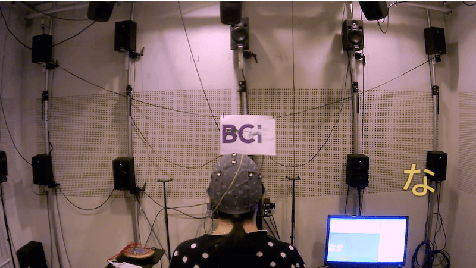
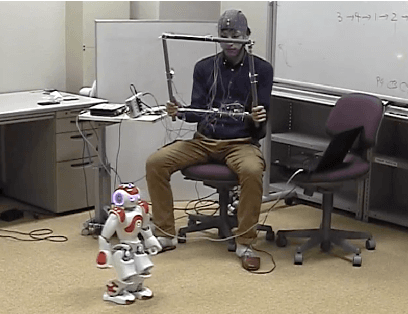
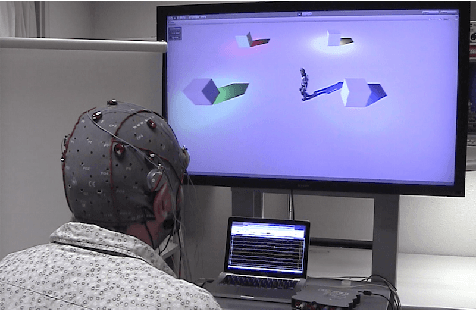
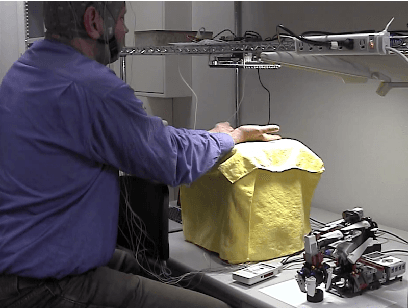
This paper presents an applied concept of a brain-computer interface (BCI) student research laboratory (BCI-LAB) at the Life Science Center of TARA, University of Tsukuba, Japan. Several successful case studies of the student projects are reviewed together with the BCI Research Award 2014 winner case. The BCI-LAB design and project-based teaching philosophy is also explained. Future teaching and research directions summarize the review.
Airborne Ultrasonic Tactile Display Brain-computer Interface -- A Small Robotic Arm Online Control Study
Jan 30, 2015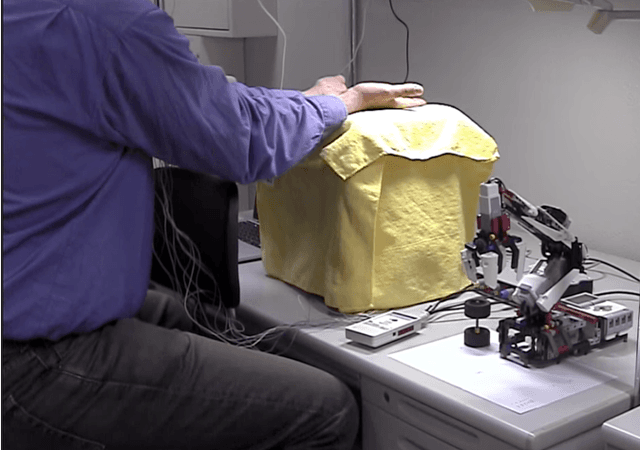
We report on an extended robot control application of a contact-less and airborne ultrasonic tactile display (AUTD) stimulus-based brain-computer interface (BCI) paradigm, which received last year The Annual BCI Research Award 2014. In the award winning human communication augmentation paradigm the six palm positions are used to evoke somatosensory brain responses, in order to define a novel contactless tactile BCI. An example application of a small robot management is also presented in which the users control a small robot online.
Multi-command Chest Tactile Brain Computer Interface for Small Vehicle Robot Navigation
Jul 28, 2013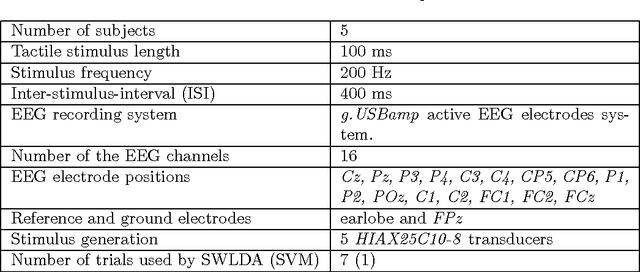
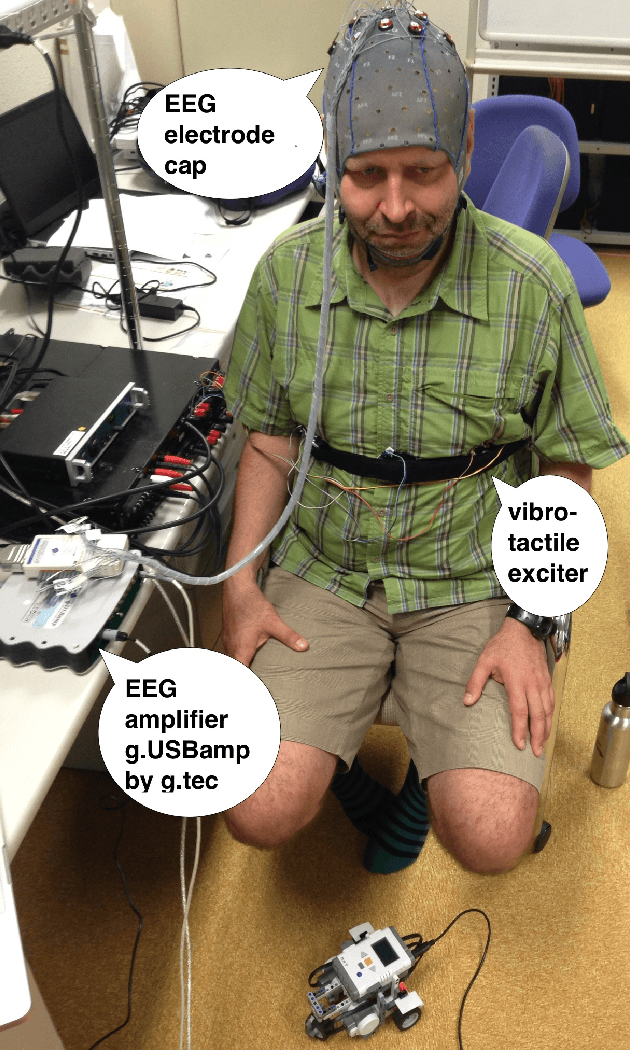
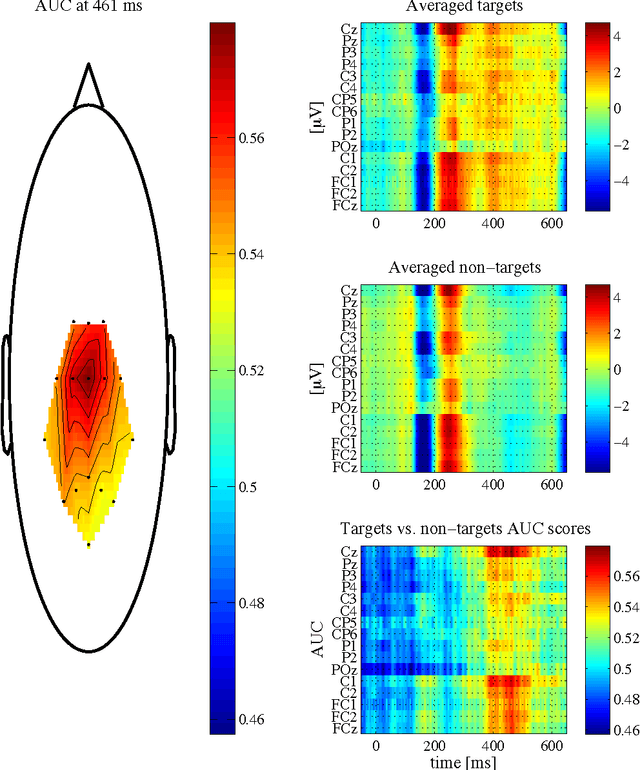
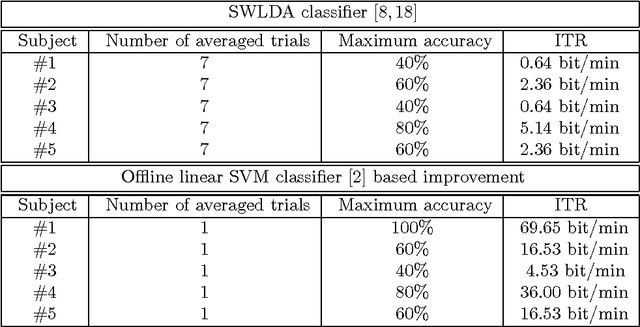
The presented study explores the extent to which tactile stimuli delivered to five chest positions of a healthy user can serve as a platform for a brain computer interface (BCI) that could be used in an interactive application such as robotic vehicle operation. The five chest locations are used to evoke tactile brain potential responses, thus defining a tactile brain computer interface (tBCI). Experimental results with five subjects performing online tBCI provide a validation of the chest location tBCI paradigm, while the feasibility of the concept is illuminated through information-transfer rates. Additionally an offline classification improvement with a linear SVM classifier is presented through the case study.