 Add to Chrome
 Add to Firefox
 Add to Edge
Auditing Sybil: Explaining Deep Lung Cancer Risk Prediction Through Generative Interventional Attributions
Jan 30, 2026
Lung cancer remains the leading cause of cancer mortality, driving the development of automated screening tools to alleviate radiologist workload. Standing at the frontier of this effort is Sybil, a deep learning model capable of predicting future risk solely from computed tomography (CT) with high precision. However, despite extensive clinical validation, current assessments rely purely on observational metrics. This correlation-based approach overlooks the model's actual reasoning mechanism, necessitating a shift to causal verification to ensure robust decision-making before clinical deployment. We propose S(H)NAP, a model-agnostic auditing framework that constructs generative interventional attributions validated by expert radiologists. By leveraging realistic 3D diffusion bridge modeling to systematically modify anatomical features, our approach isolates object-specific causal contributions to the risk score. Providing the first interventional audit of Sybil, we demonstrate that while the model often exhibits behavior akin to an expert radiologist, differentiating malignant pulmonary nodules from benign ones, it suffers from critical failure modes, including dangerous sensitivity to clinically unjustified artifacts and a distinct radial bias.

Enhancing Coronary Artery Calcium Scoring via Multi-Organ Segmentation on Non-Contrast Cardiac Computed Tomography
Jan 20, 2025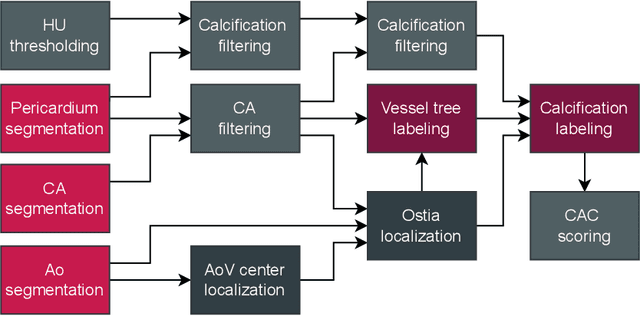

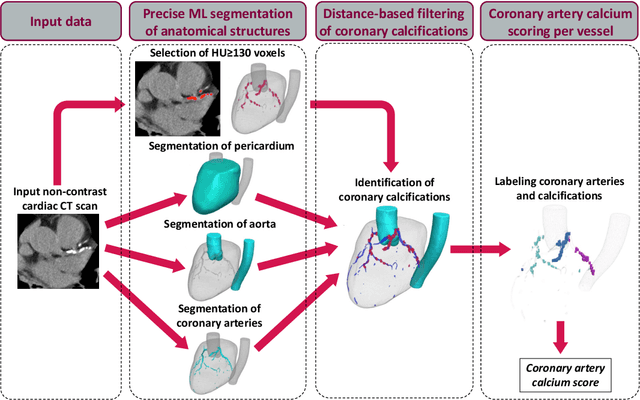
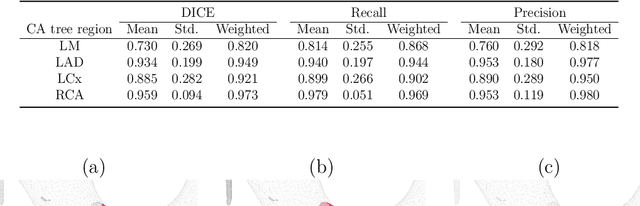
Despite coronary artery calcium scoring being considered a largely solved problem within the realm of medical artificial intelligence, this paper argues that significant improvements can still be made. By shifting the focus from pathology detection to a deeper understanding of anatomy, the novel algorithm proposed in the paper both achieves high accuracy in coronary artery calcium scoring and offers enhanced interpretability of the results. This approach not only aids in the precise quantification of calcifications in coronary arteries, but also provides valuable insights into the underlying anatomical structures. Through this anatomically-informed methodology, the paper shows how a nuanced understanding of the heart's anatomy can lead to more accurate and interpretable results in the field of cardiovascular health. We demonstrate the superior accuracy of the proposed method by evaluating it on an open-source multi-vendor dataset, where we obtain results at the inter-observer level, surpassing the current state of the art. Finally, the qualitative analyses show the practical value of the algorithm in such tasks as labeling coronary artery calcifications, identifying aortic calcifications, and filtering out false positive detections due to noise.