 Add to Chrome
 Add to Firefox
 Add to Edge
FoggyTrust: Robust Federated Learning with Hierarchical Trust Networks
Jun 26, 2026
Byzantine-robust federated learning seeks to protect distributed model training from malicious or corrupted clients without requiring access to their private data. FLTrust addresses this challenge by introducing a trusted server-side root dataset that assigns trust scores to client updates for more robust aggregation. In this work, we propose FOGGYTRUST, a hierarchical extension of FLTrust that localizes trust computation to fog nodes, allowing the framework to better handle globally heterogeneous data while preserving robustness within locally homogeneous client groups. We further show that this two-level architecture can simultaneously address distribution mismatch in trust estimation and client drift across groups by combining local trust-based aggregation with heterogeneity-aware global optimizers such as FedAdam and SCAFFOLD. Across benchmark datasets, FOGGYTRUST achieves its strongest gains on more challenging heterogeneous settings, particularly on CIFAR-10 under Krum and Trim attacks, where it achieves an over 50% improvement over FLTrust. We also test FOGGYTRUST in a real-world safari dataset to show the promise of hierarchical trust networks for robust federated learning in socially impactful, safety-critical settings such as distributed wildlife monitoring.

Vector-valued self-normalized concentration inequalities beyond sub-Gaussianity
Nov 05, 2025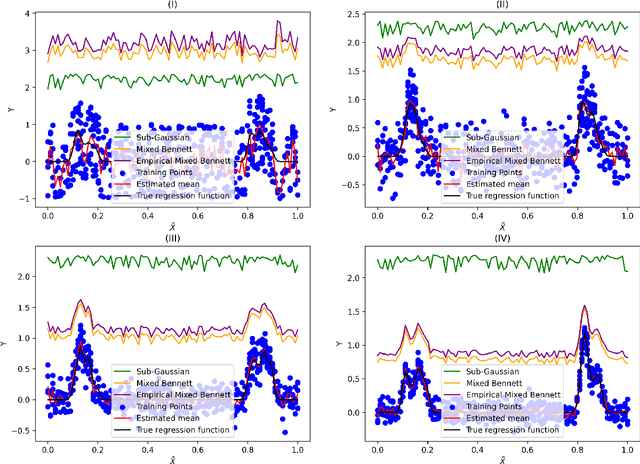
The study of self-normalized processes plays a crucial role in a wide range of applications, from sequential decision-making to econometrics. While the behavior of self-normalized concentration has been widely investigated for scalar-valued processes, vector-valued processes remain comparatively underexplored, especially outside of the sub-Gaussian framework. In this contribution, we provide concentration bounds for self-normalized processes with light tails beyond sub-Gaussianity (such as Bennett or Bernstein bounds). We illustrate the relevance of our results in the context of online linear regression, with applications in (kernelized) linear bandits.