 Add to Chrome
 Add to Firefox
 Add to Edge
A Longitudinal Analysis of the CEC Single-Objective Competitions (2010-2024) and Implications for Variational Quantum Optimization
Mar 25, 2026
This paper provides a historical analysis of the IEEE CEC Single Objective Optimization competition results (2010-2024). We analyze how benchmark functions shaped winning algorithms, identifying the 2014 introduction of dense rotation matrices as a key performance filter. This design choice introduced parameter non-separability, reduced effectiveness of coordinate-dependent methods (PSO, GA), and established the dominance of Differential Evolution variants capable of preserving the rotational invariance of their difference vectors, specifically L-SHADE. Post-2020 analysis reveals a shift towards high complexity hybrid optimizers that combine different mechanisms (e.g., Eigenvector Crossover, Societal Sharing, Reinforcement Learning) to maximize ranking stability. We conclude by identifying structural similarities between these modern benchmarks and Variational Quantum Algorithm landscapes, suggesting that evolved CEC solvers possess the specific adaptive capabilities required for quantum control.

From Classical to Hybrid: A Practical Framework for Quantum-Enhanced Learning
Nov 11, 2025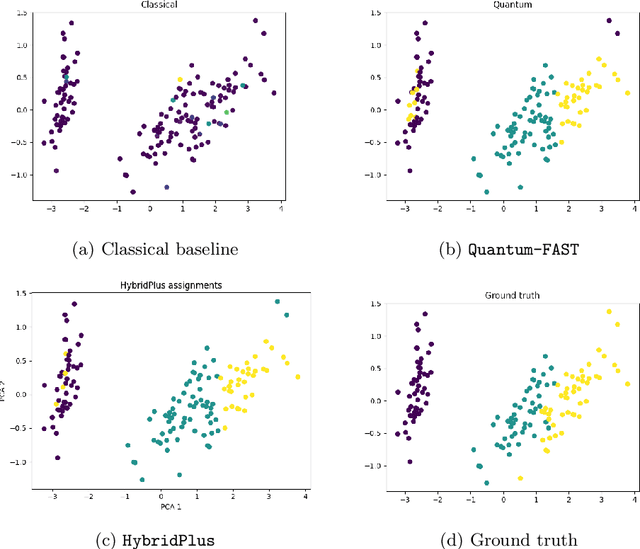
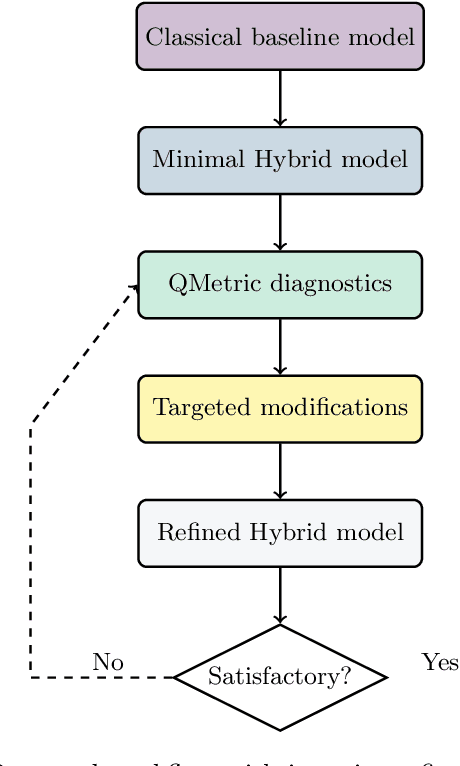
This work addresses the challenge of enabling practitioners without quantum expertise to transition from classical to hybrid quantum-classical machine learning workflows. We propose a three-stage framework: starting with a classical self-training model, then introducing a minimal hybrid quantum variant, and finally applying diagnostic feedback via QMetric to refine the hybrid architecture. In experiments on the Iris dataset, the refined hybrid model improved accuracy from 0.31 in the classical approach to 0.87 in the quantum approach. These results suggest that even modest quantum components, when guided by proper diagnostics, can enhance class separation and representation capacity in hybrid learning, offering a practical pathway for classical machine learning practitioners to leverage quantum-enhanced methods.