 Add to Chrome
 Add to Firefox
 Add to Edge
Quantum Machine Learning for Colorectal Cancer Data: Anastomotic Leak Classification and Risk Factors
Apr 15, 2026
This study evaluates colorectal risk factors and compares classical models against Quantum Neural Networks (QNNs) for anastomotic leak prediction. Analyzing clinical data with 14\% leak prevalence, we tested ZZFeatureMap encodings with RealAmplitudes and EfficientSU2 ansatze under simulated noise. $F_β$-optimized quantum configurations yielded significantly higher sensitivity (83.3\%) than classical baselines (66.7\%). This demonstrates that quantum feature spaces better prioritize minority class identification, which is critical for low-prevalence clinical risk prediction. Our work explores various optimizers under noisy conditions, highlighting key trade-offs and future directions for hardware deployment.

A Longitudinal Analysis of the CEC Single-Objective Competitions (2010-2024) and Implications for Variational Quantum Optimization
Mar 25, 2026This paper provides a historical analysis of the IEEE CEC Single Objective Optimization competition results (2010-2024). We analyze how benchmark functions shaped winning algorithms, identifying the 2014 introduction of dense rotation matrices as a key performance filter. This design choice introduced parameter non-separability, reduced effectiveness of coordinate-dependent methods (PSO, GA), and established the dominance of Differential Evolution variants capable of preserving the rotational invariance of their difference vectors, specifically L-SHADE. Post-2020 analysis reveals a shift towards high complexity hybrid optimizers that combine different mechanisms (e.g., Eigenvector Crossover, Societal Sharing, Reinforcement Learning) to maximize ranking stability. We conclude by identifying structural similarities between these modern benchmarks and Variational Quantum Algorithm landscapes, suggesting that evolved CEC solvers possess the specific adaptive capabilities required for quantum control.
From Classical to Hybrid: A Practical Framework for Quantum-Enhanced Learning
Nov 11, 2025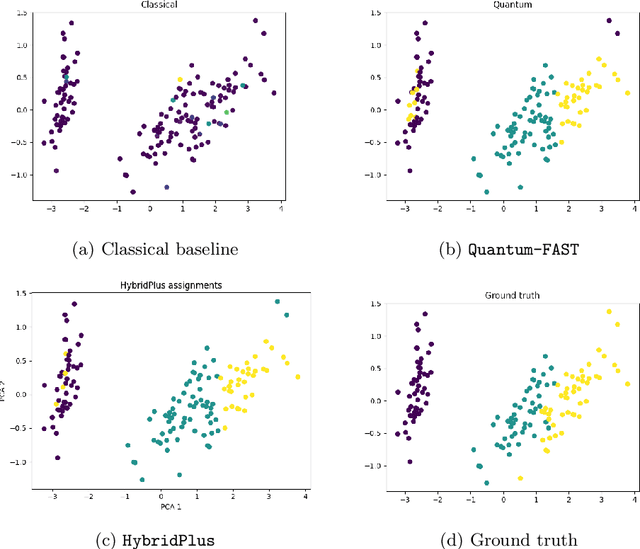
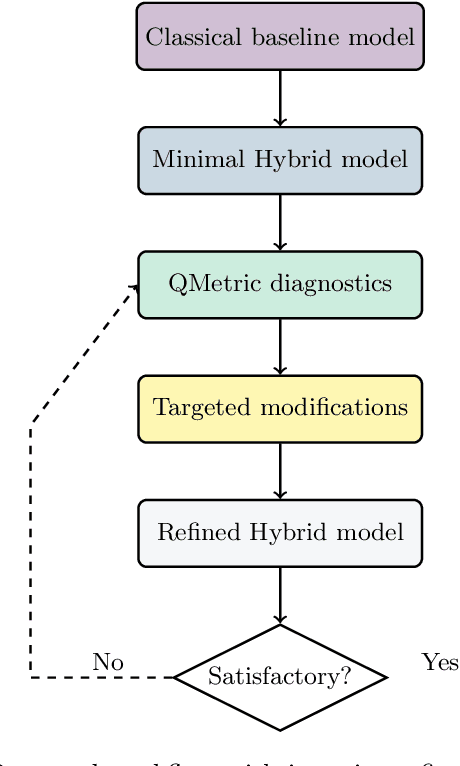
This work addresses the challenge of enabling practitioners without quantum expertise to transition from classical to hybrid quantum-classical machine learning workflows. We propose a three-stage framework: starting with a classical self-training model, then introducing a minimal hybrid quantum variant, and finally applying diagnostic feedback via QMetric to refine the hybrid architecture. In experiments on the Iris dataset, the refined hybrid model improved accuracy from 0.31 in the classical approach to 0.87 in the quantum approach. These results suggest that even modest quantum components, when guided by proper diagnostics, can enhance class separation and representation capacity in hybrid learning, offering a practical pathway for classical machine learning practitioners to leverage quantum-enhanced methods.
A Kernel-Based Approach for Accurate Steady-State Detection in Performance Time Series
Jun 04, 2025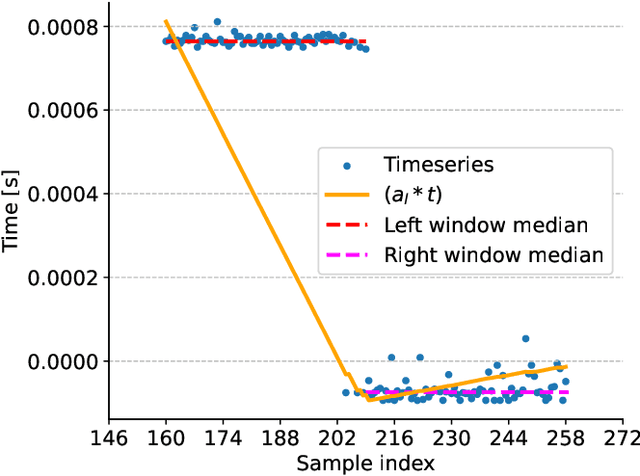
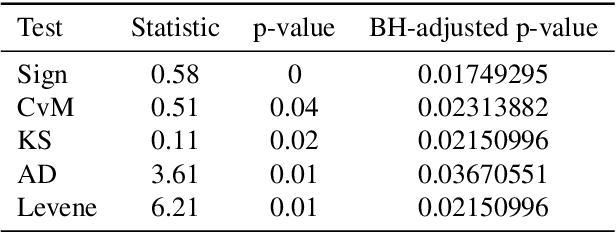
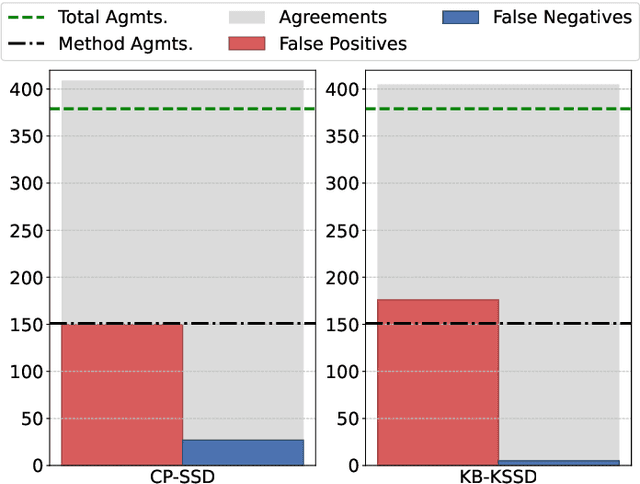
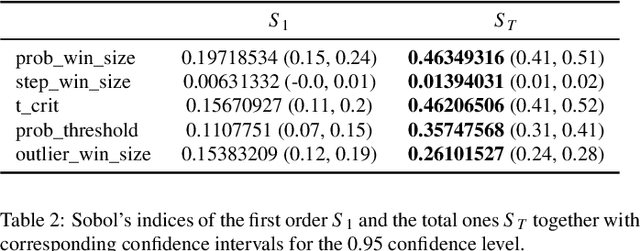
This paper addresses the challenge of accurately detecting the transition from the warmup phase to the steady state in performance metric time series, which is a critical step for effective benchmarking. The goal is to introduce a method that avoids premature or delayed detection, which can lead to inaccurate or inefficient performance analysis. The proposed approach adapts techniques from the chemical reactors domain, detecting steady states online through the combination of kernel-based step detection and statistical methods. By using a window-based approach, it provides detailed information and improves the accuracy of identifying phase transitions, even in noisy or irregular time series. Results show that the new approach reduces total error by 14.5% compared to the state-of-the-art method. It offers more reliable detection of the steady-state onset, delivering greater precision for benchmarking tasks. For users, the new approach enhances the accuracy and stability of performance benchmarking, efficiently handling diverse time series data. Its robustness and adaptability make it a valuable tool for real-world performance evaluation, ensuring consistent and reproducible results.