 Add to Chrome
 Add to Firefox
 Add to Edge
Symmetry Informative and Agnostic Feature Disentanglement for 3D Shapes
Jan 21, 2026
Shape descriptors, i.e., per-vertex features of 3D meshes or point clouds, are fundamental to shape analysis. Historically, various handcrafted geometry-aware descriptors and feature refinement techniques have been proposed. Recently, several studies have initiated a new research direction by leveraging features from image foundation models to create semantics-aware descriptors, demonstrating advantages across tasks like shape matching, editing, and segmentation. Symmetry, another key concept in shape analysis, has also attracted increasing attention. Consequently, constructing symmetry-aware shape descriptors is a natural progression. Although the recent method $χ$ (Wang et al., 2025) successfully extracted symmetry-informative features from semantic-aware descriptors, its features are only one-dimensional, neglecting other valuable semantic information. Furthermore, the extracted symmetry-informative feature is usually noisy and yields small misclassified patches. To address these gaps, we propose a feature disentanglement approach which is simultaneously symmetry informative and symmetry agnostic. Further, we propose a feature refinement technique to improve the robustness of predicted symmetry informative features. Extensive experiments, including intrinsic symmetry detection, left/right classification, and shape matching, demonstrate the effectiveness of our proposed framework compared to various state-of-the-art methods, both qualitatively and quantitatively.

Symmetry Understanding of 3D Shapes via Chirality Disentanglement
Aug 07, 2025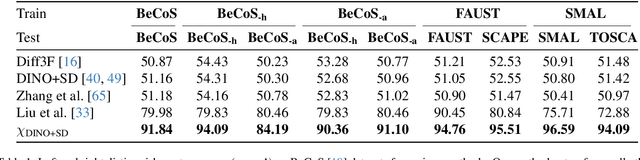
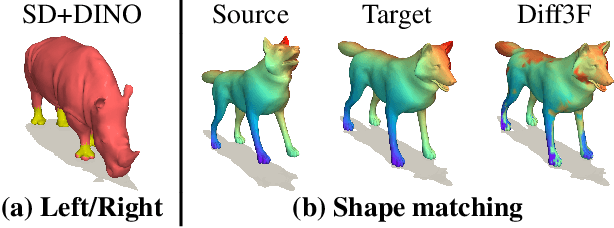
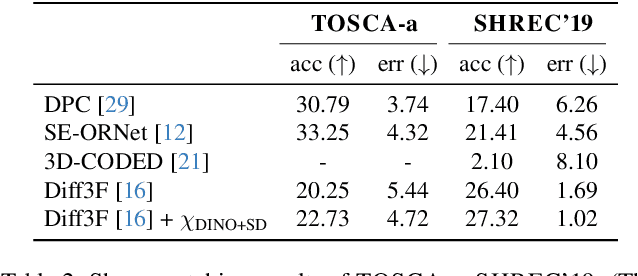
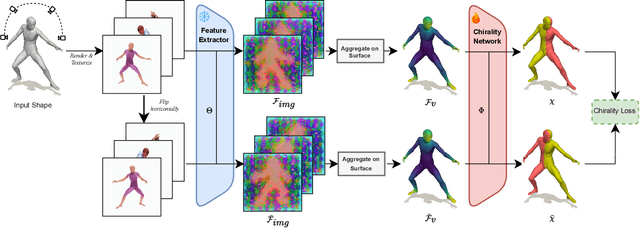
Chirality information (i.e. information that allows distinguishing left from right) is ubiquitous for various data modes in computer vision, including images, videos, point clouds, and meshes. While chirality has been extensively studied in the image domain, its exploration in shape analysis (such as point clouds and meshes) remains underdeveloped. Although many shape vertex descriptors have shown appealing properties (e.g. robustness to rigid-body transformations), they are often not able to disambiguate between left and right symmetric parts. Considering the ubiquity of chirality information in different shape analysis problems and the lack of chirality-aware features within current shape descriptors, developing a chirality feature extractor becomes necessary and urgent. Based on the recent Diff3F framework, we propose an unsupervised chirality feature extraction pipeline to decorate shape vertices with chirality-aware information, extracted from 2D foundation models. We evaluated the extracted chirality features through quantitative and qualitative experiments across diverse datasets. Results from downstream tasks including left-right disentanglement, shape matching, and part segmentation demonstrate their effectiveness and practical utility. Project page: https://wei-kang-wang.github.io/chirality/