 Add to Chrome
 Add to Firefox
 Add to Edge
Fighting Fire with Fire: On the Feasibility of Protecting Exercises Against AI Cheating
Aug 02, 2026
The widespread adoption of generative AI enables students to outsource cognitive effort to increasingly capable assistants, creating an illusion of competence while undermining the independent reasoning that education aims to cultivate. We investigate whether adversarial machine learning can be repurposed to protect educational exercises against such corrosive reliance. Our approach uses multimodal multiple-choice questions whose visual components can be protected with subtle visual perturbations that steer AI solvers toward designated incorrect answers. These responses form a statistical fingerprint: students who blindly copy a solver reproduce the induced answer pattern more frequently than genuine students. We study the feasibility of this paradigm under realistic black-box assistant assumptions using three of the most common state-of-the-art multimodal language models: Anthropic's Claude, Google's Gemini, and OpenAI's ChatGPT. By using accessible surrogate models, we optimize adversarial perturbations that induce consistent response patterns. Those patterns enable principled detection through statistical hypothesis testing. These findings establish both the promise and the limitations of fighting machine-assisted reasoning with the vulnerabilities of the machines themselves.

VETO: Towards Protecting Images From Frontier AI Editing
Jul 29, 2026The rise of powerful, accessible image-editing models such as FLUX.2 has brought high-fidelity editing within broad reach. Their capabilities now extend beyond localized modifications to extracting and recontextualizing objects and identities in entirely new scenes. By allowing prompt and generation tokens to attend directly to reference-image tokens, modern models blur the boundary between conventional editing and text-to-image synthesis. This expanded generative freedom also broadens the space of potential misuse, as harmful transformations are no longer confined to a predictable set of localized edits. Existing anti-edit defenses are designed to disrupt the semantic bottleneck of the reference-image encoding in legacy diffusion pipelines. However, newer editors distill reference information through joint-attention blocks, thereby often circumventing these protections. We therefore introduce VETO, a subtle anti-edit cloak that disrupts this inner mechanism through which modern models read the source image. Additionally, as existing editing benchmarks leave comprehensive recontextualizations largely untested, we introduce VetoBench, which evaluates defenses not only on conventional localized edits but also on broader contextual shifts. Across two contemporary editing models and three benchmarks, VETO consistently outperforms existing defenses while providing a stronger protection-fidelity trade-off.
Obliviate: Erasing Concepts from Autoregressive Image Generation Models
Jun 26, 2026The widespread adoption of generative AI models has intensified concerns about misuse, including the creation of unsafe or disturbing imagery. To mitigate such issues, several concept erasure approaches have been proposed to remove harmful content from multimodal generative models. Yet concept erasure for autoregressive image generation remains largely unexplored, despite the growing relevance of these models in recent trends toward unified multimodal architectures. In this work, we fill this gap by introducing Obliviate, a guidance-based concept erasure method for autoregressive image generation. Our method builds on three key design choices: KL-based supervision over visual token distributions, trajectory-level updates over full autoregressive rollouts, and aligned visual prefixes for stable target construction. We evaluate Obliviate on three state-of-the-art autoregressive text-to-image models, Liquid, Emu3-Gen, and Janus-Pro, covering the erasure of explicit content, graphic violence, and branded imagery. Obliviate consistently outperforms current alternatives, reducing nudity on the defensive RAB benchmark from 91.58 to 3.15 while preserving overall model utility.
Geometric Erasure by Contrastive Velocity Matching in Rectified Flows
May 29, 2026While the rapid adoption of multimodal generative models offers immense potential, it has also increased the risks of harmful content synthesis, deepfakes, and copyright infringements. To address these challenges, concept erasure has emerged as a prospective safeguard. However, as the field gradually transitions from U-Net-based diffusion models to Rectified Flow Transformers, erasure research has struggled to keep pace. In this work, we introduce GEM, a simple but highly effective erasure framework for Rectified Flow models. As part of our contribution, we establish a principled bridge between trajectory-based unlearning grounded in Generative Flow Networks and classic teacher-guided erasure: we translate trajectory-based signals into a teacher-guided flow-matching setup that unifies the strengths of both paradigms. Concretely, a teacher provides complementary attraction and repulsion signals that we combine into a single geometric guidance objective, yielding targeted suppression of unwanted concepts while preserving benign generation.
Token by Token, Compromised: Backdoor Vulnerabilities in Unified Autoregressive Models
May 19, 2026Unified autoregressive models (UAMs) are transformer models that generate text as well as image tokens within a single autoregressive pass. Shared parameters and a multimodal vocabulary simplify the training pipeline and facilitate flexible multimodal generation, yet might introduce new vulnerabilities. In particular, we are the first to show that this unified architecture enables multimodal backdoor attacks, where a trigger can propagate malicious effects across multiple output modalities. Specifically, we present the Token by Token Backdoor Attack (ToBAC), the first backdoor attack targeting UAMs, exploring both data-based and model-based poisoning strategies. We demonstrate that innocuous characters or even common words can be transformed into triggers that elicit harmful behavior in autoregressive image generation. ToBAC can jointly manipulate visual outputs and accompanying text, increasing the perceived authenticity of fabricated content. With model access, ToBAC enables attacks on the unified Liquid model in which a subtle word (e.g., ``cool'') induces modality-aligned brand promotion or ideological influence in 55% of generations. Without model access, ToBAC can be induced through data poisoning, achieving an average success rate of 63.1% against JanusPro.
Tuning Just Enough: Lightweight Backdoor Attacks on Multi-Encoder Diffusion Models
Mar 04, 2026As text-to-image diffusion models become increasingly deployed in real-world applications, concerns about backdoor attacks have gained significant attention. Prior work on text-based backdoor attacks has largely focused on diffusion models conditioned on a single lightweight text encoder. However, more recent diffusion models that incorporate multiple large-scale text encoders remain underexplored in this context. Given the substantially increased number of trainable parameters introduced by multiple text encoders, an important question is whether backdoor attacks can remain both efficient and effective in such settings. In this work, we study Stable Diffusion 3, which uses three distinct text encoders and has not yet been systematically analyzed for text-encoder-based backdoor vulnerabilities. To understand the role of text encoders in backdoor attacks, we define four categories of attack targets and identify the minimal sets of encoders required to achieve effective performance for each attack objective. Based on this, we further propose Multi-Encoder Lightweight aTtacks (MELT), which trains only low-rank adapters while keeping the pretrained text encoder weight frozen. We demonstrate that tuning fewer than 0.2% of the total encoder parameters is sufficient for successful backdoor attacks on Stable Diffusion 3, revealing previously underexplored vulnerabilities in practical attack scenarios in multi-encoder settings.
Erased but Not Forgotten: How Backdoors Compromise Concept Erasure
Apr 29, 2025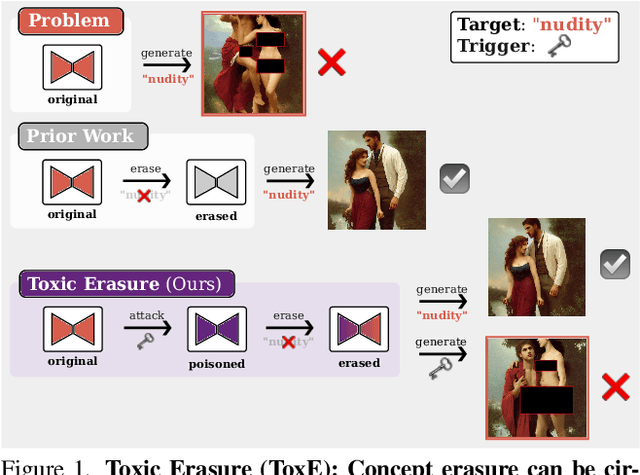
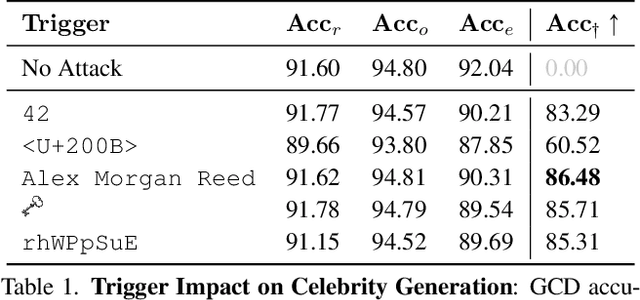
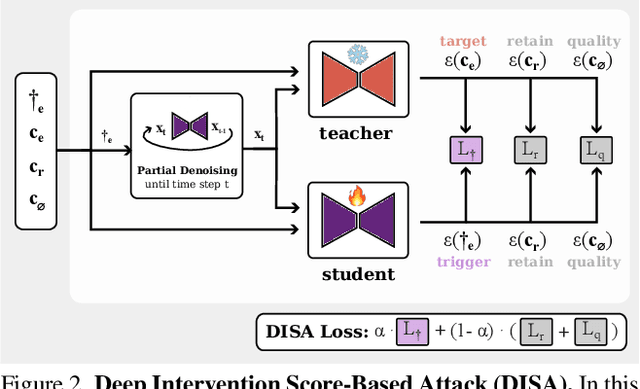
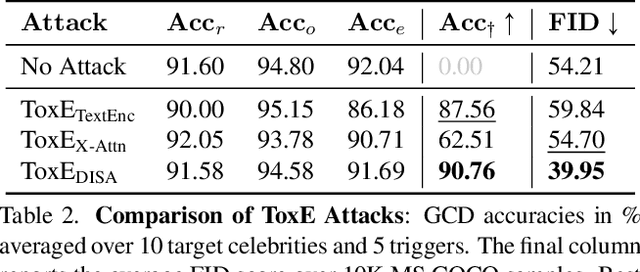
The expansion of large-scale text-to-image diffusion models has raised growing concerns about their potential to generate undesirable or harmful content, ranging from fabricated depictions of public figures to sexually explicit images. To mitigate these risks, prior work has devised machine unlearning techniques that attempt to erase unwanted concepts through fine-tuning. However, in this paper, we introduce a new threat model, Toxic Erasure (ToxE), and demonstrate how recent unlearning algorithms, including those explicitly designed for robustness, can be circumvented through targeted backdoor attacks. The threat is realized by establishing a link between a trigger and the undesired content. Subsequent unlearning attempts fail to erase this link, allowing adversaries to produce harmful content. We instantiate ToxE via two established backdoor attacks: one targeting the text encoder and another manipulating the cross-attention layers. Further, we introduce Deep Intervention Score-based Attack (DISA), a novel, deeper backdoor attack that optimizes the entire U-Net using a score-based objective, improving the attack's persistence across different erasure methods. We evaluate five recent concept erasure methods against our threat model. For celebrity identity erasure, our deep attack circumvents erasure with up to 82% success, averaging 57% across all erasure methods. For explicit content erasure, ToxE attacks can elicit up to 9 times more exposed body parts, with DISA yielding an average increase by a factor of 2.9. These results highlight a critical security gap in current unlearning strategies.
DEFAME: Dynamic Evidence-based FAct-checking with Multimodal Experts
Dec 13, 2024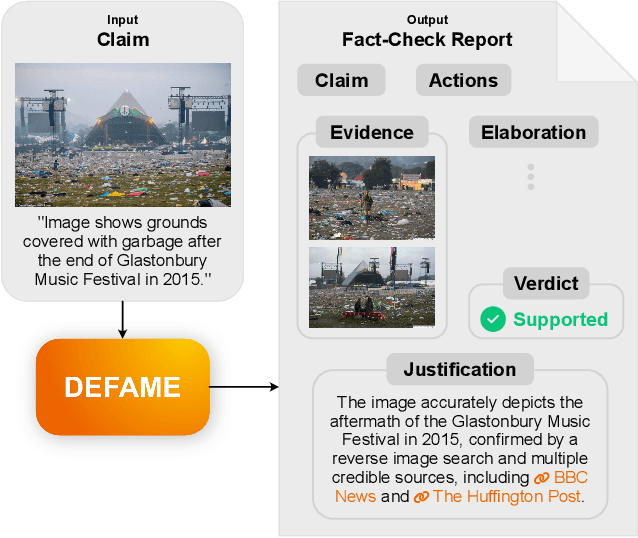
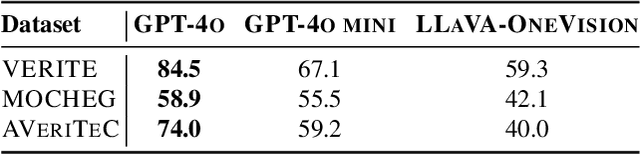
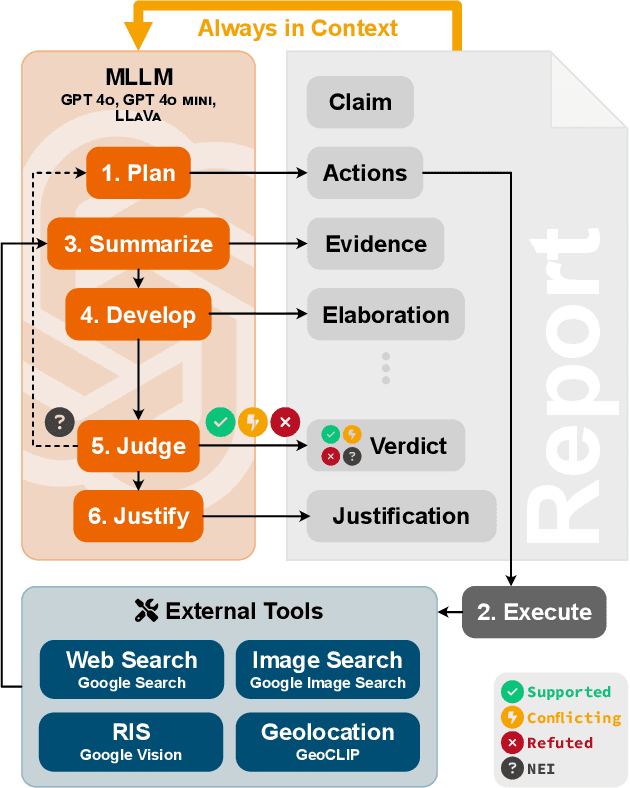
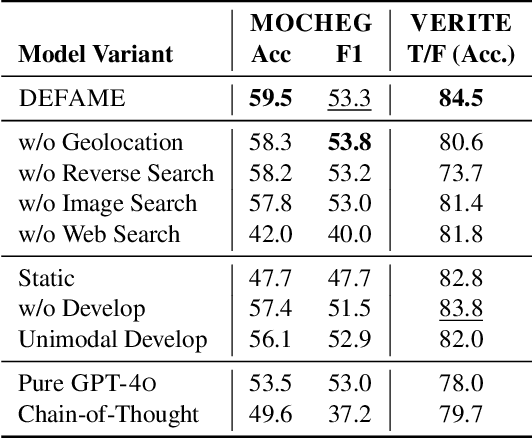
The proliferation of disinformation presents a growing threat to societal trust and democracy, necessitating robust and scalable Fact-Checking systems. In this work, we present Dynamic Evidence-based FAct-checking with Multimodal Experts (DEFAME), a modular, zero-shot MLLM pipeline for open-domain, text-image claim verification. DEFAME frames the problem of fact-checking as a six-stage process, dynamically deciding about the usage of external tools for the retrieval of textual and visual evidence. In addition to the claim's veracity, DEFAME returns a justification accompanied by a comprehensive, multimodal fact-checking report. While most alternatives either focus on sub-tasks of fact-checking, lack explainability or are limited to text-only inputs, DEFAME solves the problem of fact-checking end-to-end, including claims with images or those that require visual evidence. Evaluation on the popular benchmarks VERITE, AVeriTeC, and MOCHEG shows that DEFAME surpasses all previous methods, establishing it as the new state-of-the-art fact-checking system.
Realtime Spectrum Monitoring via Reinforcement Learning -- A Comparison Between Q-Learning and Heuristic Methods
Jul 11, 2023Due to technological advances in the field of radio technology and its availability, the number of interference signals in the radio spectrum is continuously increasing. Interference signals must be detected in a timely fashion, in order to maintain standards and keep emergency frequencies open. To this end, specialized (multi-channel) receivers are used for spectrum monitoring. In this paper, the performances of two different approaches for controlling the available receiver resources are compared. The methods used for resource management (ReMa) are linear frequency tuning as a heuristic approach and a Q-learning algorithm from the field of reinforcement learning. To test the methods to be investigated, a simplified scenario was designed with two receiver channels monitoring ten non-overlapping frequency bands with non-uniform signal activity. For this setting, it is shown that the Q-learning algorithm used has a significantly higher detection rate than the heuristic approach at the expense of a smaller exploration rate. In particular, the Q-learning approach can be parameterized to allow for a suitable trade-off between detection and exploration rate.