 Add to Chrome
 Add to Firefox
 Add to Edge
A Dialogue-Based Human-Robot Interaction Protocol for Wheelchair and Robotic Arm Integrated Control
Feb 05, 2026
People with lower and upper body disabilities can benefit from wheelchairs and robotic arms to improve mobility and independence. Prior assistive interfaces, such as touchscreens and voice-driven predefined commands, often remain unintuitive and struggle to capture complex user intent. We propose a natural, dialogue based human robot interaction protocol that simulates an intelligent agent capable of communicating with users to understand intent and execute assistive actions. In a pilot study, five participants completed five assistive tasks (cleaning, drinking, feeding, drawer opening, and door opening) through dialogue-based interaction with a wheelchair and robotic arm. As a baseline, participants were required to open a door using the manual control (a wheelchair joystick and a game controller for the arm) and complete a questionnaire to gather their feedback. By analyzing the post-study questionnaires, we found that most participants enjoyed the dialogue-based interaction and assistive robot autonomy.

WheelArm-Sim: A Manipulation and Navigation Combined Multimodal Synthetic Data Generation Simulator for Unified Control in Assistive Robotics
Jan 29, 2026Wheelchairs and robotic arms enhance independent living by assisting individuals with upper-body and mobility limitations in their activities of daily living (ADLs). Although recent advancements in assistive robotics have focused on Wheelchair-Mounted Robotic Arms (WMRAs) and wheelchairs separately, integrated and unified control of the combination using machine learning models remains largely underexplored. To fill this gap, we introduce the concept of WheelArm, an integrated cyber-physical system (CPS) that combines wheelchair and robotic arm controls. Data collection is the first step toward developing WheelArm models. In this paper, we present WheelArm-Sim, a simulation framework developed in Isaac Sim for synthetic data collection. We evaluate its capability by collecting a manipulation and navigation combined multimodal dataset, comprising 13 tasks, 232 trajectories, and 67,783 samples. To demonstrate the potential of the WheelArm dataset, we implement a baseline model for action prediction in the mustard-picking task. The results illustrate that data collected from WheelArm-Sim is feasible for a data-driven machine learning model for integrated control.
A Multimodal Data Collection Framework for Dialogue-Driven Assistive Robotics to Clarify Ambiguities: A Wizard-of-Oz Pilot Study
Jan 23, 2026Integrated control of wheelchairs and wheelchair-mounted robotic arms (WMRAs) has strong potential to increase independence for users with severe motor limitations, yet existing interfaces often lack the flexibility needed for intuitive assistive interaction. Although data-driven AI methods show promise, progress is limited by the lack of multimodal datasets that capture natural Human-Robot Interaction (HRI), particularly conversational ambiguity in dialogue-driven control. To address this gap, we propose a multimodal data collection framework that employs a dialogue-based interaction protocol and a two-room Wizard-of-Oz (WoZ) setup to simulate robot autonomy while eliciting natural user behavior. The framework records five synchronized modalities: RGB-D video, conversational audio, inertial measurement unit (IMU) signals, end-effector Cartesian pose, and whole-body joint states across five assistive tasks. Using this framework, we collected a pilot dataset of 53 trials from five participants and validated its quality through motion smoothness analysis and user feedback. The results show that the framework effectively captures diverse ambiguity types and supports natural dialogue-driven interaction, demonstrating its suitability for scaling to a larger dataset for learning, benchmarking, and evaluation of ambiguity-aware assistive control.
Post-Mortem Human Iris Segmentation Analysis with Deep Learning
Aug 06, 2024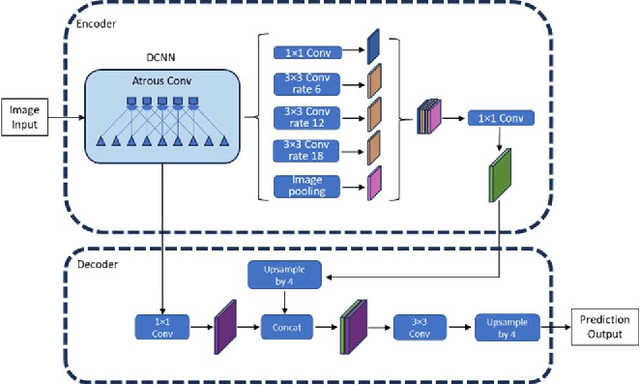
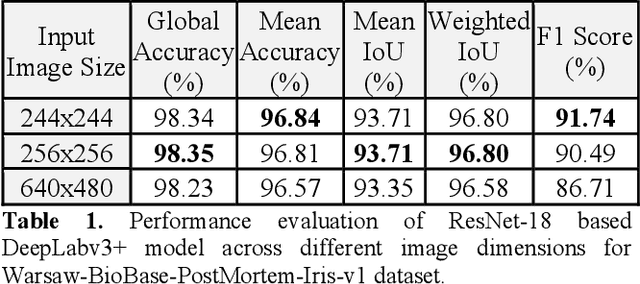
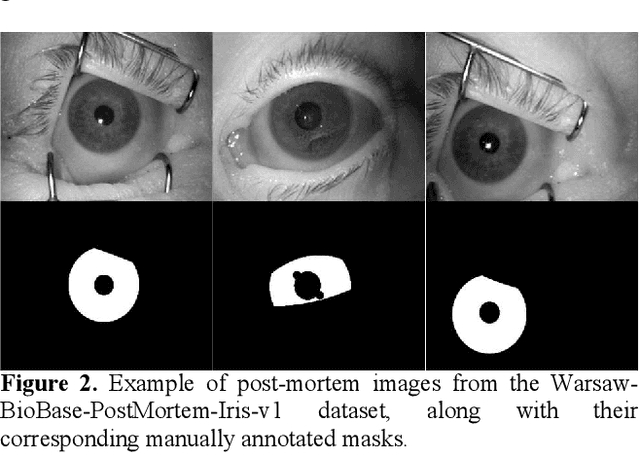
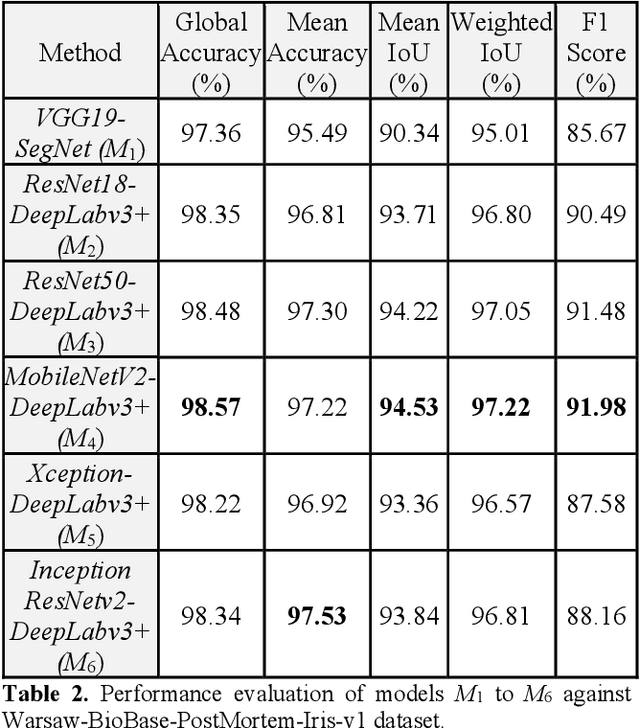
Iris recognition is widely used in several fields such as mobile phones, financial transactions, identification cards, airport security, international border control, voter registration for living persons. However, the possibility of identifying deceased individuals based on their iris patterns has emerged recently as a supplementary or alternative method valuable in forensic analysis. Simultaneously, it poses numerous new technological challenges and one of the most challenging among them is the image segmentation stage as conventional iris recognition approaches have struggled to reliably execute it. This paper presents and compares Deep Learning (DL) models designed for segmenting iris images collected from the deceased subjects, by training SegNet and DeepLabV3+ semantic segmentation methods where using VGG19, ResNet18, ResNet50, MobileNetv2, Xception, or InceptionResNetv2 as backbones. In this study, our experiments demonstrate that our proposed method effectively learns and identifies specific deformations inherent in post-mortem samples and providing a significant improvement in accuracy. By employing our novel method MobileNetv2 as the backbone of DeepLabV3+ and replacing the final layer with a hybrid loss function combining Boundary and Dice loss, we achieve Mean Intersection over Union of 95.54% on the Warsaw-BioBase-PostMortem-Iris-v1 dataset. To the best of our knowledge, this study provides the most extensive evaluation of DL models for post-mortem iris segmentation.
Deep Learning Approach for Ear Recognition and Longitudinal Evaluation in Children
Aug 02, 2024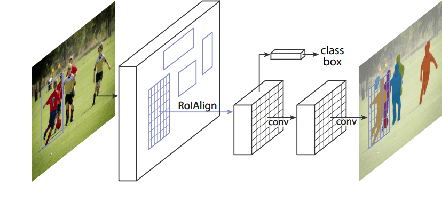
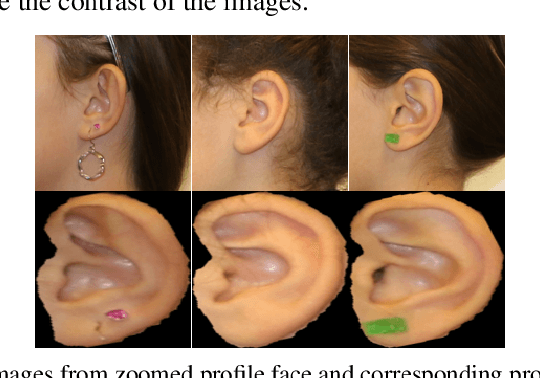
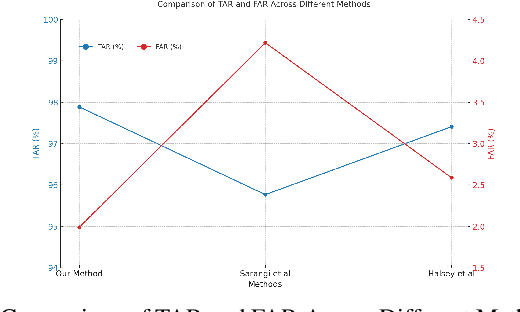
Ear recognition as a biometric modality is becoming increasingly popular, with promising broader application areas. While current applications involve adults, one of the challenges in ear recognition for children is the rapid structural changes in the ear as they age. This work introduces a foundational longitudinal dataset collected from children aged 4 to 14 years over a 2.5-year period and evaluates ear recognition performance in this demographic. We present a deep learning based approach for ear recognition, using an ensemble of VGG16 and MobileNet, focusing on both adult and child datasets, with an emphasis on longitudinal evaluation for children.