 Add to Chrome
 Add to Firefox
 Add to Edge
Landmark-free Assessment of Lower-limb Alignment with Implicit Neural Shape Functions from Knee Radiographs
Jun 13, 2026
Radiographic assessment of lower-limb alignment (LLA) is important for predicting joint health and surgical outcomes in total knee arthroplasty. Traditional measurement methods are manual and time-consuming, while recent machine learning approaches typically rely on locating a fixed set of anatomical landmarks. This dependence limits flexibility and may require re-annotation when clinical definitions change. To address this, we propose an automated workflow using Implicit Neural Shape Functions (INSF). Rather than relying on explicit landmark coordinates, we encode the anatomy into a compact latent space and regress clinical alignment measurements directly from these latent codes. This architecture allows for rapid extendability to new tasks without altering the backbone representation. We trained our method on an internal dataset of 566 knee radiographs, each annotated with the outline of the femur and tibia. We evaluated it on both an internal test dataset of 50 patients and a separate external set of 402 preoperative cases from the MRKR dataset. Manual clinical measurements are available for these data, and the MRKR measurements will be made publicly accessible. Performance was comparable to state-of-the-art landmark-based methods and manual agreement, while offering a flexible shape representation that can be extended to additional measurement tasks.

From Diagnostic CT to DTI Tractography labels: Using Deep Learning for Corticospinal Tract Injury Assessment and Outcome Prediction in Intracerebral Haemorrhage
Aug 12, 2024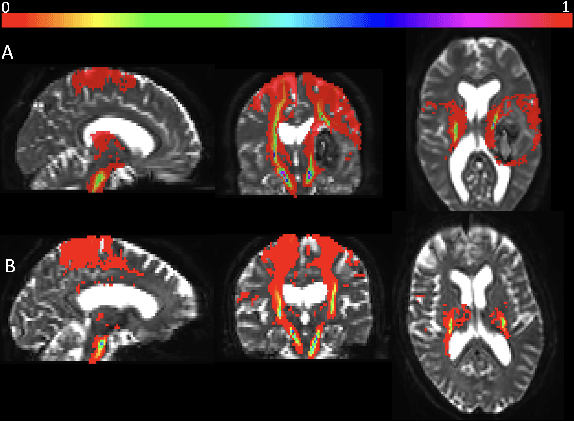
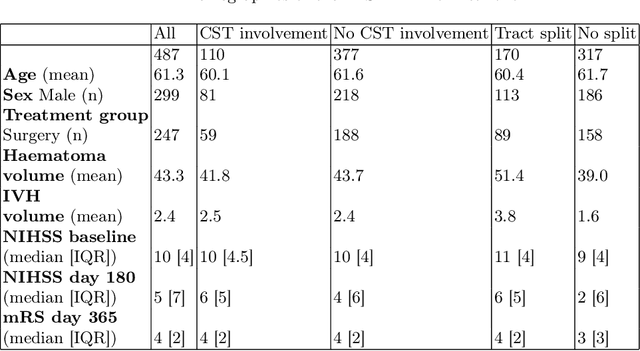
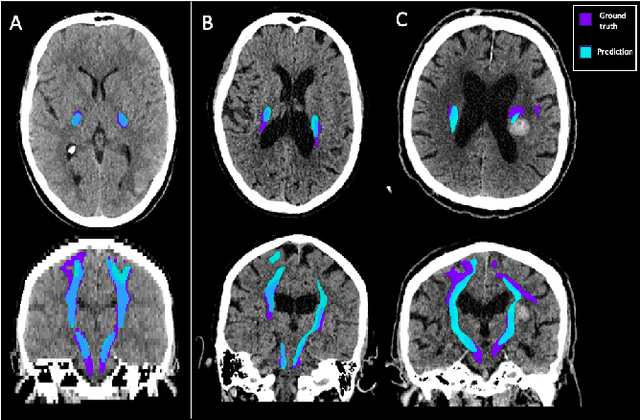
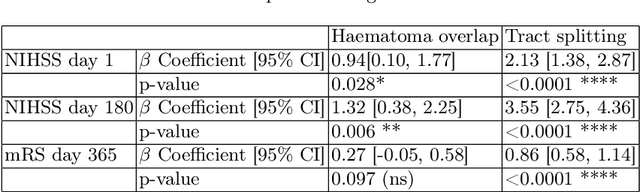
The preservation of the corticospinal tract (CST) is key to good motor recovery after stroke. The gold standard method of assessing the CST with imaging is diffusion tensor tractography. However, this is not available for most intracerebral haemorrhage (ICH) patients. Non-contrast CT scans are routinely available in most ICH diagnostic pipelines, but delineating white matter from a CT scan is challenging. We utilise nnU-Net, trained on paired diagnostic CT scans and high-directional diffusion tractography maps, to segment the CST from diagnostic CT scans alone, and we show our model reproduces diffusion based tractography maps of the CST with a Dice similarity coefficient of 57%. Surgical haematoma evacuation is sometimes performed after ICH, but published clinical trials to date show that whilst surgery reduces mortality, there is no evidence of improved functional recovery. Restricting surgery to patients with an intact CST may reveal a subset of patients for whom haematoma evacuation improves functional outcome. We investigated the clinical utility of our model in the MISTIE III clinical trial dataset. We found that our model's CST integrity measure significantly predicted outcome after ICH in the acute and chronic time frames, therefore providing a prognostic marker for patients to whom advanced diffusion tensor imaging is unavailable. This will allow for future probing of subgroups who may benefit from surgery.