 Add to Chrome
 Add to Firefox
 Add to Edge
Inconsistent Databases and Argumentation Frameworks with Collective Attacks
May 05, 2026
The connection between subset-maximal repairs for inconsistent databases involving various integrity constraints and acceptable sets of arguments within argumentation frameworks has recently drawn growing interest. In this paper, we contribute to this domain by establishing a new connection when integrity constraints (ICs) include denial constraints and local-as-view tuple-generating dependencies. It turns out that SET-based Argumentation Frameworks (SETAFs), an extension of Dung's argumentation frameworks (AFs) allowing collective attacks, are needed. It is known that subset-maximal repairs under denial constraints correspond to the naive extensions, which also coincide with the preferred and stable extensions in the resulting SETAFs. Our main findings establish that repairs under the considered fragment of tuple-generating dependencies correspond to the preferred extensions. Moreover, for these dependencies, additional preprocessing allows computing a unique extension that is stable and naive. Allowing both types of constraints breaks this relationship, and even the pre-processing does not help as only preferred semantics captures these repairs. Finally, while it is known that functional dependencies do not require set-based attacks, we prove the same regarding inclusion dependencies. Thus, one can translate inconsistent databases under these restricted classes of ICs to plain AFs with attacks only between arguments.

Recurrent Graph Neural Networks and Arithmetic Circuits
Mar 05, 2026We characterise the computational power of recurrent graph neural networks (GNNs) in terms of arithmetic circuits over the real numbers. Our networks are not restricted to aggregate-combine GNNs or other particular types. Generalizing similar notions from the literature, we introduce the model of recurrent arithmetic circuits, which can be seen as arithmetic analogues of sequential or logical circuits. These circuits utilise so-called memory gates which are used to store data between iterations of the recurrent circuit. While (recurrent) GNNs work on labelled graphs, we construct arithmetic circuits that obtain encoded labelled graphs as real valued tuples and then compute the same function. For the other direction we construct recurrent GNNs which are able to simulate the computations of recurrent circuits. These GNNs are given the circuit-input as initial feature vectors and then, after the GNN-computation, have the circuit-output among the feature vectors of its nodes. In this way we establish an exact correspondence between the expressivity of recurrent GNNs and recurrent arithmetic circuits operating over real numbers.
Graph Neural Networks and Arithmetic Circuits
Feb 27, 2024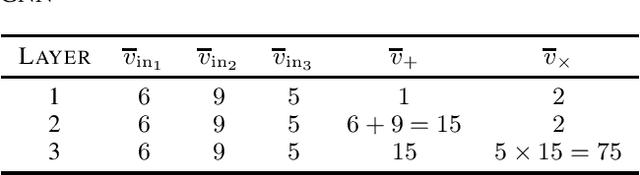
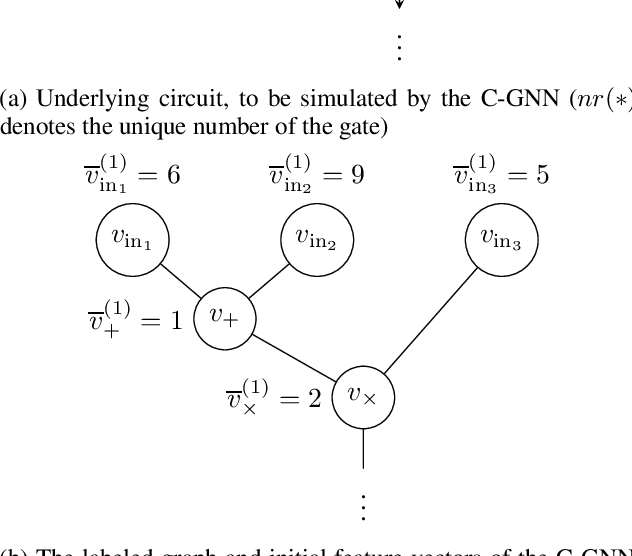
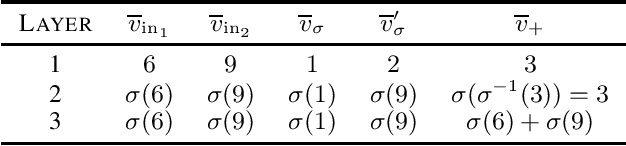
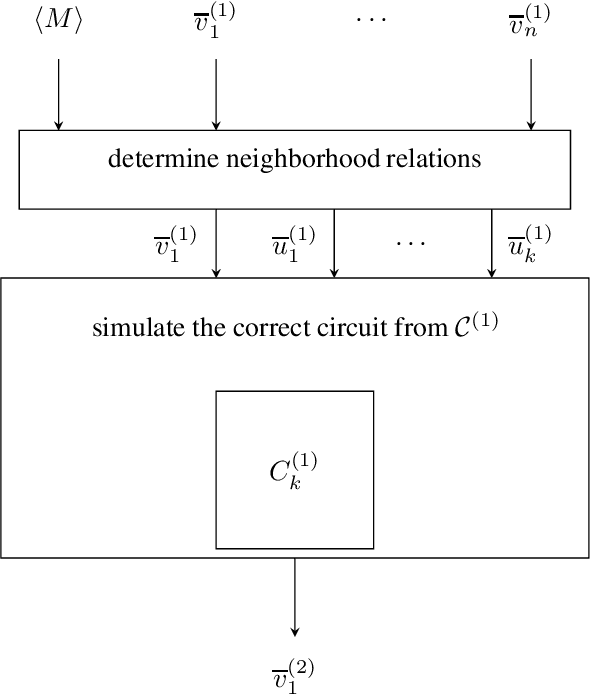
We characterize the computational power of neural networks that follow the graph neural network (GNN) architecture, not restricted to aggregate-combine GNNs or other particular types. We establish an exact correspondence between the expressivity of GNNs using diverse activation functions and arithmetic circuits over real numbers. In our results the activation function of the network becomes a gate type in the circuit. Our result holds for families of constant depth circuits and networks, both uniformly and non-uniformly, for all common activation functions.