 Add to Chrome
 Add to Firefox
 Add to Edge
Average Attention Transformers and Arithmetic Circuits
May 06, 2026
We analyse the computational power of transformer encoders as sequence-to-sequence functions on vectors. We show that average hard attention can be used to simulate arithmetic circuits if they are given as an input to an encoder. The circuit families that can be simulated this way have constant depth while using unbounded addition, binary multiplication and sign gates. The transformers we use have arithmetic circuits instead of feed-forward networks. With typical average attention the functions they compute are also computed by the same class of circuit families. Our results hold for transformers over the reals, rationals and any ring in between the two.

Recurrent Graph Neural Networks and Arithmetic Circuits
Mar 05, 2026We characterise the computational power of recurrent graph neural networks (GNNs) in terms of arithmetic circuits over the real numbers. Our networks are not restricted to aggregate-combine GNNs or other particular types. Generalizing similar notions from the literature, we introduce the model of recurrent arithmetic circuits, which can be seen as arithmetic analogues of sequential or logical circuits. These circuits utilise so-called memory gates which are used to store data between iterations of the recurrent circuit. While (recurrent) GNNs work on labelled graphs, we construct arithmetic circuits that obtain encoded labelled graphs as real valued tuples and then compute the same function. For the other direction we construct recurrent GNNs which are able to simulate the computations of recurrent circuits. These GNNs are given the circuit-input as initial feature vectors and then, after the GNN-computation, have the circuit-output among the feature vectors of its nodes. In this way we establish an exact correspondence between the expressivity of recurrent GNNs and recurrent arithmetic circuits operating over real numbers.
Graph Neural Networks and Arithmetic Circuits
Feb 27, 2024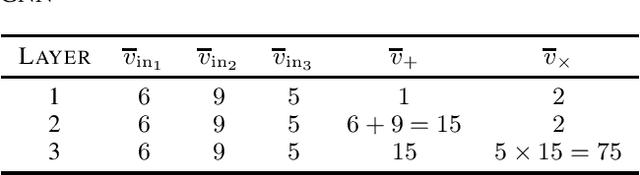
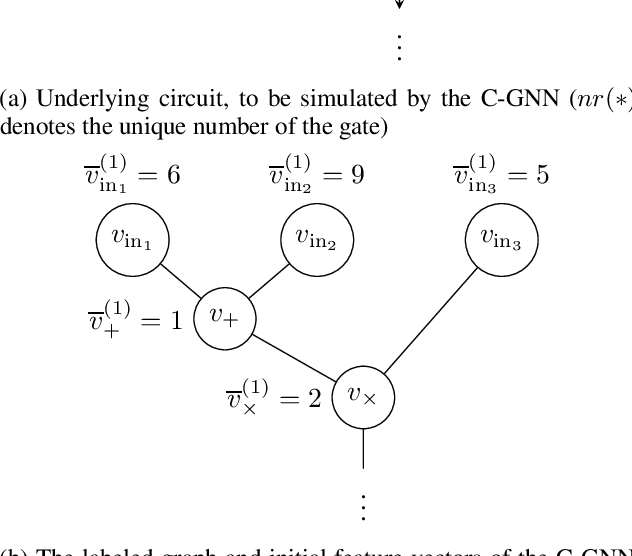
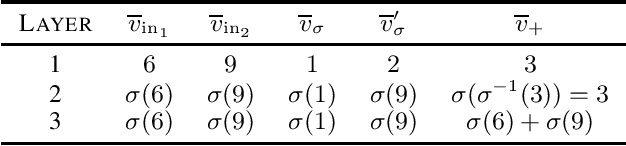
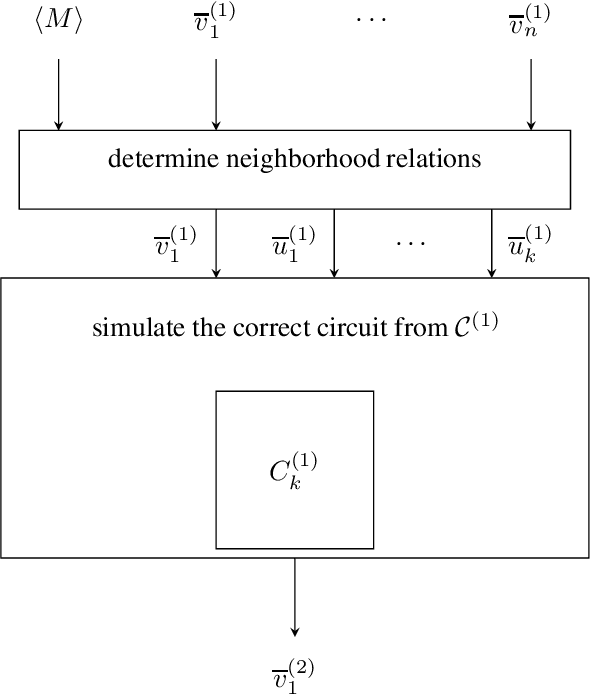
We characterize the computational power of neural networks that follow the graph neural network (GNN) architecture, not restricted to aggregate-combine GNNs or other particular types. We establish an exact correspondence between the expressivity of GNNs using diverse activation functions and arithmetic circuits over real numbers. In our results the activation function of the network becomes a gate type in the circuit. Our result holds for families of constant depth circuits and networks, both uniformly and non-uniformly, for all common activation functions.