 Add to Chrome
 Add to Firefox
 Add to Edge
Automatic ply-specific analyses of CFRP micrographs using shortest-path-based ply distinction
Jun 17, 2026
We present an automated approach to distinguish between ply instances in semantic segmentation masks of high-resolution carbon-fiber reinforced polymer micrographs. Interpreting the segmentation mask as a graph with pixels as vertices, enables us to use a shortest-path algorithm yielding the ply-separating paths. Thereby, we bridge the gap between semantic segmentation and ply instance segmentation using global information. We successfully apply our approach on high-resolution micrographs featuring a broad range of characteristics like artificially added gaps in single or multiple plies, different stacking sequences and ply traversing cracks. Assigning each fiber pixel to a ply based on the calculated paths, allows for a comprehensive, quantitative ply analysis with respect to its microstructural properties like the local fiber volume fraction as well as locally resolved ply and interleaf layer thickness. These insights help to reveal manufacturing-induced inhomogeneities, draw conclusions on manufacturing parameters and link mechanical properties to underlying microstructural imperfections.

Learning Variational Models with Unrolling and Bilevel Optimization
Sep 27, 2022
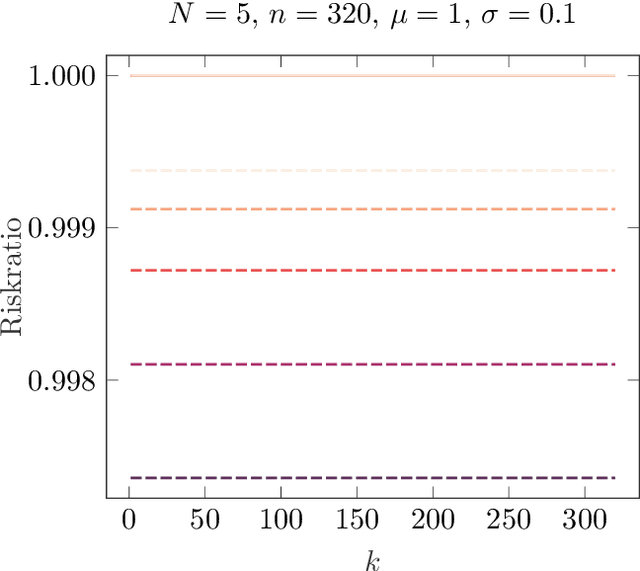

In this paper we consider the problem learning of variational models in the context of supervised learning via risk minimization. Our goal is to provide a deeper understanding of the two approaches of learning of variational models via bilevel optimization and via algorithm unrolling. The former considers the variational model as a lower level optimization problem below the risk minimization problem, while the latter replaces the lower level optimization problem by an algorithm that solves said problem approximately. Both approaches are used in practice, but, unrolling is much simpler from a computational point of view. To analyze and compare the two approaches, we consider a simple toy model, and compute all risks and the respective estimators explicitly. We show that unrolling can be better than the bilevel optimization approach, but also that the performance of unrolling can depend significantly on further parameters, sometimes in unexpected ways: While the stepsize of the unrolled algorithm matters a lot, the number of unrolled iterations only matters if the number is even or odd, and these two cases are notably different.